From Wikipedia, in Time
Time in physics is operationally defined as “what a clock reads”
Better yet, measures.
Historically, since ever, the prime motivation form time measurement is navigation and astronomy Classically, the sun, the moon and the stars through the observation of their motions, or apparent motion in the case of the sun, served as standards for units of time. Currently, the international unit of time, the second, is defined by measuring the electronic transition frequency of cesium atoms.
Before bringint it down to the common use of navigation in our iphones and such with GPS, take a look on the navigation system the US Navy uses as of its introduction.
The second (s) is the SI base unit. A minute (min) is 60 seconds in length, and an hour is 60 minutes or 3600 seconds in length. A day is usually 24 hours or 86,400 seconds in length; however, the duration of a calendar day can vary due to Daylight saving time and Leap seconds.
There are many systems for determining what time it is, including the Global Positioning System, or GPS, other satellite systems, Coordinated Universal Time and mean solar time. In general, the numbers obtained from different time systems differ from one another.
The Time article in Wikipedia gives a more detailed, specially historically how we came about to live with this idea.
There are considerations to take into account about time keeping devices as our human nature perceives them. Please take a look at: A watch is not a time keeping device
GPS
A visual example of a 24 satellite GPS constellation in motion with the Earth rotating. Notice how the number of satellites in view from a given point on the Earth’s surface changes with time. The point in this example is in Golden, Colorado, USA (39.7469°N 105.2108°W).


The GPS receiver calculates its own position and time based on data received from multiple GPS satellites. Each satellite carries an accurate record of its position and time, and transmits that data to the receiver.
Each GPS satellite continually broadcasts a signal (carrier wave with modulation) that includes:
- A pseudorandom code (sequence of ones and zeros) that is known to the receiver. By time-aligning a receiver-generated version and the receiver-measured version of the code, the time of arrival (TOA) of a defined point in the code sequence, called an epoch, can be found in the receiver clock time scale
- A message that includes the time of transmission (TOT) of the code epoch (in GPS time scale) and the satellite position at that time
Conceptually, the receiver measures the TOAs (according to its own clock) of four satellite signals. From the TOAs and the TOTs, the receiver forms four time of flight (TOF) values, which are (given the speed of light) approximately equivalent to receiver-satellite ranges plus time difference between the receiver and GPS satellites multiplied by speed of light, which are called as pseudo-ranges. The receiver then computes its three-dimensional position and clock deviation from the four TOFs.
In practice the receiver position (in three dimensional Cartesian coordinates with origin at the Earth’s center) and the offset of the receiver clock relative to the GPS time are computed simultaneously, using the navigation equations to process the TOFs.
The receiver’s Earth-centered solution location is usually converted to latitude, longitude and height relative to an ellipsoidal Earth model. The height may then be further converted to height relative to the geoid, which is essentially mean sea level. These coordinates may be displayed, such as on a moving map display, or recorded or used by some other system, such as a vehicle guidance system.


Left: Three satellites (labeled as “stations” A, B, C) have known locations. The true times it takes for a radio signal to travel from each satellite to the receiver are unknown, but the true time differences are known. Then, each time difference locates the receiver on a branch of a hyperbola focused on the satellites. The receiver is then located at one of the two intersections.
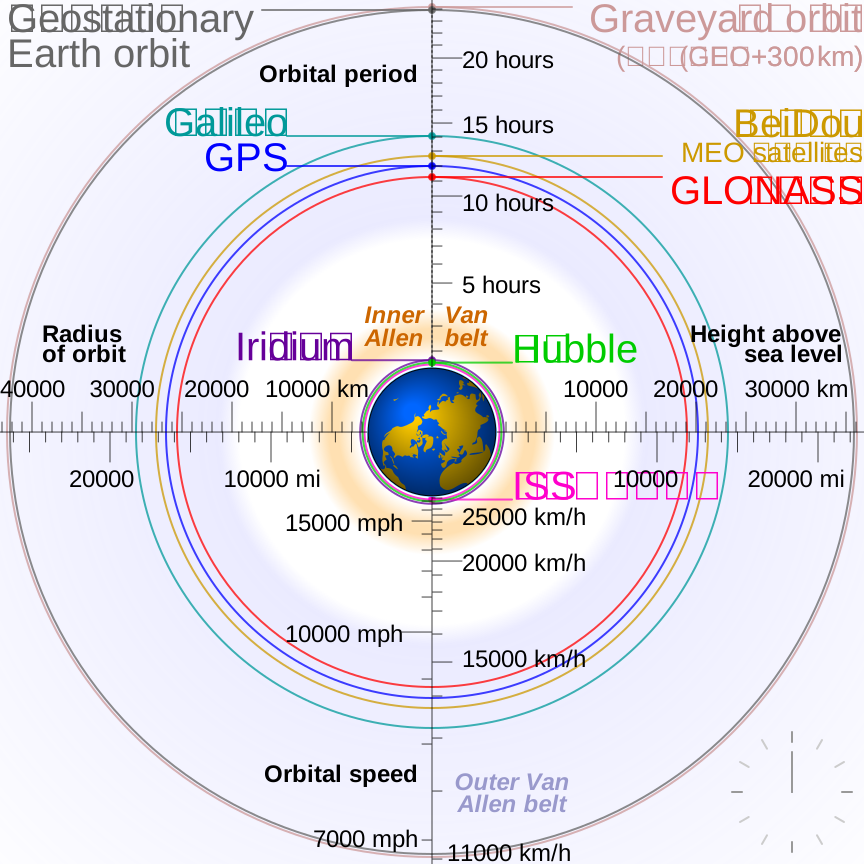
Right: Orbit size comparison of GPS, GLONASS, Galileo, BeiDou-2, and Iridium constellations, the International Space Station, the Hubble Space Telescope, and geostationary orbit (and its graveyard orbit), with the Van Allen radiation belts and the Earth to scale.[a]
The Moon‘s orbit is around 9 times as large as geostationary orbit.[b] (In the SVG file, hover over an orbit or its label to highlight it; click to load its article.)
Timekeeping
Leap seconds
While most clocks derive their time from Coordinated Universal Time (UTC), the atomic clocks on the satellites are set to “GPS time“. The difference is that GPS time is not corrected to match the rotation of the Earth, so it does not contain leap seconds or other corrections that are periodically added to UTC. GPS time was set to match UTC in 1980, but has since diverged. The lack of corrections means that GPS time remains at a constant offset with International Atomic Time (TAI) (TAI – GPS = 19 seconds). Periodic corrections are performed to the on-board clocks to keep them synchronized with ground clocks.[129]
Accuracy
GPS time is theoretically accurate to about 14 nanoseconds, due to the clock drift that atomic clocks experience in GPS transmitters, relative to International Atomic Time.[131] Most receivers lose accuracy in the interpretation of the signals and are only accurate to 100 nanoseconds.[132][133]
Format
Further information: GPS Week Number Rollover
As opposed to the year, month, and day format of the Gregorian calendar, the GPS date is expressed as a week number and a seconds-into-week number. The week number is transmitted as a ten-bit field in the C/A and P(Y) navigation messages, and so it becomes zero again every 1,024 weeks (19.6 years). GPS week zero started at 00:00:00 UTC (00:00:19 TAI) on January 6, 1980, and the week number became zero again for the first time at 23:59:47 UTC on August 21, 1999 (00:00:19 TAI on August 22, 1999). It happened the second time at 23:59:42 UTC on April 6, 2019. To determine the current Gregorian date, a GPS receiver must be provided with the approximate date (to within 3,584 days) to correctly translate the GPS date signal. To address this concern in the future the modernized GPS civil navigation (CNAV) message will use a 13-bit field that only repeats every 8,192 weeks (157 years), thus lasting until 2137 (157 years after GPS week zero).
Communication
Main article: GPS signals
The navigational signals transmitted by GPS satellites encode a variety of information including satellite positions, the state of the internal clocks, and the health of the network. These signals are transmitted on two separate carrier frequencies that are common to all satellites in the network. Two different encodings are used: a public encoding that enables lower resolution navigation, and an encrypted encoding used by the U.S. military.
 Man & Time J B Priestley