Religion

Please take a look at World Religions – Ancient and Modern by Gary Stilwell which should be examined together with the following:

According and authorized by The World’s Major Religions

Published 10 months ago  on February 11, 2022 By Anshool Deshmukh with Graphics/Design by Rosey Eason

View the high-resolution version

The religious profile of the world is rapidly changing, driven primarily by differences in fertility rates and the size of youth populations among the world’s major religions, as well as by people switching faiths. With the help of data from Pew Research Center, we break down the religious composition of the major religions in countries worldwide.

Religious Makeup of the World by Major Religions

Determining the exact number of religions across the world is a daunting task. Many religions can be difficult to categorize or to tell apart for those not intimately familiar with their doctrine. Pew Research Center organizes the world’s religions into seven major categories, which includes five major religions (Christianity, Islam, Buddhism, Hinduism, and Judaism), one category that broadly includes all Folk/Traditional religions, and an unaffiliated category. Globally, Christianity has the largest following of these categories. Around 31% of the world’s population are Christians, closely followed by Muslims at 25%. Jews have the smallest population of major religions, with only 0.2% of the world identifying as Jewish. Let’s take a look at the religious composition of the world when accounting for regions:

RegionChristiansMuslimsUnaffiliatedHindusJewsBuddhistsFolk
North America74.6%1.3%19.2%0.8%1.6%1.2%0.4%
Latin America-Caribbean89.7%0.1%8.0%0.1%0.1%0.1%1.8%
Europe72.2%6.8%20.0%0.2%0.2%0.2%0.1%
Middle East-North Africa3.6%93.1%0.6%0.6%1.6%0.2%0.3%
Sub-Saharan Africa62.0%31.4%3.0%0.2%0.1%0.1%3.2%
Asia-Pacific7.2%25.7%20.0%26.0%0.1%11.3%8.6%
World31.0%25.0%15.6%15.2%0.2%6.6%5.6%
world’s religions by seven categories

Christianity

The world’s largest religion, Christianity, is practiced by about 2.4 billion people. The country with the highest number of practicing Christians is the United States, with a Christian population of 253 million. Brazil and Mexico follow closely with 185 million and 118 million Christians, respectively.

Islam

Even though it’s the predominant religion of countries in the Middle East and Northern Africa, by sheer number, countries in Asia have the highest percentage of practicing Muslims in the world. It may surprise you to know that 14.2% of Indians are Muslim. As a result, the country is home to one of the world’s largest Muslim populations, surpassed only by Indonesia.

Judaism

While Jews historically have been found all around the globe, Judaism is highly geographically concentrated today. More than four-fifths of all Jews live in just two countries: the United States and Israel. Israel is the only country with a Jewish majority, with 76% of the population being practicing Jews.

Hinduism

Hinduism is the third-largest religion worldwide, with approximately 1.2 billion Hindus in many countries. Interestingly, however, Hinduism is the dominant religion in only three countries, India with 79%, Nepal with 80%, and Mauritius with 48%.

Buddhism

According to estimates, half the world’s Buddhists live in China. Still, they make up only 18% of the country’s population. Most of the rest of the world’s Buddhists live in East and South Asia, including 13% in Thailand (where 93% of the population is Buddhist).

Folk Religion

Folk religion is any ethnic or cultural religious practice that falls outside the doctrine of organized religion. Grounded on popular beliefs and sometimes called popular or vernacular religion, the term refers to how people experience and practice religion in their daily lives.

Unaffiliated

The religiously unaffiliated population includes atheists, agnostics, and people who do not identify with any particular religion. 720 million of the Chinese population consider themselves religiously unaffiliated, while 78% of Czechs feel the same way. However, it is worth noting that many of the religiously unaffiliated hold some religious or spiritual beliefs. For example, surveys have found that faith in God or a higher power is shared by 7% of unaffiliated Chinese adults, 30% of unaffiliated French adults, and 68% of unaffiliated U.S. adults.

Hinduism

What is discussed here, in a nutshell is the following:

Beliefs of Hinduism

(From Khan Academy)

Common to virtually all Hindus are certain beliefs, including, but not limited to, the following:

  • a belief in many gods, which are seen as manifestations of a single unity. These deities are linked to universal and natural processes.
  • a preference for one deity while not excluding or disbelieving others
  • a belief in the universal law of cause and effect (karma) and reincarnation
  • a belief in the possibility of liberation and release (moksha) by which the endless cycle of birth, death, and rebirth (samsara) can be resolved

The Hindu deities Shiva and Vishnu combined as Harihara, 600-700. Central India. Sandstone. Museum purchase, (Asian Art Museum, B70S1).

Hinduism is bound to the hierarchical structure of the caste system, a categorization of members of society into defined social classes. An individual’s position in the caste system is thought to be a reflection of accumulated merit in past lives (karma).

Observance of the dharma, or behavior consistent with one’s caste and status, is discussed in many early philosophical texts. Not every religious practice can be undertaken by all members of society. Similarly, different activities are considered appropriate for different stages of life, with study and raising families necessary for early stages, and reflection and renunciation goals of later years. A religious life need not be spiritual to the exclusion of worldly pleasures or rewards, such as the pursuit of material success and (legitimate) pleasure, depending on one’s position in life. Hindus believe in the importance of the observation of appropriate behavior, including numerous rituals, and the ultimate goal of moksha, the release or liberation from the endless cycle of birth.

Moksha is the ultimate spiritual goal of Hinduism. How does one pursue moksha? The goal is to reach a point where you detach yourself from the feelings and perceptions that tie you to the world, leading to the realization of the ultimate unity of things—the soul (atman) connected with the universal (Brahman). To get to this point, one can pursue various paths: the way of knowledge, the way of appropriate actions or works, or the way of devotion to God.

The Concept of Time in Hinduism

Das, Subhamoy. “The Concept of Time in Hinduism.” Learn Religions, Aug. 27, 2020,

Most of us are accustomed to living life according to linear beliefs and patterns of existence. We believe everything has a beginning, middle and an end. But Hinduism has little to do with the linear nature of history, the linear concept of time or the linear pattern of life.

Cyclical Time

The passage of ‘linear’ time has brought us where we are today. But Hinduism views the concept of time in a different way, and there is a cosmic perspective to it. Hindus believe the process of creation moves in cycles and that each cycle has four great epochs of time, namely Satya Yuga, Treta Yuga, Dwapar Yuga and Kali Yuga. And because the process of creation is cyclical and never-ending, it “begins to end and ends to begin”.​

Time is God

According to the Hindu theory of creation, time (Sanskrit ‘kal’) is a manifestation of God. Creation begins when God makes his energies active and ends when he withdraws all his energies into a state of inactivity. God is timeless, for time is relative and ceases to exist in the Absolute. The past, the present and the future coexist in him simultaneously.

Kalachakra

The Cycle of Time God creates the cycle of time, called Kalachakra, in order to create divisions and movements of life and sustain the worlds in periodic time frames. God also uses time to create the ‘illusions’ of life and death. It is time, which is accountable for old age, death, and dying of his creations. When we overcome time, we become immortal. Death is not the end of the line, but a gateway to the next cycle, to birth. This is also true of the universe itself and akin to the cyclic patterns in the rhythms of nature.

Basic Tenets of Hinduism

Jeff Hays, (ajhays98@yahoo.com) who you can know more details pressing his name, has a blog site assembler of factsanddetails.com from where I took the summary information about Hinduism, because I am afraid it might disappear as it happens usually with Internet. His layout, presentation and design are more comfortable do read and I suggest you go there and use the information here only if it disappeared.

The idea is to compare these notions with those of the Bible which is our ocidental reference for our basic religious beliefs.

HINDU TEXTS: THE VEDAS, UPANISHADS, BHAGAVAD GITA AND RAMAYANA

SACRED HINDU TEXTS

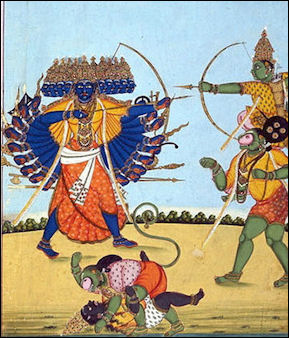
20120501-Rama_and_Hanuman_fighting_Ravana.jpg


Rama and Hanuman fighting Ravana, scene from the Ramayana Hinduism have many sacred documents but no single sacred text such as the Bible. “The result,” writes historian Daniel Boorstin, is “a wonderfully varied and constantly enriching Hindu jingle-jangle of truths, but no one path to The Truth.” Hindu texts are so closely associated with Sanskrit that all translations are regarded as profanation.

There are five primary sacred texts of Hinduism, each associated with a stage of Hinduism’s evolution. They are:

1) the “Verdic Verses” , written in Sanskrit between 1500 to 900 B.C.;
2) the “Upanishads” , written 800 and 600 B.C.;
3) the “Laws of Manu”, written around 250 B.C.;
4) “Ramayana” and
5) the “Mahabharata”, written sometime between 200 B.C. and A.D. 200 when Hinduism was popularized for the masses.

Hindu cosmology was explained in the Vedas. The Upanishads provided a theoretical basis for this cosmology. The “Brahmanas” , a supplement to the Vedas, offers detailed instructions for rituals and explanations of the duties of priests. It gave form to abstract principals offered up in the earlier texts. Sutras are additional supplements that explain laws and ceremonies.

The Hindu sacred texts are divided into Shruti (“What Is Heard”) and Smriti (“What Is Remembered”). The Sruti — which includes the Vedas and Upanishads — are considered to be divinely inspired while the Smriti — which includes the Mahabharata (including the Bhagavad Gita) and Ramayana — are derived from great sages. Some sources include a third category: nyaya (meaning ‘logic’). Hindu Shruti-Smriti classifications are based on origin not on the mode of transmission. Therefore, shruti implies something heard directly from the Gods by the sages while smriti refers to what was written down and remembered. Shruti is considered more authoritative than smriti because the former is believed to have been obtained directly from God by the spiritual experiences of vedic seers and has no interpretations.

The main Hindu texts are the Vedas and their supplements (books based on the Vedas). Veda is a Sanskrit word meaning ‘knowledge’. These scriptures do not mention the word ‘Hindu’ but many scriptures discuss dharma, which can be rendered as ‘code of conduct’, ‘law’, or ‘duty’ Hindus believe that the Vedas texts were received by scholars direct from God and passed on to the next generations by word of mouth. [Source: BBC |::|]

20120501-Sanskrit Atashgah-shiva-inscription-jackson1911.jpg

Sanskrit Atashgah Siva-inscriptionThere are six systems of Indian philosophy (ShhaDarshana). They are:

1) Jaimini’s Purva Mimansa,
2) Patanjali’s yoga,
3) Gautama’s Nyaya (Buddhism),
4) Kanada’s Vaisheshika,
5) Vyasa’s Uttar Mimansa, and
6) Kapila’s Sankhya.  

All the six systems are written in aphorisms (sutras). Though each sutra is just a few lines, huge commentaries have been written on each of them. Besides all the philosophy which expound on the cosmic attributes of the Divine, there are epics (Itihaasa-s) and stories (Puranas) written which bring into light the human attributes of the Divine.

The Ramayana was first written by Valmiki while Mahabharata was written by Sage Vyasa. Vyasa also wrote the eighteen puranas and eighteen sub-puranas. The puranas generally emphasize valued Hindu morals and are often stories about Hindu deities fighting to uphold these morals. There are also Kaavyas which are based on stories derived from the puranas. Among these, the Raghuvamsa, Meghaduta and Shakuntala are the most well known.

There are also Prakarana Granthas which are considered to be primers or an introduction for spiritual studies. Among them are Atma Bodha and Bhaja Govindam [also known as Moha Mudhgara]. There are also stotras and bhajans (devotional songs and hymns). Among the most famous stotras are Sahasranamams (1008 names of each diety).

Websites and Resources on Hinduism: Hinduism Today hinduismtoday.com ; India Divine indiadivine.org ; Wikipedia article Wikipedia ; Oxford center of Hindu Studies ochs.org.uk ; Hindu Website hinduwebsite.com/hinduindex ; Hindu Gallery hindugallery.com ; Encyclopædia Britannica Online article britannica.com ; International Encyclopedia of Philosophy iep.utm.edu/hindu ; Vedic Hinduism SW Jamison and M Witzel, Harvard University people.fas.harvard.edu ; The Hindu Religion, Swami Vivekananda (1894), .wikisource.org ; Advaita Vedanta Hinduism by Sangeetha Menon, International Encyclopedia of Philosophy (one of the non-Theistic school of Hindu philosophy) iep.utm.edu/adv-veda ; Journal of Hindu Studies, Oxford University Press academic.oup.com/jhs Hindu Texts: Clay Sanskrit Library claysanskritlibrary.org ; Sacred-Texts: Hinduism sacred-texts.com ; Sanskrit Documents Collection: Documents in ITX format of Upanishads, Stotras etc. sanskritdocuments.org ; Ramayana and Mahabharata condensed verse translation by Romesh Chunder Dutt libertyfund.org ; Ramayana as a Monomyth from UC Berkeley web.archive.org ; Ramayana at Gutenberg.org gutenberg.org ; Mahabharata holybooks.com/mahabharata-all-volumes ; Mahabharata Reading Suggestions, J. L. Fitzgerald, Das Professor of Sanskrit, Department of Classics, Brown University brown.edu/Departments/Sanskrit_in_Classics ; Mahabharata Gutenberg.org gutenberg.org ; Bhagavad Gita (Arnold translation) wikisource.org/wiki/The_Bhagavad_Gita ; Bhagavad Gita at Sacred Texts sacred-texts.com ; Bhagavad Gita gutenberg.org gutenberg.org

Vedas

The Vedas, which means “knowledge” in Sanskrit, are Hinduism’s oldest sacred scriptures.They are believed to be the world’s most ancient religious texts. Defining truth for Hindus, they comprise tens of thousands of hymns that describe the worship of nature, performance of rituals and the mysteries of existence.

Hinduism in India traces its source to the Vedas, ancient hymns composed and recited in Punjab as early as 1500 B.C. Three main collections of the Vedas — the Rig, Sama, and Yajur — consist of chants that were originally recited by priests while offering plant and animal sacrifices in sacred fires. A fourth collection, the Atharva Veda, contains a number of formulas for requirements as varied as medical cures and love magic. The majority of modern Hindus revere these hymns as sacred sounds passed down to humanity from the greatest antiquity and as the source of Hindu tradition.[Source: Library of Congress *]

20120501-Rig_Veda.jpg

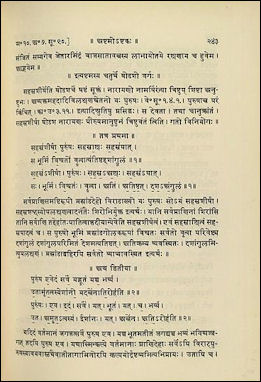
Rig Veda pageThe Vedas got their present form between 1200-200 B.C. and were introduced to India by the Aryans. Hindus believe that the texts were received by scholars direct from God and passed on to the next generations by word of mouth. Vedic texts are sometimes called shruti, which means hearing. For hundreds, maybe even thousands of years, the texts were passed on orally. [Source: BBC |::|]

The sacred texts known as the “Vedas”, or “Vedic” Verses, were written in Sanskrit between 1500 to 900 B.C. They are associated with the founding of Hinduism and consist of four texts: 1) the “Rig Veda” , a collection of 1,028 hymns and prayers; 2) the “Soma Veda” , a collection of verses taken mostly from the “Rig Veda” that have been rearranged for chanting at sacrifices; 3) the “Yajur Veda” , prose with instructions on how the prose is to be used in ceremonies; and 4) the “Antharva Veda” , comprised primarily of formulas and spells The religion described in the Vedas is more Aryan religion than Hinduism because so much emphasis is put on sacrifices. Many important gods in the Vedas have all but been forgotten while gods like Shiva and Vishnu that are minor gods in the Vedas are now major figures in Hinduism. The Vedas seems to have been written by people who lived in the Punjab and had little knowledge of people in the Ganges Plain and elsewhere in India. Few people read the Vedic verses today. They were largely passed down orally over the century until an Englishmen wrote them down in the 18th century. Vedic (pronounced VAY-dick) is Sanskrit for knowledge.

See Separate Articles: SELECTIONS, PASSAGES AND QUOTES FROM THE VEDAS factsanddetails.com ; VEDIC PERIOD (1500–500 B.C.): ARYANS, EARLY HINDUISM, LIFE AND GOVERNMENT factsanddetails.com ; ORIGINS AND EARLY HISTORY OF HINDUISM factsanddetails.com

Content of Vedas

The Vedas describe pantheon of gods, supported by the belief that God is everywhere in everything. Gods are referred to as “devas” , derived from the old Sanskrit “div” , meaning brightness. They are not beings arranged into a hierarchy or order of nature, but rather sources of blinding light that leave anyone who comes in contact with them awestruck and spellbound.

Early descriptions of the caste system are found in the Vedas, which describe Aryan society as being divided into the four major castes: the Brahmins (priestly caste); Kshatriyas (warrior caste), the Vaisyas (farmer caste); and Sudras (laborers). The distinction is made primarily to define Brahmas as priests and ceremonial leaders.


Vivaha sukta, Rigveda 10:85, 16-22, dated to 1500-1200 BC, in Sanskirt from the Devanagari manuscript

The Vedas are filled with conversations and stories with moral or spiritual messages. One conversation between a father and son goes:
“”Fetch me a fruit of the banyan tree.”
“Here is one, sir.”
“Break it.”
“I have broken it, sir.”
“What do you see?”
“Very tiny seeds, sir.”
“Break one.”
“I have broken it, sir.”
“Now what do you see?”
“Nothing sir.”
“My son,” the father said, “what you do not perceive is essence, and in that essence the mighty banyan tree exists. Believe me, my son, in that essence is the self of all that is. That is the True, that is the Self. And you are that Self, Sveraketu!””

The Vedas are made up of four compositions, and each veda in turn has four parts which are arranged chronologically: 1) The Samhitas are the most ancient part of the Vedas, consisting of hymns of praise to God. 2) The Brahmanas are rituals and prayers to guide the priests in their duties;. 3) The Aranyakas concern worship and meditation. 4) The Upanishads consist of the mystical and philosophical teachings of Hinduism. [Source: BBC |::|]

The Samhitas: 1) Rig-Veda Samhita (c. 1200 B.C.) is the oldest of the four vedas and consists of 1028 hymns praising the ancient gods. 2) Yajur-Veda Samhita is used as a handbook by priests performing the vedic sacrifices. 3) Sama-Veda Samhita consists of chants and tunes for singing at the sacrifices. 4) Atharva-Veda Samhita (c. 900 B.C.) preserves many traditions which pre-date the Aryan influence and consists of spells, charms and magical formulae. |::|

Dating the Vedas

There is a some debate surrounding the exact history and date of the Vedas. One source above says they were composed between 1500 B.C. and 600 B.C. Another says they got their present form between 1200-200 B.C. Many say they dates back to 1900 B.C., or even 4000 B.C. They were first translated into European languages in the late 18th and early 19th centuries. At this time, it was widely believed to their makers could not have made something older than classic European texts. That idea persisted for some time the West. Today, some India historians are trying push the origin of The Vedas back to the beginning of dawn of human civilization between 4000 and 3000 B.C.

Dr. Michael Witzel, Wales Professor of Sanskrit, Harvard University, said the Rig Veda is no older than 1400 B.C., based on the references to metals (bronze, and no iron), horses, and chariots. He maintains that there was no evidence to support earlier dates. He also said that Vedic Sanskrit was imported to the region, as shown by the similarity with many other languages, although there was a local substratum of language and customs that were retained in the Vedic times. [Source: Science Center at Harvard University, On 14 March 2010, lokvani.com]


Devi sukta, Rigveda10, 125 5-6, dated to 1500-1200 BC, in Sanskrit from the from the Devanagari manuscript, AD 1735


According to the Aryan invasion theory, first proposed by the British archaeologist Mortimer Wheeler around the early part of the twentieth century, the Vedas were not composed in India. They were composed by members of so-called Aryans tribes who invaded India from the Northwest, destroyed the old civilisation in the Indus Valley. Hindu nationalists promote the idea, saying the Indus Valley was inhabited by Dravidians who were driven to the south of India by the Aryans. and other parts. The Indus Valley civilization emerged around 3300 B.C. And declined around 1500 B.C. or earlier. There are Hindu nationalist overtones to the Dravidian-Aryan aspect of this theory and no archaeological evidence to back it up. Many Indian historians argue that the Indus Valley civilisation declined by 1800 BC and the Aryans appeared in north-west India around 1500 BC. Using philological evidence, the overlap between Vedic Sanskrit, old Persian and ancient European languages, they have argued since the 19th century that the Rig Vedic Aryans came from outside. Recently scholars at the University of Delhi and elsewhere, to push back the commonly accepted date of the Vedas through astronomical calculations. [Source: Vikas Pathak, The Hindu, September 18, 2015 ^^^]

Ramesh Bhardwaj, head of the Sanskrit Department at Delhi University, said: “Many scholars have used archaeology to date the Vedas, and this does not take them before 3000 BC. But there are other dating tools that have been ignored or forgotten. There are instances where Vedic literature offers the positions of stars and constellations at the moment it was composed. This can be calculated back mathematically to figure out the date when the positions actually corresponded to the description.” Mr. Bhardwaj says this can offer the latest possible date of the text, be it “5000 or 10,000 years back”. Historian D.N. Jha told The Hindu: “People have come up with dates ranging from 1100 BC to 4000 BC from astronomical calculations. This shows that the evidence itself is dubious.” He added that for the Rig Veda, it was difficult to say whether what was being seen as a constellation was indeed a description of one.” ^^^

Vedas and Polytheism

The vast majority of Vedic hymns are addressed to a pantheon of deities who are attracted, generated, and nourished by the offerings into the sacred flames and the precisely chanted mantras (mystical formulas of invocation) based on the hymns. Each of these deities may appear to be the supreme god in his or her own hymns, but some gods stand out as most significant. Indra, god of the firmament and lord of the weather, is the supreme deity of the Vedas. Indra also is a god of war who, accompanied by a host of storm gods, uses thunderbolts as weapons to slay the serpent demon Vritra (the name means storm cloud), thus releasing the rains for the earth. Agni, the god of fire, accepts the sacrificial offerings and transmits them to all the gods. Varuna passes judgment, lays down the law, and protects the cosmic order. Yama, the god of death, sends earthly dwellers signs of old age, sickness, and approaching mortality as exhortations to lead a moral life. Surya is the sun god, Chandra the moon god, Vayu the wind god, and Usha the dawn goddess. *


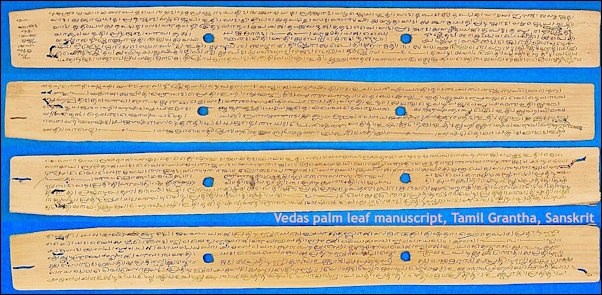
Vedas on palm leaf manuscripts, Tamil Grantha scriptm Sanskrit, from Tamil Nadu


Some of the later hymns of the Rig Veda contain speculations that form the basis for much of Indian religious and philosophical thought. From one perspective, the universe originates through the evolution of an impersonal force manifested as male and female principles. Other hymns describe a personal creator, Prajapati, the Lord of creatures, from whom came the heavens and the earth and all the other gods. One hymn describes the universe as emerging from the sacrifice of a cosmic man (purusha ) who was the source of all things but who was in turn offered into the fire by gods. Within the Vedic accounts of the origin of things, there is a tension between visions of the highest reality as an impersonal force, or as a creator god, or as a group of gods with different jobs to do in the universe. Much of Hinduism tends to accept all these visions simultaneously, claiming that they are all valid as different facets of a single truth, or ranks them as explanations with different levels of sophistication. It is possible, however, to follow only one of these explanations, such as believing in a single personal god while rejecting all others, and still claim to be following the Vedas. In sum, Hinduism does not exist as a single belief system with one textual explanation of the origin of the universe or the nature of God, and a wide range of philosophies and practices can trace their beginnings somewhere in the hymns of the Vedas. *

By the sixth century B.C., the Vedic gods were in decline among the people, and few people care much for Indra, Agni, or Varuna in contemporary India. These gods might appear as background characters in myths and stories about more important deities, such as Shiva or Vishnu; in some Hindu temples, there also are small statues of Vedic deities. Sacrificial fire, which once accompanied major political activities, such as the crowning of kings or the conquest of territory, still forms the heart of household rituals for many Hindus, and some Brahman families pass down the skill of memorizing the hymns and make a living as professional reciters of the Vedas. One of the main legacies of Brahmanical sacrifice, seen even among traditions that later denied its usefulness, was a concentration on precise ritual actions and a belief in sacred sound as a powerful tool for manifesting the sacred in daily life. *

Upanishads

The “Upanishads” or “Seances” are commentaries on the Vedas. Written between 800 and 600 B.C and comprised of a series of discourses and dialogues by “men whose hair had grown white and who had seen their sons’ sons,” they provide a theoretical basis for Hindu cosmology and teach that liberation can be obtained by doing tasks that are “difficult and painful as walking the razor’s edge” and were written when Hinduism was going through a period of deep introspection on “the infinite depth of the Soul” and “brooding on the meaning of existence.” The poet W.B. Yeats translated the Upanishads.

The Upanishads were so called because they were taught to those who sat down beside their teachers. (upa=near, ni=down, shad=sit). These texts developed from the Vedic tradition, but largely reshaped Hinduism by providing believers with philosophical knowledge. The major Upanishads were largely composed between 800-200 B.C. and are partly prose, partly verse. Later Upanishads continued to be composed right down to the 16th century. Originally they were in oral form. [Source: BBC |::|]


Chandogya Upanishad on a plam leaf strip


The early Upanishads are concerned with understanding the sacrificial rites. Central to the Upanishads is the concept of brahman; the sacred power which informs reality. Whilst the priests (brahmins) had previously been the ones who, through ritual and sacrifice, had restricted access to the divine, now the knowledge of the universe was open to those of the high and middle castes willing to learn from a teacher. |::|

Kalpana Srivastava wrote in the Industrial Psychiatry Journal: “Upanishads are store house of psychological material. The nature of mind and its functions and different psychological phenomena–normal, abnormal, pathological, paranormal, and spiritual–are explained in Vedas and Upanishadas. The core themes, according to the ancient philosophical tradition are centered around self, soul, human nature, human existence, and human experience.” [Source: Kalpana Srivastava, Industrial Psychiatry Journal, July-December 2012 ~]

Contents of the Upanishads

“There are 12 major Upanishads, which fall into three groups, ‘each standing for definite stage of thought development connected with the two Ultimates of reality’ Brhadaranyka, Chandogya, Is’a, Kena, Mandukya, Aitereya, Taittiriya, and Kausitiki are the ones, which come under the early Upanishadic period. Mundaka and Katha fall into the mid-Upanishadic period. Prasna and Svetasvatara belong to the later Upanishadic period. Upanishads Mandukya and Taittiriya, have significance in contemporary psychology in the context of studies on consciousness and personality. ~

The ancient Indian model of “Personality”, given in the Upanishads, consists of the ‘five’ sheaths. They are ‘Annamaya’ (food sheath), ‘Pranamaya’ (vital air sheath), ‘Manomaya’ (mental sheath), ‘Vijnanamaya’ (intellectual sheath), and ‘Anandamaya’ (bliss sheath). ‘Annamaya’; a segment of human system is nourished by ‘anna’, that is, food. ‘Pranamaya’ is that segment which is nourished by ‘prana’, that is, ‘bioenergy’. ‘Manomaya’ is the segment nourished by ‘education’. ‘Vijnanamaya’ is nourished by ‘ego’ and ‘Anandamaya’ is the segment nourished by ‘emotions’.

The Vedas and the Upanishads and two other texts — the “Sambitas” and the “Brahmanas” “and a few “sutras” are collectively known as the “Shruti” , which means “that which is heard.” They are considered the eternal truth and have traditionally been handed down orally. The “Aranyakas” (“Forest Books”) is a later philosophical work associated with the “Upanishads” . It offers guidance in leading a holy life and understanding rituals. The “Laws of Manu” were written around 250 B.C. These texts established Hindu law based on a large number of wise sayings a and prohibitions in everyday life. The principals of the caste system were outlines in the Laws of Manu.

The “Puranas” (“Sacred Traditions”) are lengthy medieval texts that rehash old legends; deliver new ones; and clarify Hindu cosmology, theology and religious practices. There are separate puranas devoted to Shiva and Vishnu. Other texts that emerged in the medieval period are the “dharamasutras” (law books) and “bhashyas” (philosophical works). In these book are deeply spiritual and literary songs that are known and cherished by most Hindus. Around this time a wide number of texts began appearing in local languages.


Chandogya Upanishad on a palm leaf manuscript


Puranas

Vinay Lal, professor of history at UCLA wrote: “The Puranas are a class of literary texts, all written in Sanskrit verse, whose composition dates from the 4th century B.C. to about 1,000 A.D. The word “Purana” means “old”, and generally they are considered as coming in the chronological aftermath of the epics, though sometimes the Mahabharata, which is generally classified as a work of itihas (history), is also referred to as a purana. Some scholars, such as van Buitenen, are inclined to view the Puranas as beginning around the time that the composition of the Mahabharata came to a close, that is about 300 A.D. Certainly, in its final form the Mahabharata shows puranic features, and the Harivamsa, which is an appendix to the Mahabharata where the life of Krishna or Hari is treated at some length, has sometimes been seen as a purana. [Source: Vinay Lal, professor of history, UCLA +++]

“The special subject of the puranas is the powers and works of the gods, and one ancient Sanskrit lexicographer, Amarasinha, writing in the fifth or sixth century A.D., defined a purana as having five characteristic topics, or pancalaksana: “(1) The creation of the universe; (2) Its destruction and renovation; (3) The genealogy of gods and patriarchs; (4) The reigns of the Manus, forming the periods called Manwantaras; (5) the history of the Solar and Lunar races of kings.” No one purana can be described as exhibiting in fine (or even coarse) detail all five of these distinguishing traits, but sometimes the Vishnu Purana is thought to most closely resemble the traditional definition. Around the time when the puranas first began to be composed, the belief in particular deities had become established as one of the principal marks of the Hindu faith, and to some degree the puranas can be described as a form of sectarian literature. Some puranas exhibit devotion to Shiva; in others, the devotion to Vishnu predominates. +++

“There are eighteen major puranas, as well as a similar number of minor or subordinate puranas. One method of the classification of puranas deploys the traditional tripartite division of the gunas or qualities which tend toward purity (sattva), impurity or ignorance (tamas), and passion (rajas). Thus, there are those puranas where the quality of sattva is said to predominate, and these are six in number: Vishnu; Narada; Bhagavata; Garuda; Padma; and Varaha. According to another scheme of classification, these are also the puranas in which Vishnu appears as the Supreme Being. A second set of puranas, also six in number, are described as exhibiting qualities of ignorance or impurity (tamas), and in these Shiva is the God to whom devotion is rendered: Matsya; Kurma; Linga; Shiva; Skanda; and Agni. In the third set of six puranas, the quality of rajas or blind passion supposedly prevails: Brahma; Bramanda; Brahmavaivarta; Markandeya; Bhavishya; and Vamana. The list of eighteen is sometimes enlarged to twenty, to include the Vayu Purana and the Harivamsa. Yet clearly this mode of classification, which shows every sign of sectarianism, is inadequate, since none of the puranas is devoted exclusively to either Vishnu or Shiva. +++


“Among these puranas, the Vishnu Purana and the Bhagavata Purana (also known as the Bhagavatam) are, with respect to their standing as works of devotional literature, preeminent; and the Bhagavata Purana is even the supreme work of Krishna devotional literature. Since each of the eighteen major puranas enumerates the other puranas, it is reasonable to surmise that all the puranas were revised at one point. Their length varies considerably: the Skanda has 80,000 couplets, while the Brahma and Vamana Puranas have 10,000 couplets each. +++

“Though all the Puranas have been translated into major Indian languages as well as English, only a few of them, principally the Vishnu Purana and the Bhagavatam, can safely be described as being widely known. Nonetheless, the stories told in the Puranas are part of the common currency, and in this respect the Puranas can rightfully be spoken of as the scriptures of popular Hinduism. It is the Puranas that British scholars had in mind when they mocked the literature of the Hindus as fanciful, hyperbolic, and absurd. Genealogies in which certain kings are said to rule for thousands of years, or conceptions of time where tens of thousands of years are said to be a mere instant, were not calculated to make the British regard the Puranas as a set of rational religious texts. However, it requires a very different imagination, as well as interpretive strategy, to read the Puranas. To suppose that Hindus truly believe in “330 million gods and goddesses” is to fail to understand the place of numbers in the Indian imagination, and the hermeneutic, interpretive, and creative work that numbers do. +++

“The Puranas are works that most eminently represent the deep mythic structuring of Indian civilization, and they are properly viewed as expanding upon, modifying, and transforming the orthodox Brahminism of the Vedas, principally by the introduction of the idea of bhakti or devotion. It is the Puranas which, it is no exaggeration to say, assisted in the transition from Brahminism to Hinduism, particularly a Hinduism that was more receptive to folk elements, popular forms of devotion and worship, and everyday arts, crafts, and sciences. The Puranas carry story about the gods who had become the objects of people’s devotion, as well as about the modes of worship of these gods; these gods are no longer Vedic gods, but the gods who form the Hindu trinity. Besides them, the Puranas speak of the battle between the devas and the asuras, and one can doubtless read the narratives as allegorical accounts of the struggle within each person between the forces of ‘light’ and the forces of ‘darkness’. The Puranas delineate the religious obligations by which each person is bound, and as such they are a guide to dharmic living. Though the Puranas are a vast repository of Hindu lore, religious practices — yoga, vows, puja, prayers, sacrifices — and everyday customs, they are not without a sense of humor and irony, and they complement the metaphysical austerity of the Upanishads, the magical and sacrificial lore of the Atharva Veda, and the sacerdotal orthodoxy of the Rig Veda.” ++++

Mahabharata, Ramayana and Bhagavad Gita

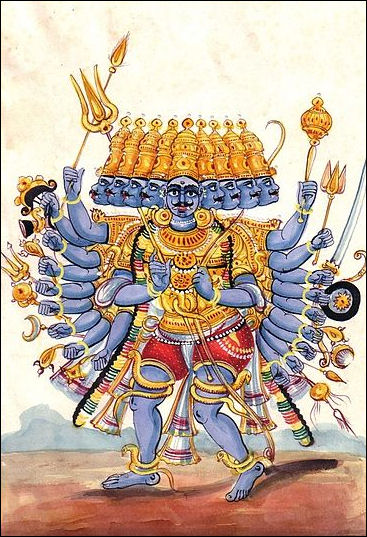
20120501-Ravana.jpg
Ravana

According to the BBC: “Composed between 500 B.C. and 100 CE, the Mahabharata is an account of the wars of the house of Bharata. It is one of the most popular Hindu texts and is known as a smriti text (the remembered tradition). This is considered by some to be of less importance than shruti (the heard text, such as the Vedas). It has, nevertheless, an important place within the Hindu tradition. [Source: BBC |::|]

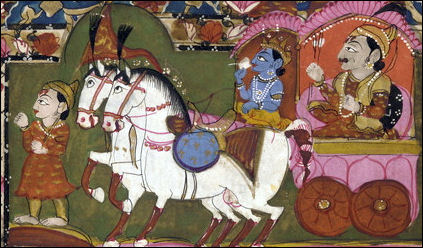
The Bhagavad Gita, or “Song of the Lord” is part of the sixth book of the Mahabharata, It takes the form of a dialogue between prince Arjuna and Krishna, his charioteer. Arjuna is a warrior, about to join his brothers in a war between two branches of a royal family which would involve killing many of his friends and relatives. He wants to withdraw from the battle but Krishna teaches him that he, Arjuna, must do his duty in accordance with his class and he argues that death does not destroy the soul. Krishna points out that knowledge, work and devotion are all paths to salvation and that the central value in life is that of loyalty to God. |::|

Composed in the same period, the Ramayana is one of India’s best known tales. It tells the story of Prince Rama who was sent into exile in the forest with his wife, Sita, and his brother, Lakshamana. Sita was abducted by the evil demon Ravana but ultimately rescued by Prince Rama with the help of the Monkey God, Hanuman. The story is written in 24,000 couplets. The symbolism of the story has been widely interpreted but basically is the story of good overcoming evil. Many people have said that it is a story about dharma or duty. |::|

Steven M. Kossak and Edith W. Watts from The Metropolitan Museum of Art wrote: “Indian people have treasured, in particular, two great epics: the Ramayana (2nd century B.C.) and the famous epic poem, the Mahabharata (500–400 B.C.), both of which may be based on actual historical events. The Ramayana has been, and still is, a rich source for art.” [Source: Steven M. Kossak and Edith W. Watts, The Art of South, and Southeast Asia, The Metropolitan Museum of Art, New York]

The “Ramayana” and the “Mahabharata” are epics like the “Iliad or “ Jason and the Argonauts. Believed to have been written between 200 B.C. and A.D. 200, with some parts probably written earlier and some parts probably written later, they are comprised of myths and stories about romance and war, and are part of a collection of texts, known as “Shmriti” (“That Which has been Remembered”), which are regarded as being supportive of the “shruti”. Amid the adventure of Hindu gods and heroes are found laws and regulation regarding caste, eating, idolatry, sacred places, festivals and superstitions. There are also long didactic passages offering guidance on politics, morality, ethics and religion. Although the “Ramayana” and “Mahabharata” were written millennia ago they remain very much alive today. When a serial drama version of the “Ramayana” was shown on television in the late 1980s and early 1990s the whole country was quiet on Sunday morning as people tuned in. The sale of television sets soared. Those that could not afford new sets gathered around windows to watch episodes. In some places the buses stopped running so the drivers could tune in. The shows was also very popular in Pakistan. One of the most devastating bombing attacks in Karachi took place outside a television shop where people had gathered to watch the series.

See Separate Articles HINDU LITERATURE: RAMAYANA, MAHABHARTA AND BHAGAVAD GITA factsanddetails.com

Ramayana

20120501-Hanuman_slaying_demons_on_each_side.jpg
Hanuman slaying demons
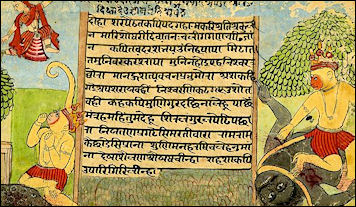
on Ramayama manuscript Ramayana (Sanskrit for “The Romance of Rama” or “The Career of the Rama”) is a great epic poem that is 24,000 verses long. it consists of seven books and tells the story of Rama, or Ramachandra, the King of Ayodhya and the God of Truth, and his adventures. The work is attributed to the poet Valmiki although it was probably written by several authors and embellished over the centuries by others.

The Ramayana is a cornerstone of religion and literature not only in India but in other South Asian and Southeast Asian nations as well. It was originally written in Sanskrit but has been translated into numerous other languages. There are many variations. The Ramayana is somewhat reminiscent of the Odyssey in its organization and plot. The stories may be based on a real life king named Rama who helped spread Hindu and Aryan ideas throughout India. Hindu nationalists believe this and based their 1980s attack on mosque in Adoyda’said to have been built on the site of Rama’s birthplace — on this belief.

Simply reading or hearing the Ramayana is said to bring about good things. The last paragraph reads: “He that has no sons shall attain a son by reading even a single verse of Rama’s song. All sin is washed away from those who read or hear it read. He who recites the Ramayana should have rich gifts of cows and gold. Long shall he live who reads the Ramayana, and shall be honored, with sons and grandsons in this world and in Heaven.”

See Separate Articles RAMAYANA: IT’S HISTORY, STORY AND MESSAGES factsanddetails.com ; PASSAGE AND SELECTION FROM THE RAMAYANA: THE INAGURATION OF RAMA AS KING factsanddetails.com

Bhagavad Gita

The “Bhagavad Gita” (“Song of God”) is an epic poem consisting of 701 Sanskrit couplets. Part of the “Mahabharata”, it blends theology and political science with a dramatic story of dynastic struggle. According to legend it was written by the sage Vyasa. It probably existed independently of the “Mahabharata” and was added and revised to its present form around the A.D. 2nd century. Today, it is the most widely read Hindu text.


Vyasa

The “Bhagavad Gita” is essentially a devotional poem set among the battles of the “Mahabharata” . It outlines rituals accessible to everyone. This contrasts with the rituals described in old Vedic texts, which involved sacrifices and elaborate rites that were only open to upper castes. Many customs and fetishes have evolved around the “Bhagavad Gita” . Some people wear a miniature copy of it around their neck for luck and to ward off evil.

The “Bhagavad Gita” begins at the battlefield of Kurukshetra, a popular pilgrimage place today. Arjuna is brooding over the upcoming clash because he has friends, relatives and teachers on the other side. Krishna advises him to pour himself into the battle and not worry about the consequences, telling the warrior that is the only way he can find knowledge, freedom and peace.

Much of the text is made of dialogues between Krishna and Arjuna with Krishna encouraging Arjuna to fight and overcome his reluctance not to fight. Krishna tells Arjuna that he must fight because he is a warrior by caste and it is his duty to fight, saying: “For there is more joy in doing one’s duty badly that in doing another’s well. It is a joy to die doing one’s duty, but doing another man’s duty brings dread.”

See Separate Articles MAHABHARATA AND BHAGAVAD GITA factsanddetails.com

Passages From the Bhagavad Gita

A famous dialogue between Krishna and Arjuna — one that has been described by the Library of Congress as “one of the great jewels of world religious literature” — occurs after Krishna changes from the human form into the “universal form” before battle to inspire Arjuna to defeat an enemy which has Krishna said are “already put to death by my arrangement.”

20120501-Krishna_and_Arjun_on_the_chariot_Mahabharata.jpg

Krishna and Arjuna on the chariot Mahabharata “Do the work that you have to do.
For work is better than inaction. You cannot even keep your body alive if you are wholly inactive…


If I did always work
Unwearying…
men would follow my ways.
The worlds would perish if I did not
work?
I should bring back chaos.
and all beings would suffer…
Cast all you acts upon me.
With your mind in the highest Soul.
Have done with craving and selfhood.
Throw off your terror, and fight!”

Concepts in the Bhagavad Gita

The central premise of the “Bhagavad Gita” is that all Hindus (or even all people), even Untouchables, who obey the rules of their caste and follow the teachings of god will be reincarnated in successfully higher castes and eventfully end up in heaven. Connected with this is the idea that all actions should be guided by dharma, the external divine law that says people should fulfill their duty and let God decide the consequences of their actions. The “Bhagavad Gita” also address the immortality of the soul in a universals sense and teaches that God can take human form to relay his message.


Krishna and Arjuna from the Gita

Unlike Buddhism, which encourages its followers to withdraw from the world, the “Bhagavad Gita” encourages people to involve themselves in the world with a detached ego. Arjura learns that: 1) he is not limited to his physical form; 2) human consciousness flows through the entire universe; and 3) nothing in the world really matters. With these realizations Arjuna is freed of doubt and delusion and can realize his Higher Self and find fulfillment.

The “Bhagavad Gita” talks about three ways of approaching the world: 1) through the mind; 2) through emotions; and 3) through actions. Those are tied with three yogas, or methods of union with the Higher Self: 1) duty, 2) insight and 3) devotion.

There are three main obstacles, or “gunas” , that hinder development: 1) “Sattva”, being too attached to happiness, purity and righteousness; 2) “Rajas” , attachment to passion and activity; and 3) “Tamas”, attachment laziness and ignorance. Chapter V, 12 of the “Bhagavad Gita” reads:


“The disciplined man, having relinquished the fruit of action.
Attains perfect peace.
The undisciplined man, impelled by desire.
Is attached to the fruit of fruit and is bound.”

Image Sources: Wikimedia Commons

Text Sources: “World Religions” edited by Geoffrey Parrinder (Facts on File Publications, New York); “Encyclopedia of the World’s Religions” edited by R.C. Zaehner (Barnes & Noble Books, 1959); “Encyclopedia of the World Cultures: Volume 3 South Asia “ edited by David Levinson (G.K. Hall & Company, New York, 1994); “The Creators” by Daniel Boorstin; “A Guide to Angkor: an Introduction to the Temples” by Dawn Rooney (Asia Book) for Information on temples and architecture. National Geographic, the New York Times, Washington Post, Los Angeles Times, Smithsonian magazine, Times of London, The New Yorker, Time, Newsweek, Reuters, AP, AFP, Lonely Planet Guides, Compton’s Encyclopedia and various books and other publications.

Last updated September 2018


This site contains copyrighted material the use of which has not always been authorized by the copyright owner. Such material is made available in an effort to advance understanding of country or topic discussed in the article. This constitutes ‘fair use’ of any such copyrighted material as provided for in section 107 of the US Copyright Law. In accordance with Title 17 U.S.C. Section 107, the material on this site is distributed without profit. If you wish to use copyrighted material from this site for purposes of your own that go beyond ‘fair use’, you must obtain permission from the copyright owner. If you are the copyright owner and would like this content removed from factsanddetails.com, please contact me.


Natural Evil at large

The name of this post brings a problem which will be the opening discussion. We have problems with language when we want to express certain things. As it is well known, science creates normally names in latin and it lights to our discussion why the use of Latin:

  •  It is estimated that there are around 8.7 million species of plants and animals in existence. Only around 1.2 million species have been identified and described, most of which are insects and millions of other organisms remain a mystery;
  • There is only one correct Latin name for any organism, plant or animal species;
  • Latin is a dead language, so it will not change as it is the case of living languages.

In our case, “at large” was meant as when it is used to refer to a criminal or dangerous animal at liberty which escaped and is not yet captured. Though the meaning “as a whole” or “in general” also fits.

In our case, natural evil shares with those unknown organisms the quality of being something which you know exists, but the details and complete description of it in a scientific or rational way, specially as it relates to all these species, is a mystery. I have doubts that the relation of natural evil with known species is fully known and understood.

Just for starts, imagine if all of sudden God decided to exercise the criteria of theologians and philosophers (I imagine Rousseau and Leibnitz leading the pack, with Nietzsche, St. Augustine and Voltaire laughing and screaming “I warned you!!”) and erased all natural evil from the face of the earth and they would be entitled to live their existence without the need of fear of closing their life cycle as up to that decision would provide, i.e, no more menaces of any kind.

The very first thing which occurs to my ignorant mind is that with the little I know about insects, they would take over and in a very short term there would be only insects on the face of earth.

This exercise, which is based on a Kind God, which would allow the group to redefine excluding insects, and instead, let animals and birds free of any menace and then what would happen? An acceleration on extinction of most species never seen….Including those who feed us. Famine at sight…

Then, God still having good will, allowed the group go back and turn to plants…. Let’s end up forest fires and allow all the plants to increase their presence as much as it is possible. What would happened? It would became impossible to plant those plants which are in the cycle to produce food as it is today because there would be no surface of earth enough… Famine at sight again,,.

Let’s forget insects, animals, plants and let’s end up with natural disasters which demands the disappearance of the seasons. God would ask them if they want it all winter, all summer, all autumn or all spring. With His characteristic kindness, God would allow to try each and every one of them. It blows my mind the amount of confusion, disaggregation, lack of guidance, which the natural clock that is embedded in everything that is alive would have to face. Chaos in sight….

This exercise could go on with all the metaphysical angles that deists, theists, atheists, theologians, philosophers like to chase their own tails, and I think the conclusion would be that reality shouldn’t be any different than it is and we should use our freedom of choice and intelligence to face these problems, because without them, it is not possible to exist.

I have a very strong suspicion that intelligence itself, formation of the differentiated ego, formation of character, and everything that makes us human, appeared mostly due to natural evil.

But there is more hope than that… It is uncomfortable to live so dangerously and yet be optimistic…It seems to me that we should pay more attention to some features of reality which normally philosophers and theologians seems not to notice.

I will step over the shoulder of a giant, one of the most brilliant intelectuals Brazil, or any portuguese speaking countries produced, which is Guimarães Rosa.

He was a diplomat, consul of Brazil in Germany during the second world war and became famous for having helped a large number of Jews to flee to Brazil, along with his wife who also worked at the Brazilian embassy at the time, contrary to the political guidelines that received forbidding them to do so. He and his wife, are considered the Brazilian Schindlers.

It is very important to note that he was a Germanophile and had a great attraction and admiration for the German language, his greatest work being considered to have a great influence inspired by Faust.

Before pointing out his particular notion about evil, let me introduce him with an exerpt of a interview which took place during the “Congress of Latin American Writers” held in Genoa in January 1965:

LORENZ: Now, speaking as a reader of your books, I tell you that I don’t find your remarks all that strange. I’m sure you’ll be able to tell many more stories, but I also hope you keep telling us about your life, although it’s not so pleasant for you. Perhaps it would not be of little importance to tell us some dates.

GUIMARÃES ROSA: That I was born in the year 1908, you already know. You shouldn’t ask me for more numerical data. My biography, especially my literary biography, should not be crucified in years. Adventures have no time, no beginning or end. And my books are adventures; for me, they are my greatest adventure. Writing, I always discover a new piece of infinity. I live in infinity; the moment doesn’t count. I will reveal a secret to you: I believe I have lived once. In this life, I was also Brazilian and my name was João Guimarães Rosa. When I write, I repeat what I experienced before. And for these two lives, a lexicon alone is not enough for me. In other words: I would like to be a crocodile living in the São Francisco River. The crocodile comes into the world as a magister of metaphysics, because for him each river is an ocean, a sea of ​​wisdom, even if it is a hundred years old. I would like to be a crocodile, because I love the great rivers, because they are deep as the soul of man. On the surface they are very lively and bright, but in the depths they are quiet and dark like the sufferings of men. I love one thing even more about our great rivers: their eternity. Yes, river is a magic word to conjure eternity. By now, you must be considering me a charlatan or a madman.

LORENZ: Not at all. I think this is the most original self-characterization I’ve ever heard. Your words sounded almost like a creed. Are they the creed of a sertanejo (from the backcountry of Brazil) from Cordisburgo? (City where G.Rosa was born)

GUIMARÃES ROSA: I’m guessing your thinking! Now, on top of everything else, you want to demand a creed from me. But I tell you one thing: only someone for whom the moment means nothing, for whom, like me, feels in infinity as if he were at home, the crocodile with both lives until now, only someone like this can find happiness and, what is even more important, keep happiness for himself, Au fond, je suis un solitaire (I am a loner at heart), I also say; but as I am not Mallarmé, this means happiness to me. Only in solitude can one discover that the devil does not exist. And this means the infinity of happiness. This is my mystique.

LORENZ: Telling the truth: you don’t mention the devil in your books, which is always doing tricks in your stories, precisely to demonstrate that he doesn’t exist, or rather, that he can be eliminated, defeated, torn apart?

GUIMARÃES ROSA: That could be absolutely right. I’m probably like my brother Riobaldo (main character of his novel). For the devil can be overcome simply, because there is man, the crossing to solitude, which is equivalent to infinity. But you, Lorenz, are very cunning; you make me talk and talk, and you take me by the hand exactly where you want me to go. I already know what your next question will be.

LORENZ: Well now I’m curious.

GUIMARÃES ROSA: Me too. You want to commit me to the word I believe and that’s why you evoked the devil, whose presence, useful in my books, I cannot deny. You want to seduce me into making confessions.

LORENZ: You guessed it right! Well then, please confess!

GUIMARÃES ROSA: I absolutely cannot understand why I let myself be extorted like this by you. Only now does the following occur to me: here are two cowboys arguing. You are one, I have said it in writing and I repeat it now. And when two cowboys argue, there are either broken heads or confessions. Cowboys are like that.

LORENZ: Fortunately I know that cowboys enjoy your sympathy and that’s why I’m willing to be a cowboy. But please tell me at once, strictly speaking, the creed by which you write.

GUIMARÃES ROSA: Yes, see, I think of it this way: every man has his place in the world and in the time allotted to him. His task is never greater than his ability to fulfill it. It consists in filling his place, in serving the truth and men. I know my place and my task; many men do not know it or even do it when it is too late. So everything is very simple for me and I only hope to do justice to this place and this task. See how simple my creed is. But I still want to emphasize that creed and poetics are the same thing. There must be no difference between men and writers; this is just a damned invention of the scientists, who want to make them two totally different people. I find that ridiculous. Life must do justice to work, and work to life. A writer who does not adhere to this rule is worthless, neither as a man nor as a writer. He is face to face with the infinite and is accountable to man and himself. There is no higher authority for him. So that you don’t have to question me about this, I would like to explain my commitment, my commitment from the heart, and that I consider the greatest possible commitment, the most important, the most human and above all the only sincere one. Rules other than this creed, this poetics and this commitment do not exist for me, I do not recognize them. These are the laws of my life, of my work, of my responsibility. I feel obliged to them, by them I guide myself, for them I live. Even with the best good will I cannot make any more confessions, because everything that can happen to me in life is contained there, or it is not worth being called a confession. 

LORENZ: After what you said at the beginning, I frankly didn’t expect this confession anymore. I thank you for making it, and I sincerely believe that this could be a basic rule of literature, if men were not opposed to it. But what do you think of your colleagues? Currently, there is so much talk about commitment, it is said that there is no author without commitment. But I have the impression that especially in Latin America — in Europe, Sartre has put a little order in this matter — many authors, naturally not all, often confuse the commitment to man with the commitment to a party, an ideology. Among the great authors of the continent this is always compensated by their literary potency, and among the second and third category you know how it is almost always.

GUIMARÃES ROSA: I don’t need to be a career diplomat to flatly refuse to make statements in response to your question. You induced me to make confessions, and now you intend to lead me into dangerous territory. I have to live with my colleagues and I don’t like to fight over matters to which I don’t attach the slightest importance. So don’t expect me to qualify my colleagues. Besides, and if you like, you can calmly consider it a delusion of grandeur, I’m content with what’s mine. I don’t like to judge my colleagues. Yes, so don’t insist: we’d better talk about Dostoevsky, Goethe, Tolstoy or Schweijik, Flaubert and Balzac, but not about my fellow writers. An author should never speak of other authors, even if he does not appreciate them. Nothing reasonable follows from this; one penetrates into strange worlds, and this leads to nothing.

LORENZ: Well, this is an opinion that must be respected. But what, in essence, is your opinion of literary criticism in relation to the assumptions you mentioned earlier? Must the critic constantly, to conserve his own terminology, “enter strange worlds”?

GUIMARÃES ROSA: The critic’s task is different from that of the author. Also, I don’t have a very favorable opinion of the criticism, at least in that respect. This is not a statement of principles; it refers more to the concept that many critics have, or not, of his work. At the beginning of my career, several of them attacked me without understanding me at all, because they threw me in the face that my style was exalted, that I remained in the unreal, and all kinds of rhetoric. It is not possible to dialogue with people who express their incompetence in writing, as they lack the basic condition for dialogue: mutual respect. That’s why what these people write doesn’t disturb me; I just don’t read newspapers anymore. And please don’t get me wrong: a critic who treats me harshly but based on understanding, who gives reasons, can remain my interlocutor and friend, no matter how great the differences of opinion that separate us. But he who writes nonsense is dull. I hate foolishness.

LORENZ: After this angry protest, it would be logical and consequential to ask your opinion on what the “ideal critic” should look like.

GUIMARÃES ROSA: Well, a critic who doesn’t have the desire or the ability to complete a particular book together with the author, who doesn’t want to be an interpreter or intermediary, who can’t be, because he lacks conditions, should abstain from criticism. Unfortunately most of them don’t, which is why so few of them usually have anything to do with literature. What such a critic intends, in short, is to take revenge on literature, or God knows what motives impel him. Maybe as a hobby. He’s a clown, or a killer. Literary criticism, which should be a part of literature, only has reason to exist when it aspires to complement, to fill, in short to allow access to the work. It is only very seldom so, and I am sorry, for a well-understood critique is very important to the writer; he helps him face his loneliness. But it is seldom like this, almost always criticism is of no value or interest, it is just a waste of time. A critique such as I wish it to be would no longer be critical in the proper sense, regardless of whether you judge the author positively or negatively. It must be a dialogue between the interpreter and the author, a conversation between equals who only use different means. It performs an indispensable literary function. In essence, it must be productive and co-productive, even in attack and even annihilation if necessary.

LORENZ: After your writer’s creed, you wanted to formulate your critic’s creed. And no doubt you are right. There are enough examples of negligent, inadmissible criticism. I just don’t know if most critics are really as silly as you think.

GUIMARÃES ROSA: Silly is not the exact word. I want to explain better: the writer, the good writer, is an architect of the soul. The bad critic, irresponsible or stupid, in this case it’s the same thing, he’s a wrecker, dedicated to stultifying, falsifying words and obscuring the truth, because he thinks he must serve a truth known only to him, or else what could be called his interests. The writer, naturally only the good writer, is a discoverer; the bad critic is his enemy, for he is the enemy of discoverers, of those who seek unknown worlds. Columbus must have always been illogical, or else he would not have discovered America. The writer must be a Columbus. But the malevolent and insufficiently educated critic belongs to that clique that wanted to prevent the match because it was contrary to their sacrosanct logic. The good critic, on the other hand, boards the ship as helmsman. That’s how I think.

LORENZ: You demand a lot. But what do you demand of yourself as an author, as a novelist? You spoke of your obligation to men and this is a little vague, it should be worded more precisely, don’t you think?

GUIMARÃES ROSA: As a novelist I try the impossible. I would like to be objective, and at the same time look at myself through the eyes of strangers. I don’t know if that’s possible, but I hate intimacy.

LORENZ: Again a magnificent paradox: “I try the impossible”. However, we should be even more concrete. We have this issue of compromise, which perhaps we could use in that sense. How would you define, for example, your conception of an author’s duty, differentiating it from Asturias or, naturally, from Jorge Amado?

GUIMARÃES ROSA: I like Asturias because it looks so little like me. This man is a genius volcano, an exception, he follows his own laws. We understand and admire each other, because we are very different from each other. But he lives in a way that creates danger: he thinks ideologically.

LORENZ: And Jorge Amado? Don’t you think that this great fabulist and friend of men also thinks ideologically?

GUIMARÃES ROSA:  No doubt he is also an ideologue; but his ideology is more sympathetic to me than that of Asturias. Asturias has the incorruptible distance of a high priest; he always enunciates new ten commandments. This is admirable, but not charming. The words of Asturias are the words of a father, of a patriarch who issues sentences in the Old Testament sense. Jorge Amado is a dreamer, and no doubt an ideologue, but he embraces the ideology of the fairy tale with its norms of justice and atonement. Beloved is a boy who still believes in Good, in the victory of Good; he espouses the least ideological and most amiable ideology I have ever known. Asturias is the powerful voice of doomsday. Amado goes on giving brushstrokes too much, and he certainly wants to send many things to the devil, but he does so in such a charming way that he convinces us with all the more reason. Asturias expresses himself with words of steel.

LORENZ: Isn’t this difference the result, so to speak, of units of experience of different degrees? Behind this definition is also hidden much of politics.

GUIMARÃES ROSA: That’s exactly it! Politics is inhumane, because it gives a man the same value as a comma in a bill. I am not a political man, precisely because I love man. We should abolish politics.


Heart and brain

LORENZ: All right. However, I believe that we will not get very far if we spend too many paradoxes. Now, something very concrete, which we have not yet talked about and which is very important for all Brazilian literature and, therefore, also for your work. I am referring to the so-called “Brazilianness”. Since I have been dealing with Brazilian literature, I have tried several times to clarify this concept. I have no other way out. Very serious people have already told me that this “Brazilianness” is just nonsense, and so far I haven’t been able to hear a definition that I like, although you, Brazilian writers, always refer to this concept. Perhaps I can get an explanation from you.

GUIMARÃES ROSAYes, look, Lorenz, whoever told you that “Brazilianness” is just nonsense must be a teacher, one of those “logicians” who don’t understand anything, who only understand with their brains; and, as is well known, the human brain is a very defective and weakened contraption. That is why man has, in addition to the brain, his feelings, his heart, as he pleases. Don’t be put off by what the know-it-alls say. You mentioned “Brazilianness” quite correctly. Nor can I give a definition for something incomprehensible, but I can attempt an interpretation. Just try.

LORENZ:You would do us a great favor, myself and a few others who struggled to clarify this concept.

GUIMARÃES ROSA: Yes, it is certainly a difficult and complicated subject. Obviously there is “Brazilianness”. It exists as the foundation stone of our souls, our thoughts, our dignity, our books and our entire way of life. But what is it? A lot of people have already broken their heads over the subject. In recent times, even outside Brazil, people have been thinking about it, and, unfortunately, only because they often cannot understand us. If I remember correctly, it was Goethe who said: Poesie ist die Sprache Unaussprechlichen.(Poetry is the unspeakable language) This is the affirmation of a maximum wisdom, and it could also be applied to “Brazilianness”; however, the problem you proposed to me does not change. You already know that you cannot explain the word “saudade” in its Lusitanian sense, without going back to the Portuguese linguistic mentality; and this word has a fundamental character similar to that one. A Portuguese does not need to explain it; you are born with it, you carry it inside you. You know it with your heart, not your head. This is what happens with “Brazilianness”; we both know how important it is and what it means; and we also only know it with our hearts. (Gilberto)Freyre sketched a very good but insufficient definition. If we don’t use the same concept “Brazilianness” again for its explanation, we won’t be able to explain it outside our linguistic and sentimental area. At least I can’t do it, although I feel this very intense “Brazilianness”, constantly inside me and despite being the last to capitulate to a linguistic problem. If this can console you, I tell you that I was also one of those who racked their brains thinking about this question. There are elements of language that are not grasped by reason; for them other antennas are needed. But, despite everything, let’s also say “Brazilianness” is the language of something unspeakable. I doubt that other people could draw a conclusion from this but, between the two of us, this is not so important. Or let’s say, to emphasize the irrational, inconceivable, intimately poetic importance, that the word itself contains a definition that has value for us. For our character, our way of thinking, living and feeling: “Brazilianness” is perhaps a feeling-thinking. Yes, I believe this can be said.

LORENZ: With that, we didn’t make much progress, because now we could ask, both myself and the others: “What the hell is a feeling-thinking?”

GUIMARÃES ROSA(laughing): Don’t be nervous. Is a pleasure. When (I speak to) other people I don’t care about get angry about something they know they couldn’t do better themselves. But “Brazilianness” simply cannot be explained. One can only materialize it in a few examples, or at least try.

LORENZ: Let’s try; at least it would be something. Please give me some examples that you think can reduce “Brazilianness” to metaphors. When you mentioned “saudade”, Lorca’s “duende” came to my mind, that demon also so inconceivable, but which Lorca himself made plausible with a few examples.

GUIMARÃES ROSA: A magnificent example: Lorca’s daimon and also Goethe’s daimon. Both are exact examples for something unspeakeable. The existence of “Brazilianness” is doubted, but no one doubts that there is a “duende” or the “Hispanicity” of Unamuno, as they were exemplified by life. Let’s talk about “Brazilianness”: we Brazilians are firmly convinced, deep in our hearts, that we will survive the end of the world that will happen one day. We will then found a kingdom of justice, as we are the only people on earth that daily practice the logic of the illogical, as our policy proves. This way of thinking is a consequence of “Brazilianness”. Another example, this time referring to myself, so you can safely believe — I’m sure you’ll ask this question during our conversation, so I anticipate the answer. I don’t know what I am. I may well be a sertanist Christian, but it may also be that I am a Cordisburgo-style Taoist, or a believing pagan à la Tolstoy. In the end, all this is unimportant. As an intelligent man, one may sometimes feel the need to become a saint or a founder of religions. Religion is a poetic subject and poetry originates from the modification of linguistic realities. In this way, it can happen that a person forms words and is actually creating religions. Christ is a good example of this. This too is “Brazilianness”. A third example: according to our Brazilian interpretation, not very Christian» but very credulous, the devil is a reality in the world. It is hidden in the essence of things, and it plays its games there. Science exists to drive out the devil. Man always suffers from metaphysical despair, because he knows the existence of the devil and can thus liquidate him, overcoming him until he achieves a humanity without falsehoods. This too is “Brazilianness”. I could spend several hours giving examples like these, but it wouldn’t make sense. To understand “Brazilianness” it is important first of all to learn to recognize that wisdom is something different from logic. Wisdom is knowledge and prudence that spring from the heart. My characters, who are always a little of myself, a little too much, must not be, cannot be intellectuals, because that would diminish their humanity.

LORENZ: This needs to be explained. You. A highly educated intellectual who reads so much, a polyglot, are you an enemy of intellectual writers?

GUIMARÃES ROSA: No, not at all. But I can’t stand these intellectual figures, from whom it is expected that at any moment balls of paper come out of their mouths. Intelligence, prudence, as I interpret them, high culture, all that is fine, then; the current writer must possess all these qualities. But it shouldn’t turn into a computer. He must not abandon the irrational zones, or else he will stop producing literature and only producing paper, Flaubert, Dostoevsky, they were priests of the word; Zola, on the other hand, was just a charlatan and because of that, today it means nothing to us, because the needs which his words express no longer exists. This is the case with all those who link their so-called commitment to everyday needs and who, moreover, do not have the linguistic faculties necessary to be able to write literature.

LORENZ: You are against logic and defend the irrational. However, your own working process is a totally intellectual and logical thing. How do you explain this contradiction to yourself, and how do you explain it to me?

GUIMARÃES ROSA: There is no contradiction. A genius is a man who does not know how to think logically, but only with prudence. Logic is prudence converted into science; so it’s useless. It leaves aside important components, because, like it or not, man is not composed only of a brain. I would even say that for most people, and I am not excluded, the brain is of little importance in the course of life. The opposite would be terrible: life would be limited to a single mathematical operation, which would not need the adventure of the unknown and unconscious, nor of the irrational. But each count, according to the rules of mathematics, has its result. These rules do not apply to man unless he believes in his resurrection and in infinity. I firmly believe. That’s why I also expect a literature as illogical as mine, which transforms the cosmos into a sertão in which the only reality is the unbelievable. Logic, dear friend, is the force with which man will someday kill himself. Only by overcoming logic can one think with justice. Think about it: love is always illogical, but every crime is committed according to the laws of logic.

LORENZ: Many things happen in your books that can be called crimes, murders, homicides, outrages. Are these, then, logical modes of conduct for your heroes, for example, Riobaldo?

GUIMARÃES ROSA: No, this cannot be said. What happens there are not crimes. The people of the sertao, the men in my books, you yourself wrote this, live without awareness of original sin; therefore they do not know what is good and what is evil. In their innocence, they commit everything we call “crimes”, but for them they are not. Something of this way of thinking has been preserved even in the justice of many civilized countries, think of the distinction between premeditated murder and thoughtless murder, or what the French call “crime of passion”, murder out of jealousy, etc. This marks limits. In the sertão, each man can find himself or be lost. Both things are possible. As a criterion, he has only his intelligence and his ability to guess. Nothing else. And this also explains that country proverb that at first glance seems like another paradox, but which expresses a very simple truth: the devil doesn’t exist, that’s why he is so strong. Sometimes you can’t find the words you’re feeling inside yourself.

Charles Baudelaire once wrote that the greatest trick the Devil ever pulled was convincing the world he didn’t exist. As the master of cunning and deception, passing from shadow to shadow, the Devil is said to be the supreme manipulator of human beings. 


LORENZ: I still have one last question, the answer to which I attach great importance. Don’t laugh, I’m not going to ask you what you’re working on now. I know it wouldn’t do anything. But I would like you to tell me what you think about the future of Latin America.

GUIMARÃES ROSA: Actually, I thought you wanted to commit me now, and then ask me every year, when the announced book would be ready. I prefer it wasn’t like that. I am a man who has seen many things in the world, who understands a lot of world literature. I don’t want to err on the side of presumptuousness, but comparing quantitatively and qualitatively what is written, for example, in Europe, with what is written among us, I feel a little proud. Of course, among us too many mediocre things are printed that have nothing to do with literature. But this exists always and everywhere. Among us, not only in Brazil and not only among the old writers and those of my generation, there are many who justify the greatest hopes, and allow us to calmly face the future. Latin America has become in the literary and artistic terrain, let’s say in German, Weltfähig. The world will have to tell. Look, Lorenz, it wouldn’t be so wrong to reduce all the sciences to a basic law, as the medieval scholastics and scientists did. No, I didn’t mean to evoke theology. But I want to paint a panorama that, deep down, outlines all the problems, intellectuals of today. Look at the future of Europe and of all humanity is like an equation with many unknowns. Europe is small, but its inhabitants are active and, in addition, they have a great tradition in their favor. And yet the Europeans have no bearing on these unknowns that determine the future of their continent. The “x” and “y” of this equation will decide tomorrow, so much so that you can almost say today. Latin America may not be the main unknown, the “x”, but it will probably be the “y”, a very important secondary unknown. From mathematics, it is known that an equation cannot be solved if a second unknown is not eliminated. Now suppose that Latin America is the “y” unknown. With this Europe is at a culmination point for its future. And I’m not just talking about the needs and economic potential of my continent. You know that we Latin Americans feel very attached to Europe. For me, Cordisburgo has always been a Europe in miniature. We love Europe as, for example, you love a grandmother. So I hope that Europe recognizes the equation and takes the “y” into account. It wouldn’t do you any harm. For us and with us, Europe may have a future not only in the economic field, not only in the political field, but also as a factor of spiritual power. At the end of the day, we are spiritual relatives: grandmother and grandchildren. Europe is a part of us; we are her adult granddaughter and we think with concern about fate, about our grandmother’s illness. If Europe died, a part of us would die with it. It would be sad if instead of living together we had to say a funeral prayer for Europe. I am firmly convinced, and that’s why I’m here talking to you, that in the year 2000 world literature will be oriented towards Latin America; the role once played by Berlin, Paris, Madrid or Rome, also Petersburg or Vienna, will be played by Rio, Bahia, Buenos Aires and Mexico. The century of colonialism has definitively ended. Latin America is now starting its future. I believe it will be a very interesting future, and I hope it will be a human future.

His prediction would come true, as six Latin American writers won the Nobel Prize for Literature: Gabriela Mistral, Miguel Ángel Asturias, Pablo Neruda, Gabriel García Márquez, Octavio Paz and Mario Vargas Llosa. This became known as the Latin American boom and, unfortunately, it did not occur for the reasons mentioned by Guimarães Rosa, but for Fidel Castro’s success in transforming Cuba into a communist one. This cycle was more or less from 1960 until the Nobel Prize of Literature was given to Mario Vargas Llosa in 2010 and, currently, it has lost its momentum and has commercial characteristics.

As I have already said, I am convinced that Guimarães Rosa, Borges and Jorge Amado never won the Nobel Prize for Literature because they did not align themselves politically, because the Nobel Prize, in its literature commissions, is not only in the hands of a leftist intelligentsia, but also because it depends on a strong Lobby on the part of the candidate’s countries, which these three did not have for their positions lacking ideology.

Jorge Amado, from the main exponent, became an opponent. Mario Vargas Lhosa also turned around and started to defend liberalism. Gabriela Mistral became a bandit capitalizing the hatred of the left, accused of horrible things. Miguel Asturias drew the perfect figure of the Latin American tyrant financed by American companies and entered the mysticism of the Mayans and was more French than anything else. Otávio Paz turned into a bandit for the Mexican left, because he realized like Jorge Amado what communism was all about. Pablo Neruda was communism’s stooge in disgusting proportions for the lack of backbone and his character, especially on a personal level, which is something to think about. Gabriel Garcia Marques has always been a notorious lackey of Fidel Castro and he disputed with Pablo Neruda who would lower himself down the most.

My final impression, including the experience of having lived in the US and having a son with US citizenship acquired after many years and closing the issue, I quote Tom Jobim: “It’s good there, but it sucks. It sucks here, but it’s good.” I didn’t travel as much as it seems Guimarães Rosa did, but at the end of the day, I don’t fucking care…


The quote from Guimarães Rosa which is a feature about how we can figure out reality and still be optimistic is the following: (from his master piece: Grande Sertão: Veredas)

“…Look, see: the most important and beautiful thing in the world is this: that people are not always the same, they are not finished yet; but that they are always changing.”

Two moments where the involved characters perceives the same Guimarães Rosa did, but contemplates suicide instead of pessimism:  

Peggy Lee’s “Is that all there is”

I remember when I was a little girl, our house caught on fire
I’ll never forget the look on my father’s face as he gathered me up
In his arms and raced through the
Burning building out on the pavement

And I stood there shivering in my pajamas
And watched the whole world go up in flames
And when it was all over I said to myself
Is that all there is to a fire?

Is that all there is, is that all there is?
If that’s all there is my friends, then let’s keep dancing
Let’s break out the booze and have a ball
If that’s all there is

And when I was twelve years old
My daddy took me to the circus, the greatest show on Earth
There were clowns and elephants and dancing bears
And a beautiful lady in pink tights flew high above our heads

And as I sat there watching
I had the feeling that something was missing
I don’t know what, but when it was over I said to myself
Is that all there is to the circus?

Is that all there is, is that all there is?
If that’s all there is my friends, then let’s keep dancing
Let’s break out the booze and have a ball
If that’s all there is

And then I fell in love
With the most wonderful boy in the world
We’d take long walks by the river or
Just sit for hours gazing into each other’s eyes
We were so very much in love
Then one day he went away and I thought I’d die, but I didn’t
And when I didn’t I said to myself
Is that all there is to love?

Is that all there is, is that all there is?
If that’s all there is, my friends, then let’s keep

I know what you must be saying to yourselves
If that’s the way she feels about it why doesn’t she just end it all?
Oh, no, not me, I’m not ready for that final disappointment
Because I know just as well as I’m standing here talking to you
That when that final moment comes and I’m
Breathing my last breath, I’ll be saying to myself

Is that all there is, is that all there is?
If that’s all there is my friends, then let’s keep dancing
Let’s break out the booze and have a ball
If that’s all there is

Songwriters: Jerry Leiber / Mike Stoller

Is That All There Is lyrics © Sony/atv Tunes Llc, Jerry Leiber Music, Mike Stoller Music

Speech: “To be, or not to be, that is the question”

(from Hamlet, spoken by Hamlet)

BY WILLIAM SHAKESPEARE

To be, or not to be, that is the question:
Whether ’tis nobler in the mind to suffer
The slings and arrows of outrageous fortune,
Or to take arms against a sea of troubles
And by opposing end them. To die—to sleep,
No more; and by a sleep to say we end
The heart-ache and the thousand natural shocks
That flesh is heir to: ’tis a consummation
Devoutly to be wish’d. To die, to sleep;
To sleep, perchance to dream—ay, there’s the rub:
For in that sleep of death what dreams may come,
When we have shuffled off this mortal coil,
Must give us pause—there’s the respect
That makes calamity of so long life.
For who would bear the whips and scorns of time,
Th’oppressor’s wrong, the proud man’s contumely,
The pangs of dispriz’d love, the law’s delay,
The insolence of office, and the spurns
That patient merit of th’unworthy takes,
When he himself might his quietus make
With a bare bodkin? Who would fardels bear,
To grunt and sweat under a weary life,
But that the dread of something after death,
The undiscovere’d country, from whose bourn
No traveller returns, puzzles the will,
And makes us rather bear those ills we have
Than fly to others that we know not of?
Thus conscience doth make cowards of us all,
And thus the native hue of resolution
Is sicklied o’er with the pale cast of thought,
And enterprises of great pith and moment
With this regard their currents turn awry
And lose the name of action.


Meaninglessness of life.

It’s not that life has no meaning… it has any meaning you want to give it… The greatest poet of the Portuguese language, from Portugal, Fernando Pessoa, who has the peculiarity of writing under the pseudonyms of characters who embody ideas totally contrary to each other, has written a poem that fits like a glove to understand the question of the meaning of life:

There’s enough metaphysics in not thinking about anything.

Alberto Caeiro (Pseudonym of Fernando Pessoa)

What do I think about the world?
I have no idea what I think about the world!
If I get sick I’ll think about that stuff.

What idea do I have about things?
What opinion do I have about cause and effect?
What have I meditated on God and the soul
And on the creation of the world?
I don’t know. For me thinking about that stuff is shutting my eyes
And not thinking. It’s closing the curtains
(But my window doesn’t have curtains).

The mystery of things? I have no idea what mystery is!
The only mystery is there being someone who thinks about mystery.
When you’re in the sun and shut your eyes,
You start not knowing what the sun is
And you think a lot of things full of heat.
But you open your eyes and look at the sun
And you can’t think about anything anymore,
Because the sun’s light is worth more than the thoughts
Of all philosophers and all poets.
The light of the sun doesn’t know what it’s doing
So it’s never wrong and it’s common and good.

Metaphysics? What metaphysics do those trees have?
Of being green and bushy and having branches
And of giving fruit in their own time, which doesn’t make us think,
To us, who don’t know how to pay attention to them.
But what better metaphysics than theirs,
Which is not knowing what they live for
Not even knowing they don’t know?
“Inner constitution of things…”
“Inner meaning of the Universe…”
All that stuff is false, all that stuff means nothing.
It’s incredible that someone could think about things that way.
It’s like thinking reasons and purposes
When morning starts shining, and by the trees over there
A vague lustrous gold is driving the darkness away.

Thinking about the inner meaning of things
Is doing too much, like thinking about health when you’re healthy,
Or bringing a cup to a spring.

The only inner meaning of things
Is that they have no inner meaning at all.

I don’t believe in God because I never saw him.
If he wanted me to believe in him,
Without a doubt he would come to talk with me
And come in my door
Telling me, Here I am!

(Maybe this is ridiculous to the ears
Of someone who, because they don’t know what it is to look at things,
Doesn’t understand someone who talks about them
With the way of speaking looking at them teaches.)

But if God is the flowers and the trees
And the hills and the sun and the moonlight,
Then I believe in him,
Then I believe in him all the time,
And my whole life is an oration and a mass,
And a communion with my eyes and through my ears.

But if God is the trees and the flowers
And the hills and the moonlight and the sun,
Why should I call him God?
I call him flowers and trees and hills and sun and moonlight;
Because if he made himself for me to see
As the sun and moonlight and flowers and trees and hills,
If he appears to me as trees and hills
And moonlight and sun and flowers,
It’s because he wants me to know him
As trees and hills and flowers and moonlight and sun.

And that’s why I obey him,
(What more do I know about God than God knows about himself?),
I obey him by living, spontaneously,
Like someone opening his eyes and seeing,
And I call him moonlight and sun and flowers and trees and hills,
And I love him without thinking about him,
And I think him by seeing and hearing,
And I walk with him all the time.


Miracles

Fernando Pessoa has an excellent quote on Miracles:

“There are two ways to live your life: One is to believe that there is no such thing as a miracle. The other is to believe that all things are a miracle.”

Curiously, Einstein has the same opinion: “Live your life as if nothing is a miracle, or everything is a miracle.Gilbert Fowler White attributed it to Einstein in the forties, although there is a suspicion that it is fake.

Fernando Pessoa’s take on Jesus Christ:

Fernando Pessoa / Alberto Caeiro: VIII. One midday in late spring

One midday in late spring
I had a dream that was like photography.
I saw Jesus Christ come down to earth.
He came down a hillside
As a child again,
Running and tumbling through the grass,
Pulling up flowers to throw them back down,
And laughing loud enough to be heard far away.
He had run away from heaven.
He was too much like us to fake
Being the second person of the Trinity.
In heaven everything was false and in disagreement
With flowers and trees and stones.
In heaven he always had to be serious
And now and then had to become man again
And get up on the cross, and be forever dying
 With a crown full of thorns on his head,
A huge nail piercing his feet,
And even a rag around his waist
Like on black Africans in illustrated books.
He wasn’t even allowed a mother and father
Like other children.
His father was two different people—
An old man named Joseph who was a carpenter
And who wasn’t his father,
And an idiotic dove:The only ugly dove in the world,
Because it wasn’t of the world and wasn’t a dove.
And his mother gave birth to him without ever having loved.
She wasn’t a woman: she was a suitcase
In which he was sent from heaven.
And they wanted him, born only of a mother
And with no father he could love and honor,
To preach goodness and justice!
One day when God was sleeping
And the Holy Spirit was flying about,
He went to the chest of miracles and stole three.
He used the first to make everyone blind to his escape.
He used the second to make himself eternally human and a child.
He used the third to make an eternally crucified Christ
Whom he left nailed to the cross that’s in heaven
And serves as the model for all the others.
Then he fled to the sun
And descended on the first ray he could catch.
Today he lives with me in my village.
He’s a simple child with a pretty laugh.
He wipes his nose with his right arm,
Splashes about in puddles,
Plucks flowers and loves them and forgets them.
He throws stones at the donkeys,
Steals fruit from the orchards,
And runs away crying and screaming from the dogs.
 And because he knows that they don’t like it
And that everyone thinks it’s funny,
He runs after the girls
Who walk in groups along the roads
Carrying jugs on their heads,
And he lifts up their skirts.
He taught me all I know.
He taught me to look at things.
He shows me all the things there are in flowers.
He shows me how curious stones are
When we hold them in our hand
And look at them slowly. (…)
…………………………………
He lives with me in my house, halfway up the hill.
He’s the Eternal Child, the god who was missing.
He’s completely natural in his humanity.
He smiles and plays in his divinity.
And that’s how I know beyond all doubt
That he’s truly the little boy Jesus.

And this child who’s so human he’s divine
Is my daily life as a poet.
It’s because he’s always with me that I’m always a poet
And that my briefest glance
Fills me with feeling,
And the faintest sound, whatever it is,
Seems to be speaking to me.
The New Child who lives where I live
Gives one hand to me
And the other to everything that exists,
And so the three of us go along whatever road we find,
Leaping and singing and laughing
And enjoying our shared secret
Of knowing that in all the world
There is no mystery
And that everything is worthwhile.
The Eternal Child is always at my side.
The direction of my gaze is his pointing finger.
My happy listening to each and every sound
Is him playfully tickling my ears.
We get along so well with each other
In the company of everything
That we never even think of each other,
But the two of us live together,
Intimately connected
Like the right hand and the left.
At day’s end we play jacks
On the doorstep of the house,
With the solemnity befitting a god and a poet
And as if each jack
Were an entire universe,
Such that it would be a great peril
To let one fall to the ground.
Then I tell him stories about purely human matters
And he smiles, because it’s all so incredible.
He laughs at kings and those who aren’t kings,
And feels sorry when he hears about wars,
And about commerce, and about ships
That are finally just smoke hovering over the high seas.
For he knows that all of this lacks the truth
Which is in a flower when it flowers
And with the sunlight when it dapples
The hills and valleys
Or makes our eyes smart before whitewashed walls.
Then he falls asleep and I put him to bed.
I carry him in my arms into the house
And lay him down, removing his clothes
Slowly and as if following a very pure
And maternal ritual until he’s naked.
He sleeps inside my soul
And sometimes wakes up in the night
And plays with my dreams.
He flips some of them over in the air,
Piles some on top of others,
And claps his hands all by himself,
Smiling at my slumber.
………………
When I die, my son,
Let me be the child, the little one.
Pick me up in your arms
And carry me into your house.
Undress my tired and human self
And tuck me into your bed.
If I wake up, tell me stories
So that I’ll fall back asleep.
And give me your dreams to play with
Until the dawning of that day
You know it will dawn.
…………………………
This is the story of my little boy Jesus,
And is there any good reason
Why shouldn’t it be truer
Than everything philosophers think
And all that religions teach?
________________________________

Miracles in the Catholic Church

Thinking about Fernando Pessoa above, I was dissatisfied with the post because it is biased in the normal way intelligent atheist people who feel orphans and helpless and have hung ups with the clergy express themselves, usually with a lot of hurt with silly attacks, fruit of impotence.They want a particular God for themselves and end up turning themselves into their gods… Too narrow.

When I woke up today, October 12, 2022, I found it to be the Day of the Patron Saint of Brazil, Nossa Senhora Aparecida. It is a national holiday, the day of obligatory mass and, as our grandchildren are here, we watch it on television, directly from the Basilica that was built in her honor.

Today’s homily is about the first miracle that Jesus performed, the turning of water into wine.

The First Reading (Est 5:1b-2; 7:2b-3), From the Book of Esther:

Esther dressed in the robes of a queen and went to stand in the inner vestibule of the royal palace, opposite the king’s residence. The king was seated on the royal throne in the throne room opposite the entrance.
Seeing Queen Esther standing in the hall, he looked at her with pleasure and held out the golden scepter in his hand, and Esther approached her to touch the scepter’s tip.
Then the king said to her, “What do you ask of me, Esther; what do you want me to do? Even if you asked me for half of my kingdom, it would be given to you.”
Esther answered him: “If I have won your favor, O king, and if it pleases you, grant me life – this is my request! – and the life of my people – this is my wish!”

Second Reading (Rev 12,1.5.13a.15-16a) From the Book of Revelation of Saint John:

A great sign appeared in heaven: a woman clothed with the sun, with the moon under her feet and on her head a crown of twelve stars. And she gave birth to a male child, who came to rule all nations with an iron scepter. But the son was taken to God and his throne.
When he saw that he had been cast out to earth, the dragon began to pursue the woman who had given birth to the boy.
The serpent then vomited like a river of water after the woman in order to submerge her. But the earth came to the woman’s rescue.

Gospel (Jn 2,1-11)

Jesus’ mother said to the servants, “Do whatever he says!” (Jn 2,5b)

At that time, there was a wedding in Cana of Galilee. Jesus’ mother was present. Also Jesus and his disciples had been invited to the wedding. As the wine ran out, Jesus’ mother said to him, “They have no more wine.”
Jesus answered her, “Woman, why do you say this to me? My time has not yet come.”
His mother said to those who were serving: “Do what he tells you!”
There were six stone jars placed there for the purification that the Jews used to do. Each of them held about 100 liters.
Jesus said to those who were serving, “Fill the water jars!” They were filled to the brim. Jesus said: “Now take it and take it to the master of the room!”. And they took it. The Master of Ceremonies tasted the water that had turned into wine. He did not know where it came from, but those who were serving did, for they were the ones who had drawn the water.
The hostess then called the groom and told him: “Everyone serves the best wine first, and when the guests are already drunk, they serve the less good wine. But you have kept the good wine until now!”
This was the beginning of the signs of Jesus. He did it at Cana in Galilee and manifested his glory, and his disciples believed in him.


Why miracles?

The purpose of a miracle may be in the direct and immediate result of the event—e.g., deliverance from imminent danger (thus, the passage of the children of Israel through the Red Sea in the Hebrew Bible [Old Testament] book of Exodus), cure of illness, or provision of plenty to the needy.

The miracles of Jesus serve as a glimpse and foretaste of what God will accomplish on a grand, universal scale when Jesus comes to establish the New Heaven and the New Earth. The miracles of Jesus offer a preview of that glorious day. The miracles offer a glimpse of Heaven on earth.

Why Jesus performed miracles? (Matthew 9:29–30; Mark 1:41; 2:5, 10; 5:36. To prove that he was the divine Son of God, to strengthen the faith of those who believed in him, because he loved and had compassion for those in need, and because of the faith of those who believed.)

The miracles themselves were not ways for Jesus to show off His power, especially since He had given up His former glory to come to earth and do the will of the Father in heaven. Instead, the miracles vindicated His claims about Himself and His teaching. Although He didn’t need to perform any miracles and refused to perform them on demand, they came so that others might believe (John 10:37-38).

The Last Miracle

What was Jesus last miracle?

The healing of Malchus was Christ’s final miracle before his resurrection. Simon Peter had cut off the ear of the High Priest’s servant, Malchus, during the scene in the Garden of Gethsemane. Jesus restored the ear by touching it with his hand.


Sometimes, very rarely, impossible things just happen and we call them miracles. And that’s the theory. A miracle is a divine intervention that transcends what is normally perceived as natural law; and so to say, it cannot be explained upon any natural basis.


Pools, such as one by CBS, reveal that 4 out of 5 americans believe in miracles.


What about brazilians? A pool, led by one of the biggest newspaper of the country showed the following results:

97% of Brazilians believe completely, 2% have doubts and 1% do not believe.


Last but not least: For me, RE Campos, it is not a matter of belief. It is observation of facts ocurred during my lifetime that have no other explanation than that they were miracles. Interesting to notice is that in most of them, I did not realize it was a miracle, because, in my experience, they came disguised as something evil, or bad. Much later, I concluded that they avoided something much worse and evolved into something good. There were miracles which took me more than 50 years to perceive it.

I agree totally with C S Lewis when he says that “The interesting thing about miracles is that they happen”.


Literature, Poetry, Music, Gospel, what is the concept from it to be applied to figure out natural Evil? Those are examples of how you can do something un-scientifically and circumvent the limitations of written discourse and… do it better than scientifically!


Desiderata: Original Text

This is the original text from the book where Desiderata was first published.

Go placidly amid the noise and the haste, and remember what peace there may be in silence. As far as possible, without surrender, be on good terms with all persons.

Speak your truth quietly and clearly; and listen to others, even to the dull and the ignorant; they too have their story.

Avoid loud and aggressive persons; they are vexatious to the spirit. If you compare yourself with others, you may become vain or bitter, for always there will be greater and lesser persons than yourself.

Enjoy your achievements as well as your plans. Keep interested in your own career, however humble; it is a real possession in the changing fortunes of time.

Exercise caution in your business affairs, for the world is full of trickery. But let this not blind you to what virtue there is; many persons strive for high ideals, and everywhere life is full of heroism.

Be yourself. Especially do not feign affection. Neither be cynical about love; for in the face of all aridity and disenchantment, it is as perennial as the grass.

Take kindly the counsel of the years, gracefully surrendering the things of youth.

Nurture strength of spirit to shield you in sudden misfortune. But do not distress yourself with dark imaginings. Many fears are born of fatigue and loneliness.

Beyond a wholesome discipline, be gentle with yourself. You are a child of the universe no less than the trees and the stars; you have a right to be here.

And whether or not it is clear to you, no doubt the universe is unfolding as it should. Therefore be at peace with God, whatever you conceive Him to be. And whatever your labors and aspirations, in the noisy confusion of life, keep peace in your soul. With all its sham, drudgery and broken dreams, it is still a beautiful world. Be cheerful. Strive to be happy.

by Max Ehrmann ©1927

Conclusion number one (from my heart):

What a wonderful thing is the way we were created! Nothing is perfect, nor can it be, however, nothing stays the same and everything changes! As evolution is present in everything and is heading towards something bigger and better, a practical and unequivocal demonstration that the evil that evolution costs us is compensated by turning us in somethin better! Perhaps the symbolism in the promise of religions that in the end everything will lead to the glory of God is a metaphor that means just that…


The Lisbon Earthquake of 1755

Please get acquainted with Voltaire’s take on the Lisbon Earthquake of 1755 and keep in mind the following to understand my take:

Through his work, Voltaire criticized religious figures and philosophers such as the optimists Alexander Pope and Gottfried Wilhelm Leibniz, but endorsed the views of the skeptic Pierre Bayle and empiricist John Locke. Voltaire was, in turn, criticized by the philosopher Jean-Jacques Rousseau; Rousseau had been mailed a copy of the poem by Voltaire, who received a letter carrying Rousseau’s criticism on 18 August 1756. Rousseau criticized Voltaire for seeking to apply science to spiritual questions, and he argued that evil is necessary to the existence of the universe and that particular evils form the general good. Rousseau implied that Voltaire must either renounce the concept of Providence or conclude that it is, in the last analysis, beneficial. Rousseau was convinced that Voltaire had written  Candide as a rebuttal to the argument he had made.[1]

Voltaire was damn right and I would eliminate de concept of Providence as it is understood wrongly by near sighted theologians and religious leaders and would recognize that free will can solve it as Keynes demonstrated and as it is becoming slowly the case and it is a proof that good prevails over evil. We should stick to reality and pay a very close atention to what is hampering it to speed up, specialy the malice of freeloaders which unfortunately, as the Bible warned long ago (LUKE 16:8): People who belong to this world are more clever in dealing with their peers than are people who belong to the light.


Where natural evil could hurt the most?

This map serves as a dramatic illustration of how much more densely populated south and east Asia are than the rest of the world. This, in turn, is a legacy of economic systems that existed centuries ago. Rice cultivation, popular in this region of the world, generates many more calories per acre than are yielded by traditional agricultural practices elsewhere. Modern technology means that the world’s population no longer has to be distributed according to where rice is cultivated. But the higher population density of the traditional rice-growing areas persists to this day nonetheless. Over time, migration and differential birth rates may level things out.

We are living through an era of massive urbanization in many of the largest-population cities of the world. This map from the World Economic Forum charts the world’s biggest metropolitan areas and forecasts their likely growth from 2001 to 2025. Big developed cities like New York and Tokyo are projected to keep growing, but the biggest gains will be in Asia and especially South Asia, where Dhaka, Calcutta, Mumbai, New Delhi, and Karachi are all forecast to achieve startling levels of growth. Given China’s massive population it is in a sense surprising that Shanghai and Beijing are projected to stay clearly smaller than the world’s very biggest cities. This is a matter of deliberate policy choice by the Chinese government, which has decided for reasons largely related to internal security that it wants to prevent too many people from moving from the countryside into the PRC’s leading cities.

Rich and poor Income cartograph animation

This handy animation rescales the size of each country to depict the number of people living there at any given income level. Then it runs up the income chain, from the poorest of the poor to the affluent. It highlights that even though many more people live in India than live in Germany or France or Japan, India contains many fewer affluent people than those countries. These kind of considerations are crucial to major global firms trying to understand where their biggest market opportunities are. Some goods can expect stellar sales in China, while others are still too pricey for the mass market there. The United States’ combination of scale and affluence makes it far and away the best single country for products targeting relatively high-end consumers.

GDP / population

The International Monetary Fund devised this handy graphic for summarizing economic output around the world. Each country is depicted as a rectangle, with the overall size of the rectangle representing the overall size of your economy. But two similarly sized rectangles can have very different shapes. A tall and skinny rectangle like Germany represents rich countries with not that many residents. A short and squat rectangle like Nigeria represents a country with many residents and a very low average standard of living. We also see here that the global income distribution is quite unequal, with around 75 percent of the world’s population living in countries that are below the global average income.

Global Hunger

This map from the International Food Policy Research Institute illustrates the world’s ability (or lack thereof) to conquer the basic problem of hunger. The big picture conclusion that India and sub-Saharan Africa have more hunger than wealthier regions is not so surprising. The fact that China, despite its much-hyped recent economic growth, continues to have a bigger hunger problem than countries like Cuba or Morocco is more intriguing. Given China’s enormous population and increasing prosperity, there seems to be a realistic chance to take a huge bite out of the world hunger problem if the PRC government is able to get better at feeding its people.

World infrastructure map

This beautiful Bill Rankin map shows every major piece of infrastructure in the world. Note the dense thicket of highways and railroads in the eastern half of the United States, and the even denser thickets covering northwestern Europe and Japan. But also note that this map highlights quantity over quality. India has what looks on paper like a very nice set of railroad lines, a legacy of British colonial rule. But the actual level of service provided by this network is relatively dismal. The map is also a way of illustrating some of the planet’s vast relatively empty spaces — there’s not much going on in eastern Russia or western China, even though both of these countries have plenty of infrastructure around their main population centers.


The Serenity Prayer, written by the American theologian Reinhold Niebuhr[1][2] (1892–1971). It is commonly quoted as:

God, give me grace to accept with serenity
the things that cannot be changed,
Courage to change the things
which should be changed,
and the Wisdom to distinguish
the one from the other.

Living one day at a time,
Enjoying one moment at a time,
Accepting hardship as a pathway to peace,
Taking, as Jesus did,
This sinful world as it is,
Not as I would have it,
Trusting that You will make all things right,
If I surrender to Your will,
So that I may be reasonably happy in this life,
And supremely happy with You forever in the next.

Amen.


Conclusion number two (from my rational side):

If a Jack Nobody like me, lost in a backward third world country like mine can figure this out effortlessly with some help and some knowledge in the use of computers, especially bearing in mind places with huge problems as it is the case with those who inhabit the denser areas, the world does not improve because it is made up mostly of stupid people who don’t want to stop suffering.

R E Campos

Evils which embed goods

Evil

It allows us free will and we stand above instincts like animals. It allows us to make choices and decide and it is essential to acquire conscience.

World War I

Drastic political, cultural, economic, and social change across Eurasia, Africa, and even in areas outside those that were directly involved. 

Pay particular attention in the article above (Aftermath of World War I) the changes affecting women. Although it is entered as Women in France, it reflects changes which happened all over the world.  

Four empires were destroyed in WWI

German and Austrian forces in 1918 defeated the Russian armies, and the new communist government in Moscow signed the Treaty of Brest-Litovsk in March 1918. In that treaty, Russia renounced all claims to EstoniaFinlandLatvia,  Lithuania,  Ukraine, and the territory of Congress Poland, and it was left to Germany and Austria-Hungary “to determine the future status of these territories in agreement with their population.” Later on, Vladimir Lenins government also renounced the Partition of Poland treaty, making it possible for Poland to claim its 1772 borders. However, the Treaty of Brest-Litovsk was rendered obsolete when Germany was defeated later in 1918, leaving the status of much of eastern Europe in an uncertain position.

Practical Things WW I brought about

3 important lessons learned from World War I

World War II

America’s response to World War II was the most extraordinary mobilization of an idle economy in the history of the world. During the war 17 million new civilian jobs were created, industrial productivity increased by 96 percent, and corporate profits after taxes doubled.

In the US, Gross Domestic Product increased from $228 billion in 1945 to just under $1.7 trillion in 1975. By 1975, the US economy represented some 35% of the entire world industrial output, and the US economy was over 3 times larger than that of Japan, the next largest economy.

It should be noticed, though, with the surrender of both Germany and Japan in 1945, military contracts were slashed and soldiers started coming home, competing with civilians for jobs. As government spending dried up, the economy dipped into a serious recession with GDP contracting by a whopping 11 percent.

As a general consequence of the war and in an effort to maintain international peace, the Allies formed the United Nations (UN), which officially came into existence on 24 October 1945.[120] The UN replaced the defunct League of Nations (LN) as an intergovernmental organization. The LN was formally dissolved on 20 April 1946 but had in practice ceased to function in 1939, being unable to stop the outbreak of World War II. The UN inherited some of the bodies of the LN, such as the International Labour Organization.

The Bretton Woods system of monetary management established the rules for commercial and financial relations among the United States, Canada, Western European countries, Australia, and Japan after the 1944 Bretton Woods Agreement. The Bretton Woods system was the first example of a fully negotiated monetary order intended to govern monetary relations among independent states. The Bretton Woods system required countries to guarantee convertibility of their currencies into US dollars to within 1% of fixed parity rates, with the dollar convertible to gold bullion for foreign governments and central banks at US$35 per troy ounce of fine gold (or 0.88867 gram fine gold per dollar). It also envisioned greater cooperation among countries in order to prevent future competitive devaluations, and thus established the International Monetary Fund (IMF) to monitor exchange rates and lend reserve currencies to nations with balance of payments deficits.

Practical Things WWII brought about

Computers

Atomic Bomb

Perhaps better call it Atomic Age. Probably the strongest factor influencing the 20th century was the atomic bomb which completely changed the nature of diplomacy, the size and power of military forces, and the development of technology that ultimately put American astronauts on the surface of the moon.

Radar/Microwave technology

The radar transmits a focused pulse of microwave energy (yup, just like a microwave oven or a cell phone, but stronger) at an object, most likely a cloud. Part of this beam of energy bounces back and is measured by the radar, providing information about the object.

Technically, is a detection system that uses radio waves to determine the distance, angle and radial velocity of objects relative to the site. It can be used to detect  aircraftshipsspacecraftguided missilesmotor vehiclesweather formations, and terrain.

It changed the way we use the kitchen and weather forecasting of meteorology.

Jet Engine/Rocket Engine/Aeronautics

For rockets the lift (thrust) is provided solely by the expelled gases. Therefore, a rocket can travel in the vacuum of space void of air, but a jet engine could not. A jet plane has a ceiling limit above which it cannot fly because there is not enough air. The jet engine must be able to ‘breathe’ in order to function

The main difference between them is that jets get the oxygen to burn fuel from the air and rockets carry their own oxygen, which allows them to operate in space.

Rockets definitely fly faster than jets. A supersonic airplane can fly faster than the speed of sound (1,236 kmh or 768 mph). The SR-71 Blackbird holds the record for fastest jet, flying at 3,418 kmh (2,124 mph). The Space Shuttle, though, accelerates to 29,000 kmh!

Those technologies developed different aeronautics which changed our lives, being satellites the main outcome of rockets and globalization for the average person the outcome of the jet engine.

The Space Race between the United States and the USSR ultimately peaked with the landing of the Apollo 11 crew on the surface of the moon on July 20, 1969. The Cold War between the United States and the USSR changed aspects of life in almost every way, but both the nuclear arms and Space Race remain significant legacies of the science behind World War II.

Medicine/Surgery/Penicillin

The effect of advances in technology for the destruction of human beings demanded care to restore the health of those involved, which generated new techniques and new forms of treatment. Surgery techniques, blood transfusionsskin grafts, trauma treatment and specially antibacterial treatment. Even though the scientist Alexander Fleming discovered the antibacterial properties of the Penicillium notatum mold in 1928, commercial production of penicillin did not begin until after the start of World War II.

Take a look at the Britannica video about innovations WWII brought about

The Greater Origin of Evil


I am convinced that discussions like theologians do, as Saint Augustine, who defined for eternity (until now…) that good is identified as being God: Creator of all things who, being Supreme Good, made everything Good. Therefore, the evil does not come from God, but from its denial. However, as a matter of fact, the root of the evil is found in the free will of man, who voluntarily denies his creator among other things that seem more important to me and that I will discuss here.

Or as philosophers do, like David Hume, an eighteenth-century skeptic. He wrote: “The old questions of Epicurus are still unanswered. [God] is willing to prevent evil, but is He not able? then He is powerless. He is able, but does He have no will? so he is malevolent. Is He able and willing? where does evil come from?” (Dialogues Concerning Natural Religion, Part X, 1779).

Kant improved it a little, by objectively approaching evil in his work Religion within the Limits of Reason Alone, from 1793, and, to this end, presents it in three levels: the evil of weakness, the evil of impurity and malignancy. However, he does indicate the concept of a fourth level that would not be possible, namely a diabolical will.

Obviously I am talking about one of the two main types of evil: Moral evil – Which covers the willful acts of human beings (such as murder, rape, etc.) Natural evil – Which refers to natural disasters (such as famines, floods, Tornados, Earth quakes, etc.)

Natural Evil and the Challenge to religious belief

Natural evil (also non-moral or surd evil) is a term generally used in discussions of the problem of evil and theodicy that refers to states of affairs which, considered in themselves, are those that are part of the natural world, and so are independent of the intervention of a human agent. Many atheists claim that natural evil is proof that there is no God, at least not an omnipotentomnibenevolent one, as such a being would not allow such evil to happen to His creation. I think it is fallacious the  deist  position which states that intervention by God to prevent such actions (or any intervention) is not an attribute of God. My perception is that God’s work in creating our reality as it is, made it in such a way that it goes alone by itself and does not need His intervention for everything that happens. Paradoxically, however, I think that God intervenes without obliterating free will. I feel it and I can’t rationally demonstrate it.
The Natural Evils, however, can be minimized or dealt with if there are resources for that, which, also obviously, end up entering the discussion which I’m bringing. I do not agree with the classification of natural events which causes pain or prevent living as evil. This subject should be tackled separately, but for the moment, I can say that it is impossible to create reality as it is without those events, for god or for bad.

Advancing my separate post about evils which bring goodness, I observe that, living in a country where there are no natural disasters and is famous for the conviction that God is Brazilian, this absence of natural problems generates an amount of evils unthinkable for those who live in regions where nature is hostile. When and if I were to discuss the problem, I would start by noting that the combined Gross National Product of all countries, about 90% comes from regions where nature is hostile and in countries where nature is not a problem, the lack of civilization and poverty due to backwardness is rampant.

The true origin and perhaps the best definition is that the origin of evil is human free will: when living in the corporeal world, man, instead of verifying before acting the consequences of his actions, surrender to certain passions that should only be used as instruments of work, instruments for his survival.

I must add that I find it false the notion that we are so made that these corrupt propensities are irremediably built into us, the best example being the idea of original sin, like every Sunday at Mass, every priest at every Mass in the world remind us for thousands of years.

I think that for better or for worse more things comes from outside than from within us and the discussion of that is the purpose of this post, but under one basic tenet: The economic contexts behind great evils that have plagued us recently, i.e., in the 20th century.  

In other words, I think that St. Augustine, David Hume, Kant, etc., are asking the wrong question or contextualizing assuming the prior existence of a God projected on our best expectations instead of reality, which is what it is and we have yet to discover what it is before having naive doubts.

From here on, I advocate that evil is more rooted in the form, or in the economic model, in which we managed or decided to implement and not in us, strangled in a reality that we cannot change by our own means.

In the significant order of implementing how to live and survive, free will is preponderant and, in my view, has its cost in the existence of evil. I think, unlike David Hume, the existence of evil is more an expression of God’s condescension to equate us, at least in principle, with Him (to be equal, I think, it is impossible), in the expectation that we will help Him in his Divine Comedy. I say this in the sense that Dante Alighieri had it, i.e., at the time Dante wrote the poem, the texts were separated between Comedy, works with happy endings, and Tragedies, with endings that contrasted with those of the Comedies. Incidently, in the text, I will point out several tragic moments that embedded comedy sequences, for those who criticize God’s reasons for allowing evil.

In other words, at the end of the day, good prevails over evil.

Most would agree that the greatest outbreak of evil in the 20th century found expression in one man – Adolf Hitler. Of course, there were other terrifying examples, such as Joseph Stalin in the late Soviet Union. There are others less popular, but equally terrifying, but this two are enough to make our point.

I do not see, perhaps because of my ignorance, anyone associating the existence, or the emergence of evil in great proportions, as in the case of Hitler and Stalin, with the economic issue, i.e., these two were trying to implement economic models that would take their countries out of a difficult economic situation, towards prosperity, enabling the distribution of good, or a good life, to all.

20th century Economic Models

What economic models did the most developed nations or civilizations use in the 20th century? I am talking about Europe, the Americas, with a strong emphasis on the United States, Russia and China, main exponents of one of the two models that were used: Government Intervention or laissez faire, which is to let the market regulate itself.

These two possibilities find their greatest expression in the minds of three great thinkers, a philosopher, Karl Marx and two economists, John Maynard Keynes and Friedrich Hayek.

Keynes believed in state interference in the economy and Hayek believed in what is now known as liberalism, which, while accepting state interference, favors free trade.
I’ll leave Marx out, because it didn’t work in the USSR and, in China, it was altered enough that we can say that it didn’t happen as Marx wanted and what’s left in China has more traces of capitalism than communism.

The journalist Nicholas Wapshott wrote a masterpiece comparing Hayek with Keynes, (Keynes X Hayek) explaining in the form of a novel, or a short story, how their ideas were implemented mainly in the United States and what influence this had on political, economic and social networks in the United States and Europe. Especially regarding the two conflicts which were the first and second world wars.

I did a rereading of this work, of which I will transcribe a part, reorganize it by presidential terms of the United States, synthesize, sometimes lighten the text, examining the ideas in two moments that Wapshott masterfully describes:

  • The period immediately preceding and following the First World War
  • The economic order installed after the Second World War

And, afterwards, I will, in my perception, list and discuss evils which embedded goods to give an idea of the subtlety of the problem that great heads did not realize on how God acts and make naive criticisms.

The period before and after the First World War

World War I (WW I) was, until its moment, the most destructive in history. It marked the entrance of high technology, with bombing by planes, tanks and machine guns, chemical weapons, such as gases, with high power to annihilate human beings. It was the end of cavalry, bayonet, of hand-to-hand fighting with some eventual nobility giving way to stupidity, verging on suicide, like the famous event of the French general who ordered a cavalry charge against a machine gun battery and the execution of 429 men ‘to set an example.’

I strongly recommend wasting 8 minutes and understanding the role of cavalry in wars and why the stupidity of insisting on it in the face of modern technology, in the video Cavalry in WW1 – Between Tradition and Machine Gun Fire

When the Maxim machine gun opened fire at a rate of more than 500 rounds per minute, the tactics of soldiers marching and firing in line became suicide. From now on the infantryman would have to run and zigzag, relying on their ability to escape enemy fire and fall on the enemy. In other words, maneuver and fire prevailed over shock.


The fight took place on one side the German Austrian conglomerate and on the other the allies, comprising Great Britain, France, Russia and in the end the entry of the United States.
The dispute was based on land ownership and access to world trade.
After four years, the balance was Germany’s submission to famine, with a balance in 1918 of nearly 10 million soldiers dead, 8 million “disappeared”, 21 million wounded and 7 million civilians killed.
A generation of young people had been maimed or murdered.

Contrary to the idealistic suggestions of the President of the United States, Woodrow Wilson, who aimed for peace by limiting the repairs to be demanded, with his 14 points, the British, French and American leaders, led by French Prime Minister Georges Clemenceau, vengefully demanded crippling reparations. and impossible to pay to Germany, the main remnant of the defeated alliance.

Keynes appeared for the first time in large measure, for his vehement condemnation of this attitude, with irreverent attacks and devastating portraits of Wilson and Clemenceau, in his famous book The Economic Consequences of Peace, published a few months after the nefarious Treaty of Versailles, which immediately became a worldwide sensation.

In this book, Keynes simply showed that these heavy reparations would lead to instability, which would bring political extremism that could trigger another, world war, chilling predictions that would come true.
Before that, still unknown worldwide, but recognized for his competence, Keynes openly condemned war, finding it immoral, defending the idea that it should stop immediately, without winners or losers.
Keynes’s only concern was, and always has been, how the economy could improve people’s lives, especially through the existence and maintenance of employment.

According to his biographer, Robert Skidelsky,, Keynes had gone along with British Prime Minister Lloyd George to assist him in the negotiations at the 1919 Paris Conference (Treaty of Versailles) as an act of personal reparation for the help he had given. in assembling the British war machine.

The idea of the Allies, cf documentation of the time, was that “Germany should compensate for all the harm done to the civilized population of the Allies and their properties by Germany’s aggression by land, sea and air”, and embodied Clemenceau’s idea, in his obstinacy that the defeated nations should pay for the physical and human destruction they had unleashed.
This was impossible, as the more the bill to be paid increased, the fewer resources were left to make any payment viable. Not to mention that new nations that emerged after the conflict, such as Hungary, Poland and Czechoslovakia, former members of the former German Empire, who had already sent their surplus to the Empire’s capital to help with the war effort.
This framework created a threat that if the Allies did nothing to allow the vanquished populations to survive and meet demands, they could head towards Russia and communism would spread to the West.

Even in the face of this, the Allies continued in their demands creating favorable conditions for the extremists, the biggest and worst of which was the rise of Nazism with Hitler at its command.
Not just for the book Keynes wrote, but for his attitude, he became a pacifist champion of the subjugated nations and Wapshott mentions the deal he made with the Germans’ chief negotiator, Dr. Carl Melchior, aiming that food supplies could reach Germany in case the German merchant navy surrendered.
In May 1918 Keynes made an appeal on behalf of Austria’s starving women and children, describing the appalling and miserable conditions they were in, having already been horribly punished for participating in the war.
Keynes was convinced and revealed to all that reparations would prove disastrous for any prospect of permanent peace in Europe and wrote to the British Minister of Finance, Austen Chamberlain, that the British Prime Minister “was leading them into the swamp of destruction, as the proposal would disorganize Europe economically and cause the death of millions of people.”

In this state of mind Keynes wrote The Economic Consequences of Peace,.

In addition to denouncing the political maneuvers of the negotiators, such as the call of general elections by Lloyd George, the British prime minister, in the middle of the negotiations, to ensure the victory of his government, or the return of Alsace Lorraine, rich in coal, and other coal mines of the Saar and Upper Silesia, which would destroy German industry. Furthermore, he derided the personalities of the participants of the Daily Conference held under the command of US President Woodrow Wilson.
If we add the handing over of coal mines to the handing over of navigable rivers such as the Rhine to an international body, together with the loss of the merchant fleet and much of the railway equipment and rolling stock, Keynes felt that “Europe’s industrial future is and the prospects for a revolution are very good” and that the treatise “skinned Germany alive” and would prove to be “one of the most outrageous acts of a cruel victor in civilized history” he wrote in his book.

When I, RE Campos, toured working Germany in the 1990s, as a researcher to improve the quality of engineering education at the largest University in Brazil, the University of São Paulo, and tried to talk with the people I interacted about the war, the atrocities, etc., I was not successful. In addition to the fact that I realized that the idea of genocide practiced by Hitler did not shame them, in fact, they showed indifference, and I couldn’t understand why, in my view influenced by the version presented in Brazil by American films.

Today, reading what I have just summarized above, I understand why.

After the end of the First World War, Keynes would be the most heard theoretical economist when dealing with two basic problems of the economy, the parities of currencies, which the British wanted to be the same before the war, and the effect of inflation or deflation, associated with it. Keynes “discovered” that convertibility into gold was a mistake, because “Gold convertibility will not change the fact that the value of gold itself depends on the policy of central banks” and that, by associating the value of the currency with the “gold standard“, domestic prices could fluctuate and could not be controlled. In addition, contrary to classical economists, the theory of equilibrium between money and prices did not guarantee full employment, another major problem for economists.
His greatest “discovery,” or contribution, that would influence the economic policies of every American government from Frank Delano Roosevelt to the present day was that full employment, or the level of unemployment, could be controlled by investments made by the state, directly in control of the Economy.
I examine this in detail by Wapshott’s pen, from the current point of view, with an emphasis on World War II.

The period before and after the Second World War

Or: The economic order installed after World War II

Franklin Delano Roosevelt 1933-1945

The “face” of the 20th century, which emerged at the end of the World War II, did not appear suddenly. It emerged slowly, with trial and error, and with a remarkable and painful event which was the Wall Street stock market crash in 1929, which caused the Great Depression, which echoed around the world.
Governments preferred to protect themselves under laissez faire, and wait for market forces to act on their own, as Adam Smith had predicted, but the reality, as understood by Keynes, was different. He claimed that it was heresy, for the time, however, laissez faire in practice is to hand over the public welfare to private companies, without control and without help. However, “private enterprise is no longer in control – it is being repressed and threatened in many different ways… And if private enterprise is no longer in control, we cannot leave it unaided.” He added that laissez faire was spurious, illogical and had been overtaken by events.
He gave a lecture at Oxford University under the title “The End of Laissez Faire“.
His analysis began with an overview of economic thinkers from the Enlightenment to the present day and contradicted them in the idea that laissez faire was respectable, natural, fair and inevitable. In addition, the idea was false that “by the operation of natural laws, individuals who pursue self-interest with enlightenment and under conditions of freedom always tend to promote the general interest.” Or, in short, the public good was the sum of the individual self-interests of all individuals combined.

In 1930 Keynes published A Treatise on Money

In this Treatise, Keynes made a distinction between saving and investment, arguing that when saving exceeds investment, recession will occur. Thus, Keynes argued that during a depression the best policy would be to promote spending and discourage saving.
In this work Keynes proposed the idea that a new mechanism should be formed to link all currencies, a “Supranational Central Bank“, which would become a reality at Bretton Woods in 1944, with a fixed exchange rate for all currencies, eliminating the relationship with the price of gold, which in reality was fixed at the price of the dollar. This bank would become the IMF (International Monetary Fund)

He created the idea of a basket with sixty important goods traded internationally that would fluctuate annually up to +/- 2% above the fixed value. He predicted that some countries would find it difficult to maintain this new parity and in these “special cases”, the Central Bank of the country in question should promote a public program of domestic investment in the form of public works.
These ideas he had already directed the previous year, to combat the rampant unemployment in Great Britain, contradicting the British Treasury which declared that “nothing could be done to combat unemployment”. He retorted in his famous phrase: “We have entered a vicious circle. We do nothing because we have no money. But it is precisely because we do nothing that we have no money.”

His idea was astonishingly simple: “There’s work to do, there are men to do it, so why not combine the two?”

From 1930 on he would work on his classic The General Theory of Employment, Interest and Money, first published in February 1936. It is considered one of the most important works of economic literature, having laid the conceptual foundations of macroeconomics. In addition to the aspect of enhancing the nascent study of macroeconomics, the book also challenges traditional concepts of classical economics, such as the long-term view of business cycles and the value of monetary and fiscal policy.

The stock market crash of 1929 and the subsequent Depression offered fertile soil for Keynesian ideas. There were US states where 4 out of 5 people were unemployed. The country was on the brink of a civil revolution.
Keynes wrote an open letter to Pres. Roosevelt, published in the NY Times on December 31, 1933, at the suggestion of Prof. from Harvard Felix Frankfurter, whom he had met in Paris during the peace negotiations, opening a door that was already open and creating a climate in the US Senate in favor of large increases in public works.
FD Roosevelt relented slowly, responding to the letter indirectly via Felix Frankfurter informing him that he was already spending 20 times as much as the previous fiscal year and ended up meeting with Keynes the following year, in May 1934, which culminated in a friendly relationship.

The fruits were not immediate and obvious, but the American economic intelligentsia came to believe it, in the words of Walter Lipmann at a Harvard lecture, that “laissez faire is dead and the modern state has become responsible for the modern economy as a whole.”
Without officially adopting Keynesian economics, Roosevelt generated one of the largest deficits in public spending until then, reaching R$6 billion in 1934.
The architects of Roosevelt’s New Deal had already reached the same conclusion as Keynes and also found support among big bankers, among them Marriner Eccles, who operated 26 banks and other large corporations, who in a famous hearing to the US Senate in 1933 said: “There is not a cause or a reason for unemployment, with its resultant poverty and suffering, of a third of our population.” And that full employment would be possible, only “by giving sufficient purchasing power to enable people to obtain the consumer goods that we, as a nation, are capable of producing.”
Roosevelt nominated Eccles as 1st chairman of the FED‘s board and he in turn chose Lauchlin Currie as assistant, and Currie equipped the government with Keynesian economists, led by Paul Samuelson, and took the imagination of those responsible for the American economy by storm.

John Kenneth Galbraith, who would play a leading role in the war that would take place, was among those who joined this team, which understood Keynes’ ideas very well and put them into operation.
The effect was that unemployment was gradually cured, rising from a peak of 25% in 1933, in 1934 to 17% and in 1935 to the still intolerable 14.3%, with national production in 1936 returning to 1929 levels.
From 1930 to 2011, the Gross Domestic Product (GDP) in the United States, which is the size of the economy adjusted for inflation and divided by population, increased six (6) times.
And reality began to demand Hayek’s ideas, as opposed to Keynes’s, exposed in his famous book The Road to Serfdom, which are examined below in the modern period.
Keynes died on Easter Sunday morning, April 30, 1946, and before we see Sayek, let’s look at Nicholas Wapshott’s excellent account which I transcribe in full on:

Keynes’ era
Three Decades of Unparalleled American Prosperity, 1946-80

Harry S. Truman  1945-1953

On his death in 1946, Keynes was celebrated with funeral services befitting a hero. His ashes were scattered in the Sussex Downs, next to his farm. At a memorial service at Westminster Abbey, Prime Minister Clement Attlee led the mourners, who included Lydia, his wife, Keynes’ aging parents, most of the cabinet, US Ambassador John Winant, as well as a handful from the Bloomsbury Circle, Duncan Grant, Vanessa Bell, Clive Bell and Leonard Woolf. The United States gave him a royal farewell at the National Cathedral in Washington, D.C.
Keynes’ death did little to slow the progressive march of the revolution that took his name. His initial motivation for studying the business cycle was to reduce the mass unemployment of the Great Depression, and The General Theory offered governments a way to avoid unemployment. The absence of Keynes, however, put the revolution in the hands of the Keynesians. They wouldn’t be anymore tempered by his wisdom. The gap between what Keynes intended and what the Keynesians did in his name became wider. For some, like Hayek, Keynes had unleashed a generation of lax economists.
As Alan Peacock, a young economist at the London School of Economics, put it, Keynes was the “Kerensky of the Keynesian Revolution,” a moderate leader pushed aside by more aggressive revolutionaries.
In Britain, Keynesian reforms received a boost from Attlee, who, as deputy prime minister during the war, was given more or less carte blanche to manage domestic politics while Winston Churchill conducted the war. According to Martin Gilbert, Churchill’s biographer, “the 1942 war coalition budget speech was entirely Keynesian…the use of national income and expenditure estimates in relation to budget formulation was a major event in the history of the application of economics to policymaking”. The key measures were a taxpayer-funded welfare state, and full employment was a national goal. Both were the work of William Beveridge, Hayek’s other employer at LSE who believed that “the ultimate responsibility… to create demand for every worker looking for a job, must be taken by the state”.
That Keynesianism was championed by one of its early benefactors was not lost on Hayek, who had always had a low opinion of Beveridge.
“I never met a man known as an economist who understood so little about economics,” recalled Hayek. The problem with Beveridge was that he lacked any enduring principles. “He was the kind of courtroom lawyer who would prepare and give a statement, speak splendidly, and five minutes then he would forget everything,” Hayek said.
More distressing for Hayek, perhaps, was that Beveridge’s secretary for the Beveridge Report — presaging nationalized social security, the National Health Service, and full employment as a national policy — was Hayek’s star student Nicholas Kaldor. Hayek angrily admitted that “Kaldor, through the Beveridge Report, did more to propagate the
Keynesian than almost anyone else.”
The notion of full employment as the primary responsibility of government was not confined to Great Britain. Australia’s Labor Prime Minister John Curtin,, who attended the Keynes memorial in London, introduced in 1945 “Full Employment in Australia“, which instructed the government to find employment for any and all individuals capable of work. In the same year, those drafting the text of the Charter of the United Nations included a commitment that all Governments should strive for “higher standards of living, full employment and conditions for social and economic progress”. The United Nations went a step further in 1948 when it declared that “every individual has the right to work, the right to free choice of employment, to just and favorable conditions and protection against unemployment”.

War-torn Europe became a laboratory of Keynesianism.
With the Russians on the doorstep of Western Europe, the United States felt that Keynes’ lessons in The Economic Consequences of the Peace should be taken without limitations: the preconditions for extremism should not be allowed to develop. Instead of punishing the losers with poverty, American taxpayers helped them become prosperous by through the Marshall Plan. That Germany, Japan and Italy should simply be helped to return to the free market was not considered. In 1946, the high priest of Keynesianism, John Kenneth Galbraith, became State Department adviser on economic policy in the occupied countries.
In the United States, Keynesianism was also on the march.

In 1943, the New Deal-era Directorate of National Resource Planning issued a New Bill of Rights to “promote and maintain a high level of national production and consumption through all appropriate measures.”
In the 1944 State of the Union address, Roosevelt launched “a second Bill of Rights” which guaranteed “the right to adequate protection against the economic fears of old age, sickness, accident and unemployment”. In January 1945, Senator James Murray, a Democrat from Montana, introduced a Full Employment Bill, drafted with the help of Alvin Hansen, the “American Keynes”, and based on the ideas of New Deal economist Leon H. Keyserling in his 1944 essay “The American Economic Goal.
The bill was almost like an introductory course to Keynes. It declared that “private enterprise, left to its own devices, cannot provide full employment and cannot eliminate periodic mass unemployment and economic depressions,” that “all Americans able to work and willing to work are entitled to an opportunity to work.” useful, paid, regular, full-time employment” and that the federal government should “provide
the amount of federal investment and expenditure that may be required… to ensure continued full employment”. There was no confidence that Missouri Senator Harry Truman — short, friendly, confident, piano-playing, who succeeded Roosevelt as president on April 12, 1945—would obey an instruction from Congress, so the executive branch was directed to submit a annual budget with the forecast of the output necessary to generate full employment, as well as estimating the output of the economy if there were no federal stimulus. The president would then have to propose “compensatory finance” legislation, which would either stimulate the economy through deficit spending or, in the case of labor shortages, reduce spending to stem excess demand. The administration of the American economy was to be overseen by the newly created Council of Economic Advisers, attached to the Joint Economic Committee of Congress. Like the United Nations, the bill considered full employment a basic human right. Keynesians were delighted. “The unhappy memory of a decade of some 10 million unemployed has not yet been erased,” wrote MIT economist Seymour E. Harris, “and the effects of the already-begun slashing of $75 billion in annual government spending federal government with the war concern us all”. He predicted a loss over the next decade of up to 62 million jobs. “Can a runaway economy support at least 50% more consumption and perhaps five times more investment than there was in the 1930s, despite the heavy tax burden?” he asked.
Keynesians were not without critics. Hayek’s friend at Harvard, Gottfried Haberler, pointed out a major flaw in the bill. “The danger is…that policies in terms of aggregate spending go too far,” he wrote. “If the unemployed are concentrated in certain ‘depressed’ areas and sectors, while full employment exists elsewhere, a general increase in spending will only serve to push prices up in the area of ​​full employment, without having much effect on depressed sectors. Then the paradox of depression and unemployment amid inflation would be experienced.” Thirty years would pass before Haberler was proved right.
Opponents of the bill were challenged to block a popular bill and employed arguments that closely followed the perennial objections to Keynes’ remedies. The economic cycles and the depressions they contained were natural phenomena reflecting legitimate business activity and should not, therefore, be subject to contrary legislation. Full employment was a fantasy because some unemployment was essential as workers moved from one employer to another. Messing with the job market would end in corrupting displacements. Opponents further argued that there were no accurate economic measures to correctly calculate future levels of employment and stimulate the economy accordingly. They also objected to making employment a human right: that would lead to disillusionment, as Americans would come to expect something that no administration could provide. Conservatives in Congress have secured considerable easing of the project until Truman signed it into law in February 1946. The title was
changed from “Full Employment Law” to simply “Employment Law. The “right” and the “prerogative” of employment have become “the responsibility of the federal government…promote maximum employment”. The demand that “the the president must submit to Congress… a general program… to ensure continuation of full employment” became a vague intention to maintain the full employment. And the annual budget for job creation has been lowered for the less imposing Economic Report of the President”

Despite concessions and defeats, Keynesians believed that the new law would serve its purpose. It made the executive branch of government take responsibility for the economy. For the first time, the government assumed the right to manage the economy, extending executive powers far beyond the existing constitutional duties to control currency and commerce. Over the next thirty years, administrations of both types pushed their new powers to the limit, manipulating the economy through taxes and similar measures in an attempt to maximize prosperity and win reelection.
Macroeconomics, the new branch of “dark science” inadvertently founded by Keynes, has become an official instrument of the US government.
It was at this time that the terms “microeconomics” and macroeconomics were first used: microeconomics was the study of the individual elements of an economy; Macroeconomics studied the economy as a whole.
Truman had little interest in economics and little time for economists. He joked that he would like to meet an economist with one arm just because then he would not hear “on one side, this; on the other, that”. He was oblivious to the fork in the road that the competing theories of Keynes and Hayek represented. He did not understand the importance of the Employment Act, nor the new bodies it created. When he appointed the first chairman of the Council of Economic Advisers, he ignored Keynesian Alvin Hansen‘s obvious claim in favor of Edwin Nourse, an economist at the Brookings Institute. “Truman was a formal supporter of Murray‘s proposed Full Employment Bill and the Council and wrote a letter of genuine endorsement when the bill passed, but he didn’t know what it was about,” Nourse recalled. “That was beyond your intellectual reach.” Still, the president was happy to take credit for the fact that every American has a job. In 1947, in his State of the Union message, he boasted of “virtually full employment.”
Nourse’s reign did not last long. His successor in 1949 was Leon Keyserling, architect of the Employment Act and one of the most important elements of the New Deal who fervently believed in planning to maintain high growth and full employment. Truman stuck with the Keynesian stream, though he favored the balanced budget, and set in motion a series of deep defense cuts to finance domestic programs. He told Keyserling, “Leon, you’re the biggest convincer I’ve ever met, but no one will ever convince me that the government can spend a single dollar it hasn’t received. I’m just a redneck.” The Korean war provided a good excuse for Keynesians to resume public spending through the Department of Defense — a trend that would continue for decades.
Keynesian thinking received a boost in 1948 with the publication by Paul Samuelson, a Hansen student at Harvard and professor at MIT, of Economics: An Introductory Analysis, which would become the Keynesian bible. In early editions, Samuelson ignored orthodox economics; he just described two options: “socialism” and Keynesianism. Neither Mises, nor Hayek, nor the Austrian School warranted a mention. Over the next sixty years, 40 million copies were sold in over 40 languages, ensuring that Keynesianism became the new orthodoxy of the non-communist world. Where Keynes read Alfred Marshall, Keynesians read, and then taught, Samuelson.
“I don’t mind who writes the laws of a country,” Samuelson said, “if I can write their economic textbooks.”

Dwight D. Eisenhower 1953-1961

Truman’s Republican successor, the leader of the Allied forces they defeated Hitler, Dwight D. “Ike” Eisenhower, was a conservative who doubted the wisdom of many Keynesian recipes. Like Hayek, he feared inflation more than than unemployment. But there was no going back to the old days of leaving the economy self-administer. According to John W. Sloan, professor of political science of Houston, former five-star general Ike “was the one who determined political economics of his administration” and was “constantly attentive and often affirmative in this area of ​​policy. Eisenhower depended on Arthur Burns, an Austrian-born business cycle expert chairman of its Council of Economic Advisers, which reviewed substantially the conservative stance on macroeconomic management Keynesian. “Just a generation ago was the typical view of economists and others citizens that the storms of depression in business should be allowed to ended by themselves, with little or no interference on the part of the
government,” he said. “Today, there is substantial agreement among Americans that
the federal government cannot remain indifferent to what happens in the economy
private sector, that the government should strive to encourage the growth of
economy and that the government has a definite responsibility to do whatever it
can to prevent depression.” True to his word, in the first recession of Eisenhower in 1954, when the Korean War ended, allowed cuts in taxes of $7 billion were made, despite the frequent whining of the conservatives, driving the federal budget into deficit. Richard Parker, biographer of Galbraith, suggests that “Ike may have been the first president of the Keynesians”.
With the Eisenhower administration coming to an end, Life magazine described the
economic policy as “practically a textbook model of how favor and encourage the free market system”.

Keynesianism was built into government in an approach dubbed “corporate Keynesianism”, ensuring that the three brief recessions of 1953-54, 1957-58 and 1958-59 were minimized by the use of “automatic fiscal stabilizers”, instruments such as unemployment insurance and social assistance payments that bolstered government spending when the economy faltered; and, as a result of the drop in individual and corporate income tax collection when the economy shrank, the increase in spending and the decrease in income to maintain the size of the economy. Even if not entirely happy with the insinuating Keynesianism, Ike was ready to sink into deficit spending during recessions.
Eisenhower spent taxpayers’ money like no president in peacetime before him, though he overcame conservative objections by making approve spending as essential to national security. The vast network of highways interstates that construction began in 1956 — a perfect example Keynesian infrastructure project — it was called the Highway of National Defense” and sold to conservatives as a way of transporting supplies in the event of a military emergency. The escalation of the Cold War was also an incentive for defense spending, no less than when Russia sent a satellite, Sputnik, into space in October 1957. The space race that followed over the next fifty years would raise NASA’s annual budget to a truly astronomical $18.7 billion, with a further $20 billion spending on Pentagon satellites and rockets. “We are living a curious kind of Keynesian militarism, in which Mars raced to fill the vacuum of the market economy,” wrote historian Richard Hofstadter. By the end of his presidency, Ike had spent more on defense than Roosevelt had to win World War II.
With all this, there was a trace of Hayekian thought in the speech of farewell to Eisenhower, who warned against corporations, or private companies, in collusion with the government. Eisenhower’s regret was that the huge expenses with weapons had led to the “military-industrial complex”. “We should not never let the weight of this combination endanger our liberties or democratic processes,” he warned.
What was best remembered from the 1950s, however, was the prosperity endless process that spread across the United States. It was a reward perfect for “the greatest generation” for winning the war against fascism. Consumerism was rampant, with appliances, refrigerators, and vending machines, washing machines filling ideally built new homes, with one car in each garage. This era is still looked upon with affection, as a time of peace and plenty. In Britain, Harold Macmillan, a Keynesian, won the election 1959 with the phrase, “you’ve never lived so well”. Eisenhower was the first president to fully understand that manipulating the economy with Keynesian measures gave the candidate a electoral advantage, although there would be a turning point in this story when the 1960 presidential election arrived. Against a $13 billion deficit in the financial year 1958/59, the result of a mini-recession that triggered spending welfare and tax cuts, Ike passed the midterm in 1958 putting pressure on voters, with an irony that went blank for Keynesians and Conservatives, not to send “people who I would rank among the spenders” for Washington.

Richard Nixon 1969-1974


1960 Debate: JFK vs. Nixon (Press to hear)

Although who succeeded Eisenhower was John Kennedy, Nixon had to be placed in our list twice, because he was the natural successor of Eisenhower. He lost to John Kennedy because of the famous First Presidential Debate held on TV, which took over radio for the first time.  

The electorate ignored Ike’s warning and returned the democratic majority to both Legislative Houses. In his final year in office, anxious not to leaving a huge deficit as an inheritance, Eisenhower tried to cut public spending. “I want to reduce [spending] to the last penny,” he said. But the Democrats, mindful, perhaps, of the fact that the cuts would hold back the economy for the presidential election that pitted Eisenhower’s offspring, the chinky Richard Nixon, to the young Democratic champion John F. Kennedy, cut even further spending, leading to a staggering $269 million surplus. At the same time, the Fed made borrowing more expensive by strongly increasing the interest rate. A new recession conveniently started in April 1960, and the voters blamed the Republicans. They had the means to get people back to work, cut interest rates, cut taxes, keep the economy effervescent, and they had chosen not to act. The fact that inflation has been maintained in 1.4% between 1952 and 1960 it counted little. Kennedy campaigned with the slogan “Let’s get the country moving again,” and he won — by a hair. A tenth of 1% split the scores of the two competing candidates if Eisenhower had given up a fraction, Nixon could have won. Nixon would complain a lot in the years to come that Eisenhower had impeded his chances of success winning the White House in the first election. It was a hard lesson that all subsequent presidents learned: success at the ballot box came from managing the economy to adjust the business cycle to the four-year election cycle. Those who dared to “do the right thing” for the budget deficit would be doomed.

John F. Kennedy 1961-1963

With John F. Kennedy, the glamorously handsome descendant of the Kennedy clan from Boston, the United States elected a president who, for the first time, openly admitted that he would employ Keynesian countermeasures not merely on the basis of the business cycle, but as a general policy tool to enhance the nation’s productivity. He knew little about economics, despite being taught at Harvard by Galbraith. Kennedy once confessed that he could not remember the difference between monetary policy and fiscal policy—i.e., between taxation and spending set by the administration and the regulation of the means of payment and interest rates set by the FED — and that he could remember that the FED was in charge of monetary policy only because the president’s surname began, like “money”, with an “M”. Kennedy surrounded himself with Keynesians, being the leader among them Galbraith, who wrote the JFK economic platform speech. When Kennedy assumed the presidency, Galbraith was installed in the Executive Office Building with a note from JFK: “Don’t tell me what I should do, tell me what I should tell others to do.” Kennedy appointed a Republican Treasury Secretary, C. Douglas Dillon, a Wall Street banker, and the cautious William McChesney Martin Jr., whose role he defined as “taking away the punch jug just when the party is starting”—that is, curbing the inflation that accompanied high public spending by raising interest rates. Other than that, Kennedy surrounded himself with Keynesians. He first approached Samuelson to invite him to chair the Council of Economic Advisers, then probed out Galbraith, who chose to be ambassador to India, before choosing Walter Heller, who dubbed the Keynesian approach to management the “New Economy”. Heller, who joined the Council with Kermit Gordon and James Tobin, was convinced that they could deliver on the promise of full employment — which they defined as a 4 percent unemployment rate — without inflation.
Galbraith’s economic goal was to resolve the “growth gap,” the difference between what the American economy produced when left to private enterprise and the fully productive economy he believed was possible if management intervened. It was little more than the “lost development” theory of the Full Employment Law in a new guise. In his first speech to Congress, Kennedy lamented the fact that “more than one and a half million unemployed — more than a third of all unemployed — could have had work. Another twenty billion dollars in personal income could have been earned in 1960. Corporate profits could have been $5 billion higher. All this could be fulfilled with readily available labor, materials and machinery — without forcing productive capacity and without causing inflation”. He sounded like Keynes during the Depression. Kennedy continued, “An unbalanced economy does not produce a balanced budget. Lower income earned by households and corporations is reflected in lower federal tax revenues. Assistance to unemployed workers and the costs of other measures to alleviate the economic crisis are sure to increase as business declines.” With the economy working at full load, the highest tax revenues would pay the public deficit. “The decline in high-employment debt contributes to economic growth by freeing up savings for productive investment by private enterprise,” he declared. Calling Heller that night, Kennedy confided, “I gave them Heller and Keynes frankly and they loved it.” No wonder Arthur M. Schlesinger Jr., JFK’s Boswell, described Kennedy as “the first unquestionably Keynesian”.
Despite Keynesian rhetoric, the narrow victory over Nixon made Kennedy wary. He feared the conservative wing of Democrats, led by Senator Harry F. Byrd Sr. of Virginia, chairman of the Senate Finance Committee, who remained staunchly opposed to deficits. For two years, Kennedy did little to stimulate the economy beyond the huge sums spent on defense and space research, both of which, like Eisenhower, he claimed were essential to national security, an argument that gained weight after the Cuban Missile Crisis. in October 1962. Military and space spending accounted for three-quarters of the increase in all spending during the Kennedy presidency, and space funding rose even more dramatically, from $1 billion in 1960 to $6.8 billion four years later. But despite this massive injection of public money, unemployment continued to rise. In 1961 and 1962, the unemployment rate remained at over 5%. When he was summoned before Congress, Keyserling declared, to the president’s fury, “They’re sending in a pygmy program to do the work of a giant.”When Kennedy finally acted to create full employment, he did so quite unexpectedly. Addressing Wall Street figures in December 1962, he announced his unexpected plan. It was Keynesianism, with a twist. “There is no need to be satisfied with a rate of growth that keeps good men out of work and good capacity out of use… To increase demand and lift the economy, the federal government’s most useful role is not to rush into a program of increases excessive spending on public spending, but expanding incentives and opportunities for private spending,” he said. “It is a paradoxical truth that tax rates are too high today and tax revenues too low, and the most healthy way to increase revenue in the long run is to cut tax rates now.” He pressed Congress to cut tax revenue by $10 billion despite the budget deficit. When Heller and Samuelson first proposed the cuts, Kennedy was stunned. “I just campaigned on a platform of fiscal responsibility and balanced budgets and you guys tell me that the first thing I should do is reduce taxes?” he asked. As Heller and Samuelson knew, the initiative followed Keynes’s 1933 proposal in The Means to Prosperity which would pump money with tax cuts into the economy to encourage demand as efficiently as public spending.
Some Keynesians—and nearly all conservatives—challenged the plan’s wisdom. Keynesians argued that more federal spending was the surest way to kick-start the economy, and conservatives said that cutting taxes when there was a budget deficit was a foolhardy gamble. Galbraith complained that cutting taxes resulted in a “reactionary” form of Keynesianism that did not address public ills as objectively as directed spending. Furthermore, tax cuts were inflationary. Heller, however, was no gambler. He operated on the latest neo-Keynesian ideas that were intended to offer a more predictable way of managing the economy. Keynes’ protegé Roy Harrod and Harvard’s Evsey Domar had, in their HarrodDomar model, extended the multiplier theory of Kahn to predict how tax cuts might lead to economic growth. And Heller himself, working with his colleague Robert Solow, learned of the 1958 work of an LSE economics professor, the New Zealander William Phillips, who postulated, in a dubbed the “Phillips curve”, a trade-off between reducing unemployment and raising inflation. In formulating policies along the Phillips curve, Heller believes ava had found a way to achieve full employment without causing prices to rise.
JFK’s tax cut proposal languished in the Senate, but after his assassination in November 1963, accidental President Lyndon Johnson solemnly promised to carry on the legacy of his predecessor in all the details.

Lyndon B. Johnson 1963-1969

Johnson was not an economist, although he had taken a keen interest in the advice Heller and others offered. “He was particularly fascinated, for example, with the state of the economy and remarkable for his ability to remember key indicators and quiz his economic advisers on the various indicators,” recalled his special assistant Douglass Cater.
Johnson used all the bargaining tricks he had learned in decades in Congress and his great natural cunning to oppose conservatives on both parties in order to push Kennedy’s 1964 “gamble” to cut taxes by lowering tax rates in general and reducing income tax higher rate from 91% to 65%. Within four years, critics of tax cuts on both the left and the right were proven wrong. Federal tax revenue rose by $40 billion, while economic growth rose from 5.8% in 1964 to 6.4% in 1965 and 6.6% in 1966. 2% in 1964 to 4.5% in 1965 and 2.9% in 1966.
Inflation was below 2% in 1964 and 1965, rising slightly to 3.01% in l966. Kennedy’s gamble proved spectacularly right. Like penicillin, Keynesianism was the new wonder drug.
In December 1965, Time Magazine gave its “Man of the Year” laurel to John Maynard Keynes. Keynes was the best, the Tower of Pisa, the Mona Lisa smile.
“Today, little more than twenty years after his death, his theories exert paramount influence in the economies of the free world,” proclaimed Time. “In Washington, the men who formulate the country’s economic policy have used Keynesian principles not only to avoid the violent cycles of the pre-war days, but to produce phenomenal economic growth and achieve remarkably stable prices.”
How had the Washington economists done this? “For its adherence to Keynes’ central theme: the modern capitalist economy does not automatically work at maximum efficiency, but can be raised to that level by government intervention and influence.” Hayek’s odious “planners” were under control. “Economists…sit confidently next to almost every major leader in government, or business, where they are increasingly called upon to predict, plan and decide,” chirped Time. Keynesianism had overcome even realistic and calculating businessmen. “They began to accept as true that the government will intervene to stave off recession or stifle inflation [and] no longer think deficit spending is immoral… Not even, in perhaps the greatest change of all, do they cease to believe that the government will always pay all its debt, no less than General Motors or IBM find it advisable to pay their long-term obligations. For those with a nose for overconfidence, the extravagant claims made as Keynesian theories suggested that Keynesian ascendancy had reached its high tide.
Supported by a growing economy and burgeoning tax revenues, Johnson began to build his legacy. In May 1964, at the University of Michigan at Ann Arbor, he declared, “We have the opportunity to move not only towards the rich society and the powerful society, but upward, towards the Great Society.” He promised to end poverty and racial inequality, protect the countryside, educate every child, and “rebuild the entire urban region of America.” Armed with a landslide victory over ultraconservative Barry Goldwater in the 1964 election, Johnson, an avid New Dealer in the 1930s, embarked on a public spending spree. As Arkansas Representative Wilbur Mills recalled, “Johnson was always a spendthrift in some ways unlike Kennedy.
He thought that you could always stimulate the economy better with public spending than with private spending”. Johnson’s program was more radical than anything Franklin Roosevelt had attempted. He extended civil rights to African Americans, embarked on a “war on poverty” through social advancement, and instituted Medicare to provide medical care to everyone over the age of 65 and Medicaid to those who could not afford health insurance.
The 1960s were a decade of unparalleled wealth. Whereas the 1950s had been largely affluent, the 1960s made the average worker comfortably prosperous. Luxuries like color television, plane travel and a second car garage have become commonplace. Hard work gave way to increased leisure. Far from introducing gradual authoritarianism, as Hayek had predicted, the new wealth that Keynesian planning produced offered new freedoms. Women, African Americans, and teenagers began to use their newfound freedom. The Keynesian Revolution was accompanied by a revolution that questioned the social habits of a poorer, more singular society.
The Keynesian miracle continued to work for Johnson. Productivity rose, real net wages doubled compared to the Eisenhower years, and unemployment fell from 4.5% in 1965 to an average of 3.9% in the subsequent four years. Johnson increased the proportion of federal budget spending on anti-poverty programs from 4.7% in 1961 to 7.9% in 1969. In addition to his domestic overhaul, Johnson intensified the war against Communist insurgents in South Vietnam. With half a million Americans finally stationed in Vietnam, defense spending jumped from $49.5 billion in 1965 to a whopping $81.2 billion in 1969. The budget remained in surplus, but the surplus was shrinking fast, and inflation began to soar, reaching 4.2% in 1968. An income tax surcharge in 1968 to stop rising prices did little to keep the economy balanced. But it was the war, not the economy, that toppled Johnson, and his departure meant the beginning of the end of the “Great Society.”

Richard M Nixon 1969-1974

Richard Nixon arrived at the White House in January 1969, suggesting he was ready to turn the Keynesian tide. “In the 1960s, the federal government spent more than $57 billion in taxes,” Nixon said in his State of the Union address in 1970. “Millions of Americans are forced into debt today because the federal government decided to get into debt yesterday. We need to balance our federal deficit.”
He concluded that full employment fueled by the deficit had caused labor shortages that pushed up wages and prices. To fight inflation, Nixon mentored his conservative-leaning economic team, including Paul McCracken, head of the Council of Economic Advisers; Herbert Stein, a member of the Board who would soon succeed McCracken; and George Shultz, director of the Office of Management and Budget, to balance the budget by sharply cutting spending.
The cuts, however, coincided with a minor recession, in which unemployment rose from 3.9% in January 1970 to 6.1% at the end of the year. In line with the belief that it was unemployment that had caused him to lose the presidential race in 1960, Nixon changed tack, saying he wanted “a full-employment budget, a budget designed to break even if the economy operates at its maximum potential.” By spending as if there were full employment, we will help make full employment possible.” He proposed an expansionary budget to “stimulate the economy and thereby open up new employment opportunities for millions.” It was pure Keynesianism, leading Nixon, in January 1970, declaring, “I am now a Keynesian in economics.” As Stein recalled, “Calling himself a Keynesian did not earn him any praise from Keynesian economists, but in fact raised protests among outraged Republicans.”
A blunt line in Nixon’s 1970 State of the Union address betrayed the calculations behind the change of heart. “I recognize the political popularity of spending programs,” he said, “and particularly in an election year.” The most overtly opportunistic postwar president, Nixon let his ambition push the economy less in the nation’s best interests than in his own self-interest to secure re-election. His Keynesian tactics would ensure that he was, in Stein’s words, “despised by liberals and conservatives alike.” Milton Friedman, Nixon’s economic adviser during the 1968 campaign, concluded, “Nixon was the most socialist president of the United States of the 20th century.”
The agent in Nixon’s race toward Keynesianism was former Texas governor, Democrat John Connally, once a close confidant of Johnson, whom Nixon appointed Treasury Secretary in December 1970. Pressed that the administration should “do something” about economic lethargy, with Federal Reserve Chairman Arthur Burns in the lead, Nixon convened a summit of advisers at Camp David in June 1971 to discuss the way forward. He found them at odds. Stein was pushing for “a more stimulating fiscal policy—a tax cut or an increase in spending or both.” While Shultz pushed for spending cuts and austerity. Nixon agreed to do nothing, a policy known as the “Four No’s: no more spending; no to tax cuts; no to price and salary controls; and no to the devaluation of the dollar”.
Within months, however, Nixon had executed a perfect backward somersault. In line with what he called the “New Economic Policy”, he approved the devaluation of the dollar, followed by the removal of the dollar from the gold standard; a financial stimulus from lower taxes and increased spending that plunged the federal budget into a $40 billion deficit; cheap federal loans to keep the Lockheed planemaker from going bankrupt; and, in August 1971, the ban on price and wage increases. Later, free trade was abandoned and a 10% import tax was imposed. It was a twist that even Keynesians were baffled. An important part of Keynes’ legacy, the Bretton Woods system of currencies pegged to the dollar, and through the dollar to gold, was gone in an instant. But the rest was overly Keynesian. William Safire, the conservative columnist and writer of Nixon’s speeches in 1960 and 1968, invoked the ghost of Karl Marx: “Laissez-faire supporters all over the world, unite! You have nothing to lose except your Keynes.”
Nixon threw the headphones at him.
Nixon endorsed a handful of interventionist measures to conjure up the prosperity he felt was essential for reelection. When a congressman,an irate Republican complained, “I’m going to have to burn a bunch of old speeches denouncing deficit spending,” the president replied, “I’m in the same boat.”

“There was always the idea that if somehow you had [price and wage control] just for a little while, that would get things under control and then you could go back [to allowing prices and wages to find their market price. ],” recalled Shultz. “But it turns out that it’s always a lot easier to get into something like this than to get out of it.” Any possibility that Nixon was master of his economic destiny was dealt a mortal blow by the quadruple increase in gasoline prices imposed by the Arab oil cartel, the Organization of the Petroleum Exporting Countries (OPEC), in 1973-74 to punish the United States. United for rearming Israel during the Yom Kippur War. The result was higher prices and slowed economic growth. Traditional instruments like the Phillips curve no longer seemed to apply. Lower or no economic growth was accompanied by inflation, in a combination hitherto deemed impossible, dubbed “stagflation”. Keynes’s age was in its throes. The Age of Stagflation had arrived.

Gerald Ford 1974-1977

Face-to-face with a weaker opponent, George McGovern, Nixon walked to a landslide victory at the polls in the 1972 election. It was basically the invasion of Democratic headquarters at the Watergate Hotel in Washington, D.C., not his somersaults into the economy which detonated Nixon’s quick departure from the Oval Office in 1974. But stagflation certainly ended his ill-fated successor, former University of Michigan football star Gerald Ford, who presided with rates of inflation and unemployment not experienced since the Great Depression. One of Nixon’s final acts was to appoint the ultra-conservative Alan Greenspan to head the Council of Economic Advisers. Greenspan had resisted Nixon’s easing for years and was glad not to be implicated in the policy reversal that introduced price and wage controls. But he could do little to save Ford. He watched from afar as the amiable president was pressured by a noisy group of dissenting consultants who suddenly and completely shifted from one supposed panacea to another.
Ford struck a brief deal when a Democratic Congress agreed to cap spending and cut taxes by $9 billion; economic data has started to move in the right direction. Inflation fell from 9.2% in 1975 to 4.88% in the month of the presidential election in 1976. Unemployment also fell, from a peak of 9% in May 1975 to 7.8% in November. too late to save Ford. Stagflation had taken its first scalp.
The Keynesians’ belief that it was impossible for unemployment and inflation to rise simultaneously was shown to be false and undermined confidence in much of the rest of their theories. The certainty that Keynes had brought to the administration of the economy was shattered. “Stagflation was the end of naive Keynesianism,” noted Milton Friedman. Economists, once omniscient, sought explanations. “A remarkable consensus on political economy emerged in Washington — a convergence of attitudes between the liberal left and the conservative right,” Greenspan recalled. “Suddenly, everyone was looking for ways to contain inflation, cut deficit spending, reduce regulations and stimulate investment.”

Jimmy Carter 1977-1981

But the old thinking was hard to let go of. The ever-smiling Georgia peanut farmer and former submarine crewman Jimmy Carter arrived at the White House with a Keynesian promise to return to the United States with full employment. In 1978, he passed the Humphrey-Hawkins Full Employment Act, a reprise of the 1945 Full Employment Bill, requiring the president and the FED to keep aggregate demand high enough to maintain full employment. In apparent contradiction, the law also directed the president and Congress to balance both the budget and the balance of trade. With Jimmy Carter running the tides, lawmakers proved their helplessness. Self-delusion and majorities in Congress were not enough to defeat stagflation. Not even Carter was the person capable of taking the United States in a painful new direction, as was evident in his most extravagant adventure of speaking unpalatable truths, the “unease” speech, suggesting that the country was suffering from a “crisis” which attacks the very heart and soul and spirit of our social will”.
That stagflation was paralyzing the rest of the world’s leaders, like the hapless British prime minister James Callaghan, was of little comfort to Carter, for whom time was quickly running out. In October 1978, he announced anti-inflationary measures, including a new era of austerity, a bonfire of business regulation, tax breaks for industry, a freeze on federal hiring, and a pledge to halve the public deficit. Each of these measures would take time to work, and in the meantime, the electoral cycle turned out to be much shorter than the gaps between recessions.
Carter received a mortal blow in January 1979 when Iran’s Islamic revolution unleashed an uproar in the Middle East. The president was caught up in a second oil crisis that rivaled the rise of OPEC in 1973, resulting in severely reduced supplies of gasoline. He imposed price controls on gasoline, leading to long lines at gas stations. He appointed a lifelong Democrat, Paul Volcker, to Fed chairman with a mission to raise interest rates to stem the demand that was thought to be the root of inflation. Carter’s failure to control prices in time for the November 1980 election was a gift to his flamboyant, affable, twinkling-eyed Republican rival Ronald Reagan, who asked voters, “Are you better off than you were four years ago?” The answer was a resounding no.
It was not just Carter who was on trial, but John Maynard Keynes as well. Thirty-four years after the great man’s death and more than forty years after the publication of his General Theory, Keynesianism seemed to have come all the way. Like the overuse of a miracle remedy, the givers of that remedy seemed to have applied the elixir too much and too often. It was time for a radical reappraisal of the economic theory that Hayek and his allies had long been plotting.

How Hayek entered the scenario and in what proportion

Ronald Reagan 1981-1989

Ronald Reagan curiously entered the scene, or in the imagination of the electorate, as a conservative, for the support he gave to Barry Goldwater, who lost resoundingly to Lyndon B. Johnson, who was vice president and succeeded John Kennedy when he was assassinated.
Reagan was perhaps the greatest communicator who ever sat in the presidency, and although he was criticized as not being an intellectual, he not only had a lot of contact with reading Keynes and Hayek, as he also had the image that he knew Hayek and Milton Friedman personally. He had also read Friedman’s book Capitalism and Freedom, which was Friedman’s echo of Hayek’s famous Road to Serfdom, which Friedman deified.
Reagan’s extraordinary powers as a communicator, managed to enter the imagination of the American voter as the champion of reducing state interference, which was the hallmark of every previous administration since F.D. Roosevelt. Despite this, he had to wait his turn to run for president, although he ran for the candidacy with Nixon in 1968. The explanation for this would be an alleged betrayal of Barrry Goldwater, who during the 8 years (1981-1989) which Reagan presided over the United States States, he was never invited to anything.
Reagan was also helped by rising inflation, which rose from 5.7% in 1970 to 11% in 1974, and the poor performance of the economy, which marked a kind of, if not the end, at least disenchantment with Keynesianism.
Hayek, who was relatively unknown among economists, taking a back seat, was surprisingly awarded the Nobel Prize in Economics in 1974, along with Gunnar Myrdal, a Keynesian who did not spare the Nobel Prize Committee for criticizing Hayek as well. Hayek, in turn, criticized the Prize as something absurd that should not exist.
This however did not stop American conservatives and liberals alike who decided to welcome Hayek’s praise as proof that his work and his ideas were worthwhile.
When Hayek was awarded the Nobel Prize, in his controversial best style, he repeated the warnings he had made 30 years earlier in his book “The Road to Serfdom”, especially his assertion that “The Keynesian belief that there was a solution to every economic problem had only conspired to make inflation and unemployment worse”. No one knows why he was quiet at the time when Hayek reigned supreme.
Two years later, in 1976, it was Milton Friedman‘s turn to win the Nobel Prize in Economics, which honored Hayek.
Margareth Thatcher was leader of the Conservative Party from 1975 to 1990, became Prime Minister in 1979 and held the post until 1990.
Although she declared herself Keynesian at first, she fully took on Hayek’s ideas and her association with Ronald Reagan is legendary and deserved a book written by the same writer we are leaning on, Nicholas Wapshott, entitled “Ronald Reagan And Margaret Thatcher”, which details how such opposite styles and personalities could get along so well.Thatcher shrunk the size of the public sector, reduced the money supply, cut taxes, reduced business regulation, and paid off public debt, selling state assets in a process that became famously called “Privatization.”
Pure Hayek with traces of Milton Friedman. She invited Friedman to dinner with her and her party and the result was that Friedman tried out his monetarist solutions in Britain. It was the first major economy to do so. It didn’t work out very well initially because of errors that Friedman pointed out and that were an incentive for Reagan in his 1980 election contest, with his Hayekian slogan: “we can take government off our backs, out of our pockets”, combined with a tax cut, which became known as Reaganomics, a bit of a mix between Hayek and Keynes, the famous “Laffer curve“, which was behind the tax reduction, according to him, an invention of Keynes.
Reagan beat Jimmy Carter and Friedman was invited to join the new Economic Policy Advisory Board (EPAB)
The same remedy that Thatcher applied in Great Britain was applied in the USA and also caused a deep recession that lasted 16 months in 1981-82, but inflation dropped sharply from 11.8% in 1981 to 3.7% in 1983.
Interestingly, Reagan’s tax cuts proved to be as efficient as Kennedy’s (applied by Lyndon Johnson), with the highest rate at 70%, down from a threshold of 90% (Yes, Brazilians, that’s what you pay in Tax in the US for very high gains), causing a real collection rate to jump from 2.1% in the previous 4 years to 8.6%. Gross domestic product rose from 4.6% to 5.1% in the same period and the unemployment rate dropped from 5.8% in January 1962 to 3.8% in December 1966.
Reagan took even bigger cuts, being 25% less for everyone and for the highest earners it dropped from 70% in 1981 to 28% in 1988. Corporate taxes fell from 28% to 20%.
The results were impressive, the economy that had grown between 1978 and 1982 at a rate of 0.9% in real terms, rose between 1983 and 1986 to 4.8%. The unemployment rate stood at 5.3%.
The consequence came, the budget deficit grew, which led Reagan to rescind several tax exemptions for the highest incomes, and the income tax reached a record income of 37 billion dollars, that is, 0.8% of the Gross Domestic Product, the largest since the post-war period. Despite monetarists crowing for victory, an important element Friedman did not like to mention, Reagan irrigated the economy with taxpayers’ money at an unprecedented rate.
During the Cold War, defense spending soared from $267 billion in 1980 to $393 billion in 1988.
The public deficit rose from a third of gross domestic product in 1980 to more than half of GDP at the end of 1988, that is, from 900 billion dollars to 2.8 trillion dollars.

Robert Solow, Nobel laureate in economics at MIT, and John K Galbraith more or less agree that this propitious Reagan economy was made by people who criticized Keynes, and did not understand him, which resulted in an involuntary anonymous Keynesianism.
The next two decades saw Hayek’s warning about the potential for tyranny in government intervention grow in popularity.
The collapse of the Soviet Union in 1991 ended 75 years of criminal communist experiment by erasing the free market from Russian life. Leaders of the new democratic governments, such as Václav Havel and Václav Klaus, the first presidents of the Czech Republic, and Leszek Balcerowicz, the Polish deputy prime minister, praised Hayek as an inspiration in his darkest days. With the retreat of Keynesian ideas and the return to free market ideas and the fall of Marxism-Leninism, Hayek lived long enough to feel vindicated. Watching the events unfold, he remarked, “I told you that.” He died at age 92, on March 23, 1992, in Freiburg im Breisgau, Germany.
Keynes continued to haunt governments, especially those of the US and England, like a ghost. The conclusion of those involved was that a Hayek-Keynes cocktail had to be applied and the issue had more definition in the Academy, with Hayek’s supporters being called “Freshwater economists” because they clustered near the Great Lakes and defenders Keynesian of “salt water economists” because they were more on the East Coast and West Coast. The debate was the same as it had always been between Keynes and Hayek, only now, Hayek was on top and Keynes was on the bottom.
The “end of economic history” was announced, and the cyclical dragon of booms and recessions seemed defeated. Milton Friedman was recognized as the best explanation of the mystery of the Great Depression and the period became known as the “Great Moderation”, with a bipartisan politics called Friedmanist and responsible for this was Alan Greenspan.
Greenspan was seen as a mixture of sorcerer and poker player, being known as the “percentage player” type, his ultra cautious philosophy can be summed up as follows, as he himself said: “I always ask myself the question: what will be the costs to the economy if we are wrong? If there is no adverse risk, one can try the policy one wants. But if the cost of failure is potentially too great, the policy should be avoided, even if the probability of success is fifty-fifty, because you cannot accept the cost of failure.”

George H.W.Bush (father) 1989-1993

George H.W.Bush (father), still as Reagan’s deputy, was elected in 1979, basically maintaining the course that Reagan had set, but without the same success. Bush, (father), has entered an economic storm headfirst. The 92 months of boom under Reagan, the longest since the Kennedy/Johnson prosperity of 1960s and the second longest period of economic expansion since 1854, came to an abrupt end in 1990, leaving Bush hanging on the brush. The inflation rose to 6.1% at the end of the year, and unemployment rose to 6.7%, in 1991, and 7.4% in 1992. The budget deficit doubled from US$ 152 billion, in 1989 to $290 billion in 1992 and forced Republicans to make a deal with a Democratic Congress. The compromise of Bush’s decision was to raise taxes rather than cut spending, a decision that undermined his credibility with many Republicans, including Friedman still angry for Bush’s dismissive rejection. Friedman was sarcastic about Bush’s reversal, repudiating the administration’s economic policy as
“Reaganomics in reverse” and “uduv economics” (with “uduv” being the word voodoo
from back to front). “Mr. Bush may have strong convictions in areas such as foreign policy. He clearly has none in economic policy”, attacked Friedman.

Bill Clinton 1993-2001

This picture described above, associated with Ross Perot‘s disastrous campaign, ended up electing Bill Clinton, whose campaign mantra was: “It’s the economy, stupid.” Clinton advocated a balanced budget and did not want to be identified as a Keynesian liberal. Aware of the fact that Reagan had left a national debt of 3 (three) trillion dollars, Clinton advocated a “third way”, mixing conservative measures with progressive social policies.
In 1993, Clinton inherited a $290 billion federal deficit, and the Congressional Budget Office warned that it could reach $455 billion by 2000. As Greenspan recalled, “the hard truth was that Reagan had borrowed from Clinton, and Clinton was having to pay.”
Clinton promised to cut the deficit in half and, according to Greenspan, was determined to deliver on that promise. To that end, Clinton appointed economic advisers who were reluctant to raise taxes and spending. And he was happy too. He benefited from “peace dividends,” the power to cut defense spending with the end of the Cold War, and presided over the advent of the digital age, in which computers increased business efficiency. In 1997, Clinton managed to pass the Balanced Budget Act, for the most part cutting Medicare costs to balance the budget in 2002.
In the summer of 2000, he announced a current account surplus for the third consecutive year, US$69 billion in the 1998 financial year, US$124 billion in 1999 and an estimate of at least US$230 billion in 2000, the first surplus in three consecutive years since 1947-49, when Harry Truman was president. Debt had been reduced by $360 billion in three years, with $223 billion paid in 2000, the largest single-year deficit reduction in US history. At that rate, the $5.7 trillion national debt would be paid off in full by 2012. Greenspan hailed Clinton as “the best Republican president we’ve had in a long time” and “as far from classic liberal billing and spending as one could be and , just like that, be a democrat”
He cut regulations that had been in place since F D Roosevelt, for banks, insurance companies and finance companies and for the first time in sixty years, investment banks were allowed to merge with depository banks.

George W Bush (filho) 2001-2009

A series of month-long legal battles led to the highly controversial 5-4 Supreme Court decision Bush v. Gore, who ended the recount. After the recount was completed, Bush won Florida by 537 votes, a margin of 0.009%.
When he took over, the horizon was promising, he inherited a surplus of 128 billion dollars in fiscal year 2000-1, with the prospect of rising to 280 billion dollars for the following year.
The Congressional Budget Office calculated that the surplus would reach $5.6 trillion over the next decade, from which $3.1 trillion already committed to Social Security and Medicare had to be deducted. The Office, in the face of this, expected that the 3.4 trillion dollars of the national debt would be paid leaving 500 billion dollars in cash. With a Republican majority in both Houses of Congress Bush (son) was free to announce a $1.35 trillion tax cut through 2010, with $400 billion taking effect immediately, or $600 per American family.
However, a recession began to form, a result of the inflated collapse of Internet companies and the effect of tax cuts, with the result of increased competition brought about by globalization.
The worst was yet to come.
In July, revenue began to fall and the Standard & Poors index plummeted 20%, making the Superavit expectation flicker like a will-o’-the-wisp.
On top of that, the Al Qaeda attacks took place in September 2011. Osama Bin Laden wanted to establish terror in the United States, hoping to do the same thing he had done with the Soviet Union, which almost went bankrupt, with its Vietnam, which it was Afghanistan.
In view of this, Bush (son), in the best Keynesian style, approved new and massive federal expenditures to strengthen borders, improve airport security and, in addition, several places were improved for political purposes, such as the construction of the fire station in Maine.
Greenspan lowered the interest rate to 1% to inject quick money into the economy as inflation was preferable to this rather than a terrorism-inspired recession.
It didn’t work right and the expectation of increasing the previous year’s surplus from 128 billion dollars to 280, turned into a budget deficit of 158 billion dollars. In September 2002, the law that required the Budget Reinforcement to be combined with Taxes to pay it expired and was not renewed.
Bush (son) acted as if the surplus was expected to occur and increased defense spending, increased Medicare drug options and on top of that, reduced taxes.
Reagan’s spirit was still alive and well, and the claim that “Reagan had proved that deficits don’t matter” was invoked.
The Republican Party and its voters, in theory wanted Small Government, but in practice not only had no interest, but moved strongly in the opposite, Keynesian direction.
The bill came and in 2004 the budget deficit was at 400 billion dollars. In November 2006, the Republican Party lost a majority in both houses. The defeat, according to Dick Armey, House Majority Leader from 1995 to 2002, signaled the end of the Hayekian small government revolution of 1994. Looking back on the US Contract, he wrote: “Our basic question in those early years was: how can we reform the government and restore money and power to the American people? Finally, political innovators and the ‘Spirit of 94’ have largely been replaced by political bureaucrats driven by a narrow vision. His question became: how do we retain political power?” Hayek’s idealistic vision had been defeated by old-school politics.

Added to this, the dubious value of debts bundled with subprime mortgages on residential real estate, lost value completely, paralyzing the banks and the nervousness of the bankers scared the customers and provoked a run that had not been seen since the mid-19th century, with, for example, Northern Rock, a savings and investment bank that had borrowed extensively on the open market, could not get enough credit to cover customer withdrawals, and so could other banks. Panic spread on both sides of the Atlantic. Hayek’s laissez faire case for the banks turned out to be a disastrous experiment. Greensnspan, at his best, told Congress when called upon to explain: “I made a mistake in assuming that the self-interest of organizations, specifically banks and others, were such that they would be better able to protect their own shareholders and their stakes in companies.” … I was shocked.” Greenspan’s remarks echoed those of Keynes eighty years earlier when commenting on the Great Depression. “We have become involved in colossal disorder in spoiling a delicate machine whose workings we do not understand,” wrote Keynes. “The result is that our possibilities for wealth may go to waste for a while—perhaps for a long time.”

“For about thirty years Keynes’ reputation waned,” wrote Peter Clarke, Keynes’ biographer. “In about thirty days, the defunct economist was rediscovered and rehabilitated.” Asked in 2000 if the Keynesian Era was lost forever, John Kenneth Galbraith declared: “If we were to have another recession, which is possible, we would again use some of the government’s gross surplus to create jobs and get the economy moving again.”
He little imagined how prophetic his observation would be. In February 2008, Bush asked Congress for a Keynesian economic stimulus of $168 billion in income tax rebates. The Treasury bought $700 billion from banks with “assets problems,” an euphemism for bad debt. The state, the spender of last resort, intervened wholesale to prevent the economy from slipping into the void. In Britain, banks were bailed out in exchange for shares; in the United States, bankers received money directly, so that the president would not be accused of “socialism”.
Interest rates were halved between September 2007 and April 2008, huge short-term loans were made to banks, and the FED bought bad mortgage debt. In March 2008, Bear Stearns, a leader in subprime mortgage lending, was sold at liquidation price to J P Morgan Chase. The following September, Lehman Brothers went bankrupt.
In October 2008, Treasury Secretary Henry Paulson received $700 billion from Congress to bail out other companies that were failing. On December 16, 2008, the FED reduced interest rates to zero. Similar actions have been taken by governments and central banks around the world.
Keynes was back with a vengeance. Time magazine hailed the old man’s return with the headline “Keynes’ recovery.” “What we are seeing now,” wrote journalist Justin Fox, “is the fear that we are heading for an economic collapse, caused by a collapse in demand, caused by a collapse in credit. Faced with this threat, governments apparently cannot avoid turning to the remedy formulated by Keynes during the dark years of the early 1930s: stimulating demand by spending far more than they collect, preferably, but not necessarily, on public works. useful public services such as highways and schools.” Robert Lucas, the Nobel Prize winner who did more than most Chicago economists to bury Keynes, declared, “I imagine everyone is a Keynesian in a trench.” As the resurgent Keynesian tide engulfed the Treasury and FED, and “saltwater economists regained prestige and control, “freshwater economists” were visibly silent. (In the US, the idea that the economy should be based on free market forces with few government controls: Freshwater economics is so called because it originated in universities near the Great Lakes, especially Chicago). “I thought everyone agree that Keynesianism doesn’t work,” was the isolated complaint of Chris Edwards of the conservative Cato Institute. “But now, with the new stimulus package before Congress, all these Keynesians have emerged and, I wonder, where are all the theorists who oppose the Keynesian system.”

Barack Obama 2009-2017

In February 2009, President Barack Obama lobbied Congress to pass a $787 billion bill on fiscal stimulus and spending on unemployment insurance and infrastructure.
The old Keynes-Hayek arguments erupted again, as if 80 years had not passed.
The fact before the eyes was that there was a need to pump money into the economy as quickly as possible, even though much of Obama’s package was backloaded, i.e., with money trickling into the economy months later, sometimes years later. Instead of administration-mandated projects that could be implemented immediately and would quickly translate into employment for the unemployed, lawmakers often proposed long-term projects in their own states that would have little immediate effect on the economy.
The notion that what was good for General Motors was good for the United States was taken literally. Americans, fearful for their jobs, put off buying a new car, leaving three of the four largest domestic auto companies, and their long list of suppliers, on the brink of bankruptcy. They received money from the Treasury in exchange for an equity stake.
In November 2008, world leaders gathered at the G-20 meeting in Washington agreed on a common policy to avert the looming Great Depression. They promised to cut interest rates and allow public spending to outstrip tax collections. By the time they met in Pittsburgh in September 2009, the prospect of a prolonged recession seemed to have been averted. By the early summer of 2010, the mood among world leaders had changed. No sooner had Keynesian remedies started to work than consumers regretted it. The scale of the national debt threatened currencies, while creditors feared that governments would default.
The high indebtedness of the shaky Greek economy forced the European Union, in May 2010, to hastily put together a joint loan to prevent the Greek government from reneging on its debts. In November 2010, Ireland was also rescued, followed in April 2011 by Portugal. Similar doubts about sovereign debt were expressed about the economy of Italy, Spain, Belgium, even France. Allowing Greece, Ireland and Portugal to go bankrupt would have threatened the viability of the European Union’s currency, the euro, which in turn would undermine the move towards Europe’s political integration. In June 2010, at the G-20 meeting in Toronto, Canada, the same world leaders who had supported Keynesian solutions just eighteen months earlier insisted on sharply reducing government spending and paying off the national debt. This turnaround was like giving someone with a headache aspirin, and then immediately doing a stomach wash.
Two years after Obama’s stimulus package was passed, there was little evidence that it had worked. The unemployment rate rose to 9.8% in November 2010, with more than 15 million out of work. Homes foreclosures continued at rapid pace. Opponents of the stimulus, including all Republicans in Congress, argued that it was not working, that the recovery was being impeded by the “rational expectations” of those who believed that extra federal spending and borrowing could lead to higher taxes and less lenient conditions for business. They wanted the federal deficit to be reduced as soon as possible.
Paul Krugman, the New York Times economics Nobel laureate, reminded those who wanted an immediate return to a policy of cutting taxes and spending that they were inviting a double recession, just as Franklin Roosevelt had instigated Roosevelt’s Recession of 1937.
Soon, Keynesians like Krugman, who had always doubted that the stimulus was big enough and fast enough, were demanding a second, bigger injection of money and credit into the economy. “We are now, I fear, in the early stages of a third depression,” he wrote. “All over the world… governments are obsessed with inflation, when the real threat is deflation, preaching the need to tighten their belts, when the real problem is inadequate spending.”
When the Democrats lost the November 2010 midterm elections, elections dominated by Tea Party demands that government borrowing be suspended and the deficit paid without delay, the Obama administration found itself running an economy harshly constrained by the vision of the Republican leadership, which insisted on perpetuating Bush’s tax cuts for the wealthy as well as the middle class, and aimed at the government’s compulsory universal health insurance. The tax cuts and the corresponding extension of unemployment insurance provided yet another Keynesian stimulus, which added $858 billion in two years to the federal deficit.Meanwhile, the FED continued to buy back government bonds to keep long-term interest rates low, driving the dollar’s value down. Increasing the nation’s money supply when businesses were already awash with cash only confirmed the warning by Marriner Eccles, Franklin D Roosevelt’s Fed chairman, of the impotence of the policy monetary stimulus: “You can’t push a rope”, that is, no matter how much money you make available, you can’t force entrepreneurs to make investments.

Keynes or Hayek?

Or, state intervention or laissez faire? Which is better, top-down or bottom-up?
Keynes sought a cure for mass unemployment. His remedy was to increase total aggregate demand. He suggested several paths: using monetary means, lowering interest rates and channeling money into the economy, through tax breaks and public works.
With his monetary prescriptions, Friedman refined Keynes but did not replace him. “[Monetarism] has benefited greatly from the work of Keynes,” Friedman wrote in 1970. “If Keynes were alive today, he would undoubtedly be at the forefront of the [monetarist] counterrevolution.”
As Friedman put it: “We all use a lot of General Theory‘s analytical details; we all accept, at the very least, a large part of the change in agenda for analysis and research that General Theory has introduced.”
Friedman’s position offers clues to how to gauge who won the competition Keynes-Hayek. In economics, Friedman was closer to Keynes and he often praised Keynes’ economics, particularly A Treatise on Monetary Reform. Hayek admitted that “Milton’s monetarism and Keynesianism have more in common with each other than I do with either”. When it came to politics, however, Friedman was closest to Hayek. Keynes believed that state intervention was an adequate means of improving the lives of citizens. Friedman agreed with Hayek that whenever the state intervened in the economy, it was an impediment to the ability of the free market to create wealth. Friedman approved tax cuts not to pump money into the economy, as Keynes recommended, but because he believed the government would shrink as a result. In this regard, Hayek has taken great strides. Communist tyrannies finally fell, spurred on by those who were inspired by Hayek’s anti-statist sentiments.
While celebrating the end of Soviet communism, Hayek felt that he had been defeated by Keynes in the widespread introduction of economic planning.
According to Friedman, speaking in 2000, “there is no doubt about who won the intellectual argument… Intellectual opinion in the world today is much less in favor of central planning and controls than it was in 1947. What is more doubtful is who won the practical discussion. The world is more socialist today than it was in 1947. Government spending in almost every country in the West is higher today than it was in 1947… Government regulation of business is greater”.
Hayek took the absolutist position that since no one could know what was on the minds of each member of society and that the best indicator of their conflicting needs was market prices, all attempts to direct the economy were misplaced. Over time, his failure to attract support during Keynesian hegemony seemed to lead him to defend his position ad absurdum. Finally, Hayek wanted state power to retreat to a tiny citadel and he wanted to see every last element of an economy, even the issuing of currency, in private hands because it challenged the state’s monopoly of the powers to create money. This put him in direct opposition to Friedman, who, while he wanted government to be minimized, believed that an economy should be managed to provide steady growth. Friedman’s chosen instrument, monetary policy, required a state-run central bank. Hayek believed that issuing money was the key to ending the business cycle, a common concern for him and Keynes. “I believe that if it weren’t for government interference in the monetary system, we wouldn’t have industrial fluctuations or periods of depression,” said Hayek. “If the issue of issuing currency is placed in the hands of companies whose business depends on their success in keeping the currency they issue stable, the situation changes completely.”

The two leaders who promoted Hayek’s ideas, Ronald Reagan and Margaret Thatcher, went down the path of shrinking the state to allow free enterprise to flourish. On her ninetieth birthday, Thatcher wrote to Hayek: “It has been ten years this week since I was privileged to become Prime Minister… The leadership and inspiration that your work and your thinking have given us has been absolutely crucial; and we owe you a great debt.” Thatcher awarded Hayek the Companion of Honour, one of Britain’s greatest distinctions, as a reward. The compliment was not fully returned. Interviewed by Mises‘s adopted daughter, Gita Sereny, in 1985, Hayek was eager to point out that “of course, it is not true that I advise Ms. Thatcher”.
Hayek’s disappointment was also evident when a Forbes writer asked him in 1989 to evaluate the achievements of Reagan and Thatcher. He found their policies “as reasonable as they could have been at the time. They are modest in their ambitions.” Neither Thatcher nor Reagan made more than a start to achieve Hayek’s ultimate goal of replacing the state with private enterprise. Of the two, it was Thatcher who made the most progress, although she started from a lower base, having inherited a mixed economy ripe for reform. Reagan’s Hayekian rhetoric always outweighed his desire to reduce the size of the state, as evidenced by the extraordinary increase in the federal budget during his years in the presidency.
Hayek wrote The Road to Serfdom in wartime, when fighting against despotism was more acute, describing the book forty years later as “a treaty for the times”. More than sixty years later, however, the book is cited without taking into account the special conditions under which it was written. Even those who might be expected to agree with
Hayek is quick to admit that his apocalyptic views do not justice to the benignity of post-war European social democratic governments. The neoconservative thinker Adam Wolfson concluded that “the most modern democracies have lived in more extensive welfare states and highly socialized than the United States, without somehow reaching ‘the summit’, from which they fall into totalitarianism. There is really no road into servitude through the welfare state.”
Paul Samuelson, the main propagandist of Keynesianism, was, as expected, more vigorous. “As I wrote in 2007, Sweden and other Scandinavian places… are the most ‘socialistic’ by Hayek’s crude definition. Where are your (concentration camps) with gas chambers?” he asked. “Have the vilest elements risen to power? When surveys are compiled on ‘measurable unhappiness’ are places like Sweden, Denmark, Finland and Norway best exemplifying slavery? No. Of course.” Even by Hayek’s own measures of well-being, economic growth, social democracies outperformed their free-market neighbors.
Hayek would not compromise on this point. He believed that Sweden had achieved economic success despite, rather than because of, its large state sector and that the boredom he felt among Swedes was a symptom of their loss of freedom.
“Sweden and Switzerland are two countries that escaped the damage [sic] of two wars and have become depositories of a large part of Europe’s capital,” he suggested. But
this widely shared wealth and the absence of unemployment have come to a High price. “There is, perhaps, more social discontent [for which he, perhaps, wanted to refer to the suicides] in Sweden than in almost any other country I’ve been The standard feeling that life is not really worth living is very strong in Sweden.”
Hayek’s rejection of the view among many intellectuals that social democratic countries such as Sweden were more civilized than free-market economies market led to his being widely ridiculed. He was treated with disdain by leading figures on both the right and the left. In 1967, when the Hayekian tide had reached its lowest point, Anthony Quinton, Thatcher’s favorite philosopher, called him a “magnificent dinosaur”, while British Marxist historian Eric Hobsbawm described him as a “jungle prophet”. “For much of his life his economic and political positions were completely out of sync with those of the intelligentsia,” wrote the editor of their collected works, Bruce Caldwell. “He attacked socialism when it was considered the ‘middle ground’, when apparently all people of good conscience had socialist sympathies… For much of the century Hayek was the target of ridicule, contempt, or, perhaps worse, for a man of ideas, of indifference.”
Hayek is still widely considered unacceptable, particularly in Europe. However, there have been moves to give him what he deserves since he was awarded the Nobel Prize in economics in 1974.

In 2003, the Encyclopedia Britannica’s 250-word entry on Hayek was replaced by a longer, more generous account. It was included in the Harvard Social Studies program, an American source of Keynesianism. But despite the patronage of political commentator Glenn Beck, who has devoted considerable time to popularizing The Road to Serfdom’s message, Hayek remains a little-known figure, paradoxically both a hero to those who define themselves as marginalized and the favored economist of big business.
In Hayek’s view, government should be left to manage only those elements of society that could not be managed by anyone else, such as defence. Among the services that Hayek believed should be privatized were “everything from education to transportation and communications, including post, telegraph, telephone and broadcasting services, all so-called ‘public utilities’, the various ‘social’ insurance and , above all, the issuing of money”.
Impressively, and perhaps surprisingly for those who subscribe to Hayek’s general aims today, he advocated universal health insurance and mandatory unemployment insurance, enforced, if not directly provided, by the state, and believed that there should be free movement of workers across national borders.
Hayek, never a conservative, had become a libertarian, but he did not propose a state of anarchy. In place of the government, he suggested that private companies perform community duties. “There was no need for the central government to decide who should be allowed to provide different services, and it is highly undesirable for it to have mandatory powers to do so.” Instead, he envisioned “quasi-commercial corporations competing for citizens.”
Those who didn’t like what the company offered should move to another place.
He concluded that representative democracy all too often offered a “tyranny of the majority” that curtailed individual liberties and imposed unnecessary costs. He insisted that “the free market is the only mechanism ever discovered to achieve participatory democracy.” In light of this ultimate goal, to replace a representative government, with all its interest groups, lobbies, and parties, with a privatized society, it is not surprising, then, that Hayek felt that Reagan and Thatcher hardly made any headway.
Reagan and Thatcher successfully managed representative democracy. Exposing Hayek’s full opinion would leave them open to the electorally venomous accusation that they were undemocratic. Other post-war politicians were primarily concerned with ensuring that everyone was given a chance to exercise the freedoms promised to them. While Hayek focused on an abstract utopia, progressives won battles for African American civil rights, women, homosexuals, and the physically disabled. Many political campaigns, such as the environmental movement and the seismic cultural shift that emanated from the changed mores of the 1960s, were not inspired at all by notions of governance. To many, Hayek’s heroic materialism seemed nothing but heroic.
But public debate slowly shifted in Hayek’s favor. In Chile in the 1970s, Hayek was invoked to contain communism. While most of Western Europe maintained the mixed economy and welfare state, in Britain Thatcherism offered a new turn, despite the “Hayek light” that Tony Blair‘s neo-Labour government embraced. It was in the United States, then, where free enterprise has always been a national creed, that Hayek’s beliefs most advanced, in part because the nation was founded on the notion that individuals should be free from government.
Generations of Americans practiced Hayek’s philosophy long before he articulated it. Belief in the unfettered market was important to the 18th century gentlemen who wrote the Constitution. However, representative democracy over time has transgressed absolute freedoms.
As conservative political scientist Adam Wolfson says, quoting Alexis de Tocqueville, “big government is, as it were, written in the political DNA of democracy”.

How does Europe deal with the matter?

For them, however, it was not so much to choose between Keynes and Hayek as to find a way to avoid a financial crisis later on to ensure the survival of the euro and maintain the pace of European political integration. Led by the Germans, who have been paying disproportionately for sixty years to ensure the European Union’s success, Europeans grew fearful that sovereign debt crises in Greece, Ireland, Portugal and elsewhere could lead to an irreversible race against the euro. The Germans acted, but at the expense of Keynesian measures that had lessened the worst effects of the 2008 financial crisis.

The price of proceeding with European political integration was a further tightening of the money supply and deep cuts in public spending.
Britain has also come under pressure to impose cuts or face a race against the pound. After the 2010 general election, in which neither party won a majority, David Cameron’s ruling coalition of Conservatives and Liberal Democrats announced an unprecedented experiment to shrink the British public sector: 10% cuts in spending identified in the first year; a target of 25% cuts by the end of the five-year Parliament. The excuse for embracing a Hayekian solution was not lost on British Conservatives such as Foreign Secretary William Hague and Labor and Welfare Secretary Iain Duncan Smith, who had long harbored the dream of completing Thatcher’s revolution. The re-establishment of Keynes’s Second Age was short-lived, but the invocation of Hayek’s name remained so divisive that few who advocated a smaller state could be moved to openly express their inspiration. Nor would they have acknowledged their debt to Keynes for saving capitalism twice in eighty years.

Evils which embedded goods 

What Was Jesus’ Good News?

Dr. Gary A. Stilwell

Lecture taken from my book – Christianity: 5000 Years of History and Development
Pages: 25-29, 208-215, 222-229, 169-178, 251-265 in that order

Press the three bars on the left upper top side to show up in full the presentation. (if needed)
Adjust the screen pressing the square with two triangles sided to the + sign

A origem maior do mal

Estou convencido de que estão equivocadas as discussões como fazem os teólogos, como Santo Agostinho, que definiu para a eternidade (até agora…) que o Bem é identificado como sendo Deus: Criador de todas as coisas que por ser Sumo Bem fez tudo bom. Sendo assim, o mal não vem de Deus, mas, da negação do mesmo. Porém, a bem da verdade, a raiz do mal encontra-se no livre-arbítrio da vontade do homem, que voluntariamente nega seu criador dentre outras coisas que me parecem mais importantes e que vou discutir aqui.

Ou como fazem os filósofos, como David Hume, um cético do século XVIII. Ele escreveu: “As velhas perguntas de Epicuro ainda não foram respondidas. [Deus] está disposto a impedir o mal, mas não é capaz? então ele é impotente. Ele é capaz, mas não tem vontade? então ele é malévolo. Ele é capaz e disposto? de onde vem o mal?” (Diálogos sobre a religião natural, Parte X, 1779).

Kant melhorou um pouco, ao  abordar objetivamente o mal na sua obra A Religião nos Limites da Simples Razão, de 1793, e, para tal, apresenta-o em três níveis: o mal da fraqueza, o mal da impureza e a malignidade. No entanto, ele indica o conceito de um quarto nível que não seria possível, a saber, uma vontade diabólica.

Obviamente, estou falando de um dos dois principais tipos de mal: Mal moral – abrange os atos intencionais de seres humanos (como assassinato, estupro, etc.) Mal natural – Refere-se a desastres naturais (como fome, enchentes, etc.).
Os Males Naturais, porém, podem ser minimizados ou enfrentados havendo recursos para isto, que, também obviamente, acabam entrando na discussão que trago.

A verdadeira origem e talvez melhor definição é que  a origem do mal está no livre arbítrio humano: ao conviver no mundo corporal o homem, ao invés de verificar antes de agir as consequências de seus atos, se entregou a certas paixões que deveriam ser usadas apenas como instrumentos de trabalho, instrumentos para sua sobrevivência.

Devo acrescentar que acho falsa a noção de que somos feitos de tal maneira que estas propensões corrompidas estão embutidas em nós, irremediavelmente, sendo o melhor exemplo a ideia do pecado original, como todo domingo na missa, todos os padres em todas as missas do mundo nos lembram há milhares de anos.

Acho que vem mais coisa de fora do que de dentro de nós e este é o objetivo deste post: examinar os contextos econômicos por trás de grandes males que nos assolaram recentemente, isto é, no século 20.

Em outras palavras, acho Sto Agostinho, David Hume, Kant, etc., fazendo a pergunta errada ou contextualizando na existência prévia de um Deus projetado nas nossas melhores expectativas e a realidade, que é como ela é e ainda temos que descobrir como é.

A partir daqui, defendo que o mal está mais enraizado na forma, ou no modelo econômico, em que conseguimos ou decidimos implementar e não em nós, estrangulados em uma realidade que não podemos mudar por nossos próprios meios.

Na ordem significativa de implementarmos como viver e sobreviver, o livre arbítrio é preponderante e, ao meu ver, tem seu custo na existência do mal. Penso ao contrário de David Hume, a existência do mal é mais expressão de uma condescendência de Deus em nos equiparar, ao menos em principio, a Ele (igualar, acho impossível), na expectativa de que O ajudemos na sua Divina Comédia. Digo isso no sentido que Dante Alighieri teve, isto é, à época em que Dante escreveu o poema os textos eram separados entre Comédia, obras dotadas de finais felizes, e Tragédias, com finais contrastantes aos das Comédias. Alias, no texto, vou apontar vários momentos trágicos que embutiram sequências de comédia, para os que criticam simploriamente as razões de Deus para permitir o mal.  

Ou seja, ao fim do dia, o Bem prevalece sobre o mal. 

A maioria concordaria que o maior surto do mal no século 20 encontrou expressão em um homem – Adolf Hitler. É claro que houveram outros exemplos aterrorizantes, entre eles Joseph Stalin na União Soviética e outros menos votados, porem igualmente aterrorizantes, mas servem para defendermos nosso ponto.

Eu não vejo, talvez por ignorância minha, ninguém associando a existência, ou o irrompimento do mal em surtos nas maiores proporções que se tem noticia, como no caso de Hitler e de Stalin, com a questão econômica, isto é, estes dois estavam tentando implementar modelos econômicos que tirariam seus países de uma situação econômica difícil, para a prosperidade, possibilitando a distribuição do bem para todos.  

Modelos Econômicos do século 20

Quais os modelos econômicos que as nações ou povos mais desenvolvidos utilizaram no século 20? Falo da Europa, das Américas, com forte ênfase nos Estados Unidos, na Rússia e na China, principais expoentes de um dos dois modelos que foram usados: A interferência do Estado ou o laissez faire, que é deixar que o mercado de regule por si mesmo. 

Estas duas possibilidades têm sua maior expressão na mente de três grandes pensadores, um filósofo, Karl Marx e dois economistas, John Maynard Keynes e Friedrich Hayek.

Keynes acreditava na interferência do Estado na Economia e Hayek acreditava no que hoje é conhecido como liberalismo, que embora aceite interferência do Estado, privilegia o livre comércio.

Vou deixar Marx de fora, porque não funcionou na URSS e, na China, foi suficientemente alterado para podermos afirmar que não aconteceu como ele queria e o que restou na China tem mais traços do capitalismo do que do comunismo.

O jornalista Nicholas Wapshott escreveu uma obra prima comparando Hayek com Keynes, (Keynes X Hayek) explicando em forma de um romance, ou um conto, como as idéias deles foram implementadas principalmente nos Estados Unidos e qual a influência disto nos eventos políticos, econômicos e sociais, nos Estados Unidos e na Europa. Especialmente com relação aos dois conflitos que foram a primeira e a segunda guerra mundiais.

Nota (RE Campos): A Internet permite acessar informações sobre biografias, lugares, locais, eventos, etc., que nem sempre existem em Português. Como vou traduzir para o Inglês, quem tiver curiosidade ou necessidade de saber detalhes, aconselho ler o texto em Inglês, que vai conter o máximo de referências possíveis, sendo que este texto em Português, vai limitar ao que existe em Português e, quando necessário, colocar em Inglês mesmo.

Fiz uma releitura desta obra, vou transcrever uma parte, reorganizar por mandatos presidenciais dos Estados Univos, sintetizar, às vezes deixar o texto mais leve, as idéias em dois momentos que Wapshott descreve magistralmente:

  • O período que antecedeu e sucedeu à Primeira Guerra Mundial
  • A ordem econômica instalada após a Segunda Guerra Mundial

E, ao final, listar males que trouxeram bens embutidos e dão ideia da sutileza do problema que grandes cabeças não perceberam como Deus age e fazem críticas ingênuas.

O período que antecedeu e sucedeu à Primeira Guerra Mundial

A 1a. Grande Guerra foi até o seu momento, a mais destrutiva da história. Marcou a entrada da alta tecnologia, com o bombardeio por aviões, tanques de guerra e metralhadoras, armas químicas, como gases, com alto poder de aniquilamento de seres humanos. Foi o fim da cavalaria, baioneta, da luta corpo a corpo com alguma nobreza eventual dando lugar à estupidez, beirando ao suicídio, como o famoso evento do general francês que ordenou uma carga de cavalaria contra uma bateria de metralhadoras.

Infelizmente está somente em Inglês, mas dá para entender com letreiro, e recomendo fortemente perder 8 minutos e entender o papel da cavalaria nas guerras e o porquê da estupidez de insistir com ela diante da tecnologia modera, no video Cavalry in WW1 – Between Tradition and Machine Gun Fire (Cavalaria na Primeira Guerra Mundial – Entre Tradição e Metralhadora)

Quando a metralhadora Maxim abria fogo a uma cadência de mais de 500 disparos por minuto, a tática dos soldados que marchavam e disparavam em linha se convertia em suicídio. Agora em diante o infante teria de correr e zigzagear, confiando na sua capacidade para escapar ao fogo adversário e cair sobre o inimigo. Quer dizer, passou a prevalecer a manobra e o fogo ao choque.


 A luta ocorreu de um lado o conglomerado austríaco alemão e do outro os aliados, compreendendo a Grã Bretanha, França, Rússia e no final a entrada dos Estados Unidos.
A disputa se deu em função da posse de terras e acesso ao comércio mundial.

Depois de quatro anos, o saldo foi a submissão da Alemanha pela fome, com um saldo em 1918 de quase 10 milhões de soldados mortos, 8 milhões “desaparecidos”, 21 milhões feridos e 7 milhões de civis mortos.

Uma geração de jovens havia sido mutilada ou assassinada.

Contrariando as sugestões idealistas do Presidente dos Estados Unidos, Woodrow Wilson, que visava a paz, limitando os reparos a serem exigidos, com seus 14 pontos, os líderes britânicos, franceses e americanos, liderados pelo primeiro ministro francês Georges Clemenceau, vingativamente cobraram reparações paralisantes e impossíveis de serem pagas à Alemanha, principal remanescente da aliança derrotada.

Keynes apareceu pela primeira vez em grande medida, pela sua veemente condenação a esta atitude, com ataques irreverentes e retratos devastadores de Wilson e Clemenceau, em seu famoso livro As Consequências Econômicas da Paz, publicado alguns meses depois do nefando Tratado de Versailles, que se transformou em sensação mundial imediatamente.

Neste livro, Keynes simplesmente mostrou que estas pesadas reparações levariam à instabilidade, que traria extremismo político que poderiam detonar outra guerra, mundial, previsões arrepiantes que se tornariam realidade.

Antes disso, ainda desconhecido mundialmente, mas reconhecido pela sua competência, Keynes condenava a guerra abertamente, achando-a imoral, defendendo a ideia de que deveria cessar imediatamente, sem vencedores ou vencidos.

A única preocupação de Keynes era e sempre foi, como a economia poderia melhorar a vida das pessoas, especialmente pela existência e manutenção de emprêgo.

Segundo seu biógrafo, Robert Skidelsky, Keynes seguira junto com o Primeiro Ministro britânico Lloyd George para ajudá-lo nas negociações da Conferência de Paris de 1919 (Ver em Português: Tratado de Versalhes) como um ato de reparação pessoal, pela ajuda que ele dera na montagem da máquina de guerra britânica.

A idéia dos Aliados, cf documentação da época, era de que “a Alemanha compensasse todo o mal causado à população civilizada dos aliados e suas propriedades pela agressão da Alemanha por terra, mar e ar”, e deu corpo à ideia de Clemenceau, na sua obstinação de que as nações derrotadas pagassem pela destruição física e humana que haviam desencadeado.

Coisa impossível, pois quanto mais aumentavam a conta a ser paga, menos recursos sobravam para tornar viável qualquer pagamento. Sem mencionar que nações novas surgidas após o conflito, como a Hungria, Polônia e a Tcheco-Eslovakia, antigos membros do antigo Império Germânico, já haviam enviado seus excedentes para a capital do Império, para ajudar no esforço de guerra.

Este quadro criava uma ameaça de que se os Aliados não fizessem nada para permitir que as populações vencidas conseguissem sobreviver e atender às demandas, poderiam ir na direção da Rússia e o comunismo se espalharia pelo Ocidente.

Mesmo diante disso, os Aliados continuavam nas suas exigências criando condições propícias para os extremistas, sendo a maior e a pior delas a ascenção do Nazismo com Hitler no seu comando.

Não apenas pelo seu livro, mas por sua atitude, ele se transformou num campeão pacifista das nações subjugadas e Wapshott menciona o acordo que ele fez com o negociador chefe dos alemães, Dr. Carl Melchior, visando que suprimentos de comida pudessem chegar à Alemanha, no caso da marinha mercante alemã se rendesse.

Em Maio de 1918 Keynes fez um apelo em favor das mulheres e crianças da Áustria que estavam passando fome, descrevendo as assustadores e miseráveis condições que estavam, já tendo sido espantosamente punidos pela participação na guerra.

Keynes estava convicto e revelava a todos que as reparações se mostrariam desastrosas para qualquer perspectiva de paz permanente na Europa e escreveu ao Ministro da Fazenda britânico, Austen Chamberlain, que o primeiro ministro inglês “os estava levando para o pântano da destruição, pois a proposta desorganizaria a Europa economicamente e iria provocar a morte de milhões de pessoas.”

Neste estado de espirito que escreveu As Consequências Econômicas da Paz.

Além denunciar as manobras políticas dos negociadores, como a convocação de eleições gerais por Lloyd George, primeiro ministro britânico, no meio das negociações, para assegurar vitória do seu governo, ou a devolução da Alsácia Lorena, rica em carvão, e outras minas de carvão do Saar e Alta Silésia, que destruiriam a indústria alemã. Além disso, ele ridicularizou as personalidades dos participantes da Conferência diária mantida sob o comando do Presidente americano Woodrow Wilson.

Se acrescentarmos a entrega das minas de carvão com a entrega dos rios navegáveis, como o Reno para um organismo internacional, juntamente com a perda da frota mercante e grande parte do equipamento ferroviário e material rodante, Keynes achava que “o futuro industrial da Europa é negro e as perspectivas de uma revolução muito boas” e que o tratado “esfola a Alemanha viva” e que provaria ser “um dos atos mais ultrajantes de um vencedor cruel na história civilizada” cf escreveu no seu livro.

Quando eu, RE Campos, visitei a Alemanha a trabalho na década de 90, como pesquisador para melhoria da qualidade de ensino de Engenharia na maior Universidade do Brasil, a Universidade de São Paulo, e tentei conversar com as pessoas que interagi sobre a guerra, as atrocidades, etc., não tive sucesso. Além de que eu percebia que a idéia do genocídio praticado por Hitler não os envergonhava, na verdade, demonstraram indiferença, e eu não conseguia entender porque, na minha visão influenciada pela versão apresentada no Brasil pelos filmes americanos.

Hoje lendo o que acabo de sintetizar anteriormente, entendo por que.

Após o término da 1a Grande Guerra, Keynes iria ser o mais ouvido economista teórico em se tratando de dois problemas básicos da economia, as paridades das moedas, que os Britânicos queriam que fosse a de antes da guerra, e o efeito de inflação ou deflação associado com isso. Keynes “descobriu”, que era um erro a conversibilidade em ouro, pois “A conversibilidade ao ouro não vai alterar o fato de que o próprio valor do ouro depende da política dos bancos centrais” e que, ao associarem o valor da moeda com o “padrão ouro”, os preços domésticos podiam flutuar e não podiam ser controlados. Além de que, contrariando os economistas clássicos, a teoria do equilibrio entre dinheiro e preços, não garantia pleno emprego, outro grande problema dos economistas.

Sua maior “descoberta”, ou contribuição, que iria influenciar as políticas econômicas de todos os governos americanos a partir de Frank Delano Roosevelt até os dias atuais era que o pleno emprego, ou o nível de desemprego, poderia ser controlado pelos investimentos feitos pelo Estado, diretamente no controle da Economia.

Examino isso em detalhes pela pena de Wapshott, do ponto de vista atual, com ênfase na 2a. Guerra mundial.

O período que antecedeu e sucedeu à Segunda Guerra Mundial

Ou: A ordem econômica instalada após a Segunda Guerra Mundial

Franklin Delano Roosevelt

 A “cara” do século 20, que surgiu a partir do término da 2a Grande Guerra, não apareceu de repente. Foi surgindo vagarosamente, com tentativas e erros, e com um evento marcante e sofrido que foi a quebra da bolsa em 1929, que provocou a Grande Depressão americana, que ecoou no mundo inteiro.
Os governos preferiam se proteger sob o laissez faire, e esperar que as forças de mercado agissem por si só, como previra Adam Smith, mas a realidade, na forma como entendida por Keynes, era outra. Ele afirmava que era uma heresia, para a época, porém, o laissez faire na prática é entregar o bem-estar público à empresa privada, sem controle e sem ajuda. Porém, “a empresa privada não está mais no controle – está sendo reprimida e ameaçada de muitos modos diferentes… E, se a empresa privada não está mais no controle, não podemos deixá-la sem ajuda”. Ele acrescentou que o laissez faire era espúrio, ilógico e havia sido ultrapassado pelos acontecimentos.
Ele fez uma palestra na Universidade de Oxford sob o título “O fim do laissez faire
A análise dele começava com uma visão geral dos pensadores economistas desde o Iluminismo até os dias atuais e os contradisse na idéia de que o laissez faire era algo respeitável, natural, justo e inevitável. Alem era falsa a ideia de que “pelo funcionamento das leis naturais, indivíduos que perseguem o interesse próprio com esclarecimento e em condições de liberdade sempre tendem a promover o interesse geral.” Ou, em resumo, o bem público era o somatório dos interesses próprios individuais de todos os indivíduos combinados.

 Em 1930 Keynes publicou Um Tratado sobre a Moeda ( A Treatise on Money). Neste Tratado, Keynes estabeleceu uma distinção entre poupança e investimento, argumentando que quando a poupança excede o investimento ocorrerá recessão. Assim, Keynes justificou que durante uma depressão a melhor política seria promover despesa e desencorajar a poupança.

Nesta obra Keynes propôs a ideia de que deveria ser formado um novo mecanismo para vincular todas as moedas, um “Banco Central Supranacional, que iria se tornar realidade em Bretton Woods, em 1944, com uma taxa de câmbio fixa pra todas as moedas, eliminando a relação com o preço do ouro, que na realidade fixou-se ao preço do dólar. Este banco viria a ser o FMI (Fundo Monetário Internacional)

Ele criou a ideia de uma cesta com sessenta bens importantes comercializados internacionalmente que flutuasse anualmente até +/- 2% sobe o valor fixado. Ele previu que alguns países teriam dificuldade de manter esta nova paridade e nestes “casos especiais”, o Banco Central do pais em questão deveria promover um programa público de investimento doméstico na forma de obras públicas.

Estas ideias ele ja havia direcionado no ano anterior, para combater o desemprego rampante da Grã Bretanha, contrariando o Tesouro Britânico que declarou que “nada poderia ser feito para combater o desemprego”. Ele retrucou, na sua famosa frase: “Entramos num círculo vicioso. Não fazemos nada porque não temos dinheiro. Mas é precisamente porque não fazemos nada que não temos dinheiro.”

A idéia dele era assombrosamente simples: “Há trabalho para fazer, há homens para fazê-lo, porque não juntar os dois?”

A partir de 1930 ele trabalharia na sua obra clássica, A Teoria Geral do Emprego, do Juro e da Moeda, publicado pela primeira vez em fevereiro de 1936. É considerado uma das mais importantes obras de literatura econômica, tendo lançado as bases conceituais da macroeconomia. Além do aspecto de incrementar o nascente estudo da macroeconomia, o livro também desafia conceitos tradicionais da Economia clássicacomo a visão a longo prazo dos ciclos econômicos e o valor da política monetária e da política fiscal.

A quebra da bolsa de 1929 e a subsequente Depressão ofereceram solo fértil para a s ideias keynesianas. Haviam estados americanos em que 4 de 5 pessoas estavam desempregadas. O pais estava à beira de uma revolução civil.

Keynes escreveu uma carta aberta ao Pres. Roosevelt, publicada no NY Times em 31 de Dezembro de 1933, por sugestão do Prof. de Harvard Felix Frankfurter, que ele conhecera em Paris nas negociações de paz, escancarando uma porta que já estava aberta e criando clima no Senado americano em favor de grandes aumentos de obras públicas.

FD Roosevelt cedeu vagarosamente, respondendo a carta indiretamente via Felix Frankfurter informando que já estava gastando 20 vezes mais que no ano fiscal anterior e acabou se encontrando com Keynes no ano seguinte, em Maio de 1934, que culminou num relacionamento amistoso.

Os frutos não foram imediatos e evidentes, mas a intelligentsia econômica americana passou a acreditar, nas palavras de Walter Lipmann, numa conferencia em Harvard, que “o laissez faire está morto e o Estado moderno se tornou responsável pela economia moderna como um todo.”

Sem adotar oficialmente a economia keynesiana, Roosevelt gerou pelos gastos públicos um dos maiores deficits até então, chegando a R$6 bilhões de dólares em 1934.

Os arquitetos do New Deal de Roosevelt já haviam chegado à mesma conclusão que Keynes e também encontrou apoio entre grandes banqueiros, entre eles Marriner Eccles, que operava 26 bancos e outras grandes corporaçõe, que numa famosa audiência ao Senado americano em 1933 disse: “Não existe causa ou razão pra o desemprego, com sua resultante em pobreza e sofrimento, de um terço de nossa população.” E que o pleno emprego seria possível, apenas “dando poder de compra suficientemente adequado para capacitar as pessoas a obter os bens de consumo que nós, como nação, somos capazes de produzir.”

Roosevelt indicou Eccles para 1o.presidente do conselho do FED e ele por sua vez escolheu Lauchlin Currie como assistente, e Currie aparelhou o governo com economistas keynesianos, liderados por Paul Samuelson, e tomaram de assalto o imaginário dos responsáveis pela economia americana.

John Kenneth Galbraith, que teria papel preponderante a partir da guerra que ocorreria, estava entre os que entraram junto com este time, que compreendeu muito bem as ideias de Keynes e as colocaram em operação.

O efeito foi que o desemprego foi paulatinamente curado, saindo de um pico de 25% em 1933, em 1934 para 17% e em 1935 para os ainda intoleráveis 14,3%, sendo que a produção nacional em 1936 voltou aos níveis de 1929.

De 1930 a 2011, o Produto Doméstico Bruto (GDP), nos Estados Unidos, que é o tamanho da economia ajustada pela inflação e dividida pela populalção, aumentou 6 (seis) vezes.

E a realidade passou a exigir as ideias de Hayek, opostas às de Keynes, expostas no seu famos livro O Caminho da Servidão, que são examinadas a seguir no período moderno.

Keynes morreu num domingo de Páscoa, pela manhã, em 30 de Abril de 1946, e antes de vermos Sayek, vejamos o excelente relato de Nicholas Wapshott que transcrevo na integra sobre:

A era de Keynes
Três décadas de prosperidade americana inigualada, 1946-80

Harry S. Truman  

Em sua morte em 1946, Keynes foi celebrado com serviços fúnebres apropriados
a um herói. Suas cinzas foram espalhadas em Sussex Downs, próximo à sua
fazenda. Em um serviço memorial na Abadia de Westminster, o primeiro ministro Clement Attlee conduziu os pranteadores, que incluíam Lydia, sua esposa, os pais
idosos de Keynes, a maioria do gabinete, o embaixador americano John Winant,
assim como um punhado do Círculo de Bloomsbury, Duncan Grant, Vanessa
Bell,
Clive Bell e Leonard Woolf. Os Estados Unidos lhe deram uma régia
despedida na Catedral Nacional, em Washington, D.C.
A morte de Keynes pouco retardou a marcha progressiva da revolução que
tomou seu nome. Sua motivação inicial para estudar o ciclo de negócios foi
reduzir o desemprego em massa da Grande Depressão, e The General Theory
oferecia aos governos um meio de evitar o desemprego. A ausência de Keynes, no
entanto, colocou a revolução nas mãos dos keynesianos. Eles não seriam mais
moderados pela sabedoria dele. A defasagem entre o que Keynes pretendia e o
que os keynesianos fizeram em seu nome tornou-se maior. Para alguns, como
Hayek, Keynes havia desatrelado uma geração de economistas negligentes.
Como disse Alan Peacock, jovem economista da London School of Economics,
Keynes foi o “Kerensky da Revolução Keynesiana”, um líder moderado posto
de lado por revolucionários mais agressivos.
Na Grã-Bretanha, as reformas keynesianas receberam um empurrão de Attlee,
que, como primeiro-ministro substituto durante a guerra, recebeu mais ou
menos carta branca para administrar as políticas domésticas enquanto Winston
Churchill
c
onduzia a guerra. De acordo com Martin Gilbert, biógrafo de
Churchill, “o discurso do orçamento da coalizão de guerra de 1942 era
inteiramente keynesiano… o uso da renda nacional e as estimativas de gastos em
relação à formulação do orçamento foram um grande evento na história da
aplicação da economia à formulação de políticas”. As medidas-chave eram um
Estado do bem-estar financiado pelos contribuintes, e o emprego pleno era uma
meta nacional. Ambos eram trabalho de William Beveridge, o outro empregador
de Hayek na LSE que acreditava que “a derradeira responsabilidade… criar
demanda para todo trabalhador à procura de emprego, deve ser tomada pelo
Estado”.
Que o keynesianismo foi defendido por um de seus primeiros benfeitores não
passou despercebido a Hayek, que sempre teve baixa opinião de Beveridge.
“Nunca encontrei um homem conhecido como economista que entendesse tão
pouco de economia”, recordou Hayek. O problema com Beveridge era que ele
carecia de quaisquer princípios duradouros. “Era o tipo de advogado de tribunal
que prepararia e daria uma declaração, falaria esplendidamente e cinco minutos
depois esqueceria tudo”, disse Hayek.
Mais penoso para Hayek, talvez, tenha sido que o secretário de Beveridge para
o Beveridge Report — pressagiando o seguro social nacionalizado, o Serviço
Nacional de Saúde
e o pleno emprego como política nacional — tenha sido o
aluno-estrela de Hayek, Nicholas Kaldor. Hayek admitiu, com irritação, que
Kaldor, por meio do Beveridge Report, fez mais para propagar o pensamento
keynesiano que quase qualquer outra pessoa”.
A noção de pleno emprego como responsabilidade primária do governo não
estava restrita à Grã-Bretanha. O premiê trabalhista da Austrália John Curtin,
que foi ao memorial de Keynes em Londres, introduziu, em 1945, o “Pleno
Emprego na Austrália
”, que instruía o governo a encontrar emprego para todo e
qualquer indivíduo capaz de trabalhar. No mesmo ano, os que esboçavam o
texto da Carta das Nações Unidas incluíram o compromisso de que todos os
governos deveriam esforçar-se por “padrões mais altos de vida, pleno emprego e
condições de progresso social e econômico”. As Nações Unidas deram um passo
adiante, em 1948, quando declararam que “todo e cada indivíduo tem o direito
de trabalhar, direito à livre escolha do emprego, a condições de trabalho justas e
favoráveis e à proteção contra o desemprego”.
A Europa dilacerada pela guerra tornou-se um laboratório do keynesianismo.
Com os russos na soleira da porta da Europa Ocidental, os Estados Unidos
consideraram que as lições de Keynes em The Economic Consequences of the Peace
deviam ser tomadas sem limitações: as precondições para o extremismo não
deveriam ter permissão para se desenvolver. Em vez de punir os derrotados com
a pobreza, os contribuintes americanos os ajudaram a se tornar prósperos por
meio do Plano Marshall. Que Alemanha, Japão e Itália deviam, simplesmente,
ser ajudados a retornar ao livre mercado não foi cogitado. Em 1946, o sumo
sacerdote do keynesianismo, John Kenneth Galbraith, se tornou conselheiro do
Departamento de Estado sobre política econômica nos países ocupados.
Nos Estados Unidos, o keynesianismo também estava em marcha. Em 1943,
a Diretoria de Planejamento de Recursos Nacionais, da era do New Deal,
divulgou uma “Nova Carta de Direitos” para “promover e manter um alto nível
de produção e consumo nacional por meio de todas as medidas apropriadas”.
No discurso sobre o Estado da União de 1944, Roosevelt lançou “uma segunda
Carta de Direitos
”, que garantia “o direito à proteção adequada contra os medos
econômicos da velhice, doença, do acidente e desemprego”. Em janeiro de
1945, o senador James Murray, democrata de Montana, apresentou um
projeto de lei de Pleno Emprego, esboçado com a ajuda de Alvin Hansen, o
“Keynes americano”, e baseado nas ideias do economista do New Deal Leon H.
Keyserling
em seu ensaio de 1944 “The American Economic Goal”.
O projeto de lei era quase como um curso de introdução a Keynes. Declarava
que “a empresa privada, deixada aos seus próprios recursos, não pode prover
pleno emprego e não pode eliminar o periódico desemprego em massa e as
depressões econômicas”, que “todos os americanos aptos a trabalhar e
desejando trabalhar têm direito a uma oportunidade de emprego útil,
remunerado, regular e de tempo integral” e que o governo federal devia “fornecer
o volume de investimento e gastos federais que possam ser necessários… para
assegurar a continuidade do pleno emprego”. Não havia confiança em que o
senador de Missouri Harry Truman — baixo, amigável, confiante, tocador de
piano, que sucedeu Roosevelt como presidente em 12 de abril de 1945 —
obedeceria a uma instrução do Congresso, então o ramo executivo foi
direcionado a submeter um orçamento anual com a previsão do produto
necessário para gerar pleno emprego, assim como estimar o produto da
economia se não houvesse estímulo federal. O presidente, então, teria que
propor uma legislação de “finanças compensatórias”, que iria tanto estimular a
economia por meio de gasto deficitário ou, no caso de escassez de mão de obra,
reduzir o gasto para deter o excesso de demanda. A administração da economia
americana devia ser supervisionada pelo recém-criado Conselho de Consultores
Econômicos,
ligado ao Comitê Econômico Conjunto do Congresso. Como as
Nações Unidas, o projeto de lei considerava o pleno emprego um direito
humano básico.
Os keynesianos estavam deliciados. “A memória infeliz de uma década de
cerca de 10 milhões de desempregados ainda não foi apagada”, escreveu o
economista do MIT Seymour E. Harris, “e os efeitos da redução, já iniciada, dos
US$ 75 bilhões anuais de gastos do governo federal com a guerra dizem respeito
a todos nós”. Ele predisse uma perda na década seguinte de até 62 milhões de
empregos. “Uma economia desgovernada é capaz de suportar, no mínimo, 50%
mais consumo e, talvez, cinco vezes mais investimento do que existia nos anos
1930, a despeito da pesada carga de impostos?”, perguntou.
Os keynesianos não deixavam de ter críticos. O amigo de Hayek em Harvard,
Gottfried Haberler, apontou uma falha capital no projeto de lei. “O perigo é…
que as políticas em termos de gasto agregado exagerem”, escreveu. “Se os
desempregados estiverem concentrados em certas áreas e setores em ‘depressão’,
enquanto existe pleno emprego em outro lugar, um aumento geral do gasto só
serviria para empurrar os preços para cima na área de pleno emprego, sem ter
muito efeito nos setores deprimidos. Então, o paradoxo de depressão e
desemprego em meio à inflação seria experimentado.” Trinta anos se passariam
antes que se comprovasse que Haberler estava certo.
Oponentes do projeto de lei foram desafiados a barrar um projeto popular e
empregaram argumentos que seguiram de perto as perenes objeções aos remédios
de Keynes. Os ciclos econômicos e as depressões que continham eram
fenômenos naturais a refletir a atividade legítima dos negócios e não deveriam,
portanto, sofrer legislação contrária. O pleno emprego era uma fantasia porque
algum desemprego era essencial enquanto os trabalhadores mudavam de um
empregador para outro. Mexer com o mercado de emprego terminaria em
deslocamentos corruptores. Opositores argumentaram adicionalmente que não
existiam medidas econômicas acuradas para calcular corretamente níveis futuros
de emprego e estimular a economia apropriadamente. Também objetaram a
tornar o emprego um direito humano: isso levaria à desilusão, na medida em que
os americanos viessem a esperar algo que nenhuma administração poderia
proporcionar.
Conservadores no Congresso asseguraram considerável abrandamento do
projeto até Truman transformá-lo em lei, em fevereiro de 1946. O título foi
mudado de “Lei do Pleno Emprego” para simplesmente “Lei do Emprego”. O
“direito” e a “prerrogativa” do emprego tornaram-se “responsabilidade do
governo federal… promover o máximo de emprego”. A demanda de que “o
presidente deve encaminhar ao Congresso… um programa geral… para assegurar
a continuação do pleno emprego” tornou-se uma vaga intenção de manter o
pleno emprego. E o orçamento anual para criação de empregos foi rebaixado
para o menos impositivo “Relatório Econômico do Presidente”.
Apesar das concessões e derrotas, os keynesianos acreditavam que a nova lei
serviria ao seu objetivo. Ela fazia o ramo executivo do governo assumir
responsabilidade pela economia. Pela primeira vez, o governo assumia o direito
de administrar a economia, ampliando poderes executivos muito além dos
deveres constitucionais existentes para controlar a moeda e o comércio. Nos
trinta anos seguintes, administrações de ambos os tipos levaram seus novos
poderes ao limite, manipulando a economia por meio dos impostos e de medidas
similares em uma tentativa de maximizar a prosperidade e conseguir a reeleição.
A macroeconomia, o novo ramo da “ciência sombria” inadvertidamente fundado
por Keynes, tornou-se um instrumento oficial do governo dos Estados Unidos.
Foi nessa época que os termos “microeconomia” e “macroeconomia” foram
usados pela primeira vez: a microeconomia era o estudo dos elementos
individuais de uma economia; a macroeconomia estudava a economia como um
todo.
Truman tinha pouco interesse em economia e pouco tempo para economistas. Ele brincava que gostaria de conhecer um economista com um braço só porque assim não ouviria “de um lado, isso; de outro, aquilo”. Era alheio à bifurcação na estrada que as teorias concorrentes de Keynes e Hayek representavam. Não compreendia a importância da Lei do Emprego, nem os novos organismos que ela criava. Quando apontou o primeiro presidente do Conselho de Consultores Econômicos, ignorou a óbvia pretensão do keynesiano Alvin Hansen em favor de Edwin Nourse, um economista do Instituto Brookings. “Truman era um apoiador formal do projeto de Lei do Pleno Emprego, proposto por Murray, e do Conselho e escreveu uma carta de genuíno endosso quando o projeto foi aprovado, mas não sabia do que se tratava”, lembrou Nourse. “Isso estava além de seu alcance intelectual.” Mesmo assim, o presidente ficou feliz por receber o crédito pelo fato de todo americano ter um emprego. Em 1947, na mensagem sobre o Estado da União ele se gabou do “praticamente pleno emprego”.
O reinado de Nourse não durou muito. Seu sucessor em 1949 foi Leon Keyserling, arquiteto da Lei do Emprego e um dos elementos mais importantes do New Deal que acreditava ferventemente em planejar para manter alto crescimento e pleno emprego. Truman ficou com a corrente keynesiana, embora fosse a favor do orçamento equilibrado, e pôs em marcha uma série de profundos cortes na defesa para financiar os programas domésticos. Ele disse a Keyserling: “Leon, você é o maior convencedor que já conheci, mas ninguém jamais me convencerá de que o governo possa gastar um só dólar que não tenha recebido. Sou apenas um caipira.” A guerra coreana deu um bom pretexto para os keynesianos retomarem os gastos públicos por meio do Departamento de Defesa — uma tendência que continuaria por décadas.
O pensamento keynesiano recebeu um empurrão em 1948 com a publicação
por Paul Samuelson, um estudante de Hansen em Harvard e professor no MIT,
de Economics: An Introductory Analysis, que se tornaria a bíblia keynesiana. Nas
primeiras edições, Samuelson ignorou a economia ortodoxa; descreveu apenas
duas opções: “socialismo” e keynesianismo. Nem Mises, nem Hayek, nem a
Escola Austríaca justificaram uma menção. Nos sessenta anos seguintes, 40
milhões de exemplares foram vendidos em mais de 40 idiomas, assegurando que
o keynesianismo se tornasse a nova ortodoxia do mundo não comunista. Onde
Keynes lia Alfred Marshall, os keynesianos liam, e depois ensinavam, Samuelson.
“Não me incomodo com quem escreve as leis de um país”, disse Samuelson, “se
puder escrever seus compêndios econômicos.”

Dwight D. Eisenhower

O sucessor republicano de Truman, o líder das forças Aliadas que derrotaram
Hitler, Dwight D. “Ike” Eisenhower, era um conservador que duvidava da
sabedoria de muitas receitas keynesianas. Como Hayek, temia mais a inflação do
que o desemprego. Mas não havia volta aos velhos dias de deixar a economia
autoadministrar-se. De acordo com John W. Sloan, professor de ciência política
de Houston, o ex-general de cinco estrelas Ike “era quem determinava a política
econômica de sua administração” e estava “constantemente atento e era
frequentemente afirmativo nessa área da política”. Eisenhower dependia de
Arthur Burns, especialista em ciclos econômicos nascido na Áustria e
presidente de seu Conselho de Consultores Econômicos, que revisou
substancialmente a posição conservadora em administração macroeconômica
keynesiana. “Apenas uma geração atrás era visão típica de economistas e outros
cidadãos que se devia permitir que as tempestades de depressão nos negócios
acabassem por si mesmas, com pequena ou nenhuma interferência por parte do
governo”, disse. “Hoje, existe um substancial acordo entre os americanos de que
o governo federal não pode permanecer indiferente ao que acontece na economia
privada, que o governo deve esforçar-se para fomentar o crescimento da
economia e que o governo tem responsabilidade definida de fazer tudo o que
pode para prevenir depressões.” Fiel à sua palavra, na primeira recessão de
Eisenhower em 1954, quando a Guerra da Coreia terminou, permitiu que cortes
nos impostos de US$ 7 bilhões fossem feitos, apesar das lamúrias frequentes dos
conservadores, levando o orçamento federal ao déficit. Richard Parker, biógrafo
de Galbraith, sugere que “Ike pode ter sido o primeiro presidente da República
keynesiano”.
Com a administração Eisenhower chegando ao fim, a revista Life descreveu a
política econômica como “praticamente, um modelo de livro-texto de como
favorecer e estimular o sistema de livre mercado”.
O keynesianismo era construído dentro do governo em uma abordagem apelidada de “keynesianismo empresarial”, garantindo que as três breves recessões, de 1953-54, 1957-58 e 1958-59, foram minimizadas pelo uso de “estabilizadores fiscais automáticos”, instrumentos como pagamento de seguro-desemprego e assistência social que reforçavam o gasto governamental quando a economia fraquejava; e, como resultado da queda na arrecadação do imposto de renda individual e empresarial
quando a economia encolhia, o aumento do gasto e a redução da receita para
manter o tamanho da economia. Mesmo que não inteiramente feliz com o
insinuante keynesianismo, Ike estava pronto para afundar em gastos deficitários
durante as recessões.
Eisenhower gastou o dinheiro dos contribuintes como nenhum presidente em
tempos de paz antes dele, embora vencesse as objeções conservadoras fazendo
aprovar os gastos como essenciais à segurança nacional. A vasta rede de rodovias
interestaduais que começou a ser construída em 1956 — um exemplo perfeito
de projeto de infraestrutura keynesiano — foi chamado de programa “Rodovia
de Defesa Nacional
” e vendido aos conservadores como forma de transportar
suprimentos no caso de emergência militar. A escalada da Guerra Fria foi
também um incentivo ao gasto com a defesa, não menos que quando a Rússia
mandou um satélite, Sputnik, ao espaço, em outubro de 1957. A corrida espacial
que se seguiu nos cinquenta anos seguintes elevaria o orçamento anual da NASA
a verdadeiramente astronômicos US$ 18,7 bilhões, com mais US$ 20 bilhões
gastos com os satélites e foguetes do Pentágono. “Estamos vivendo uma curiosa
espécie de militarismo keynesiano, no qual Marte correu para preencher o vácuo
da economia de mercado”, escreveu o historiador Richard Hofstadter. No final de sua presidência, Ike havia gastado mais com a defesa do que Roosevelt para vencer a Segunda Guerra Mundial.
Com tudo isso, havia um traço de pensamento hayekiano no discurso de
adeus de Eisenhower, que advertia contra corporações, ou companhias privadas,
em conluio com o governo. O remorso de Eisenhower era que os enormes gastos
com armas haviam levado ao “complexo industrial-militar”. “Não devemos
nunca deixar o peso dessa combinação colocar em perigo nossas liberdades ou
processos democráticos”, avisou.
O que foi mais bem lembrado dos anos 1950, entretanto, foi a prosperidade
interminável que se espalhou pelos Estados Unidos. Foi uma recompensa
perfeita para “a maior geração” por vencer a guerra contra o fascismo. O
consumismo era exuberante, com eletrodomésticos, refrigeradores e máquinas de
lavar preenchendo casas novas idealmente construídas, com um carro em cada
garagem. Ainda se olha para essa era com afeto, como um tempo de paz e
fartura. Na Grã-Bretanha, Harold Macmillan, um keynesiano, venceu a eleição
de 1959 com a frase, “vocês nunca viveram tão bem”.
Eisenhower foi o primeiro presidente a compreender completamente que
manipular a economia com medidas keynesianas dava ao candidato uma
vantagem eleitoral, embora fosse ocorrer uma reviravolta nessa história quando
chegasse a eleição presidencial de 1960. Contra um déficit de US$ 13 bilhões no
ano financeiro 1958/59, resultado de uma minirrecessão que desencadeou gastos
de assistência social e cortes na arrecadação de impostos, Ike passou as eleições de
meio de mandato em 1958 pressionando os eleitores, com uma ironia que não
passou em branco para keynesianos e conservadores, a não mandar “pessoas que
eu classificaria entre os gastadores” para Washington.

Richard Nixon

O eleitorado ignorou o aviso de Ike e fez retornar a maioria democrática para
ambas as Casas Legislativas. Em seu último ano de mandato, ansioso para não
deixar um enorme déficit como herança, Eisenhower tentou cortar o gasto
público. “Quero reduzir [o gasto] ao último centavo”, disse. Mas os democratas,
atentos, talvez, ao fato de que os cortes refreariam a economia no aquecimento
para a eleição presidencial que opunha a cria de Eisenhower, o queixudo Richard
Nixon
, ao jovem campeão democrata John F. Kennedy, cortaram ainda mais
os gastos, levando a um surpreendente superávit de US$ 269 milhões. Ao
mesmo tempo, o FED tornou os empréstimos mais caros ao aumentar
fortemente a taxa de juros.
Uma nova recessão começou convenientemente em abril de 1960, e os
eleitores culparam os republicanos. Eles tinham os meios para levar as pessoas de
volta ao trabalho, cortar taxas de juros, reduzir impostos, manter a economia
efervescente, e tinham escolhido não agir. O fato de a inflação ter sido mantida
em 1,4% entre 1952 e 1960 contou pouco. Kennedy fez a campanha com o
slogan “Vamos pôr o país em movimento novamente”, e venceu — por um fio.
Um décimo de 1% dividiu as contagens dos dois candidatos concorrentes. Se
Eisenhower tivesse cedido uma fração, Nixon poderia ter vencido. Nixon se
queixaria muito nos anos seguintes de que Eisenhower impedira suas chances de
conquistar a Casa Branca na primeira eleição. Foi uma lição dura que todos os
presidentes subsequentes aprenderam: o sucesso na urna vinha de administrar a
economia para ajustar o ciclo de negócios ao ciclo de eleições de quatro anos.
Aqueles que ousassem “fazer a coisa certa” pelo déficit orçamentário estariam
condenados.

John F. Kennedy

Em John F. Kennedy, o descendente glamorosamente bonito do clã Kennedy, de Boston, os Estados Unidos elegeram um presidente que, pela primeira vez, admitiu abertamente que empregaria contramedidas keynesianas não meramente na base do ciclo de negócios, mas como uma ferramenta política geral para reforçar a produtividade da nação. Ele sabia pouco sobre economia, apesar de ter sido ensinado em Harvard por Galbraith. Kennedy uma vez confessou não ser capaz de lembrar a diferença entre política monetária e política fiscal — isto é, entre tributação e gastos estabelecidos pela administração e a regulação dos meios de pagamento e as taxas de juros determinadas pelo FED — e que podia lembrar-se de que o FED estava a cargo da política monetária apenas porque o sobrenome do seu presidente começava, como “money”, com um “M”. Kennedy cercou-se de keynesianos, o principal deles Galbraith, que escreveu o discurso da plataforma econômica de JFK. Quando Kennedy assumiu a presidência, Galbraith foi instalado no Edifício de Escritórios do Executivo com um bilhete de JFK: “Não me diga o que eu deveria fazer e sim o que devo dizer aos outros para fazer”. Kennedy nomeou secretário do Tesouro um republicano, C. Douglas Dillon, banqueiro de Wall Street, e, para presidente do FED, o cauteloso William McChesney Martin Jr., cujo papel definiu como o de “levar embora o jarro de ponche justamente quando a festa estiver começando” — isto é, frear a inflação que acompanhava o alto gasto público por meio do aumento das taxas de juros. Fora isso, Kennedy cercou-se de keynesianos. A princípio aproximou-se de Samuelson para convidá-lo a presidir o Conselho de Consultores Econômicos, depois sondou Galbraith, que optou por ser embaixador na Índia, antes de escolher Walter Heller, que apelidou a abordagem keynesiana da administração de “Nova Economia”. Heller, que se juntou no Conselho a
Kermit Gordon e James Tobin, foi convencido de que poderiam cumprir a promessa de pleno emprego — que definiram como uma taxa de desemprego de 4% — sem inflação.
O objetivo econômico de Galbraith era resolver o “hiato de crescimento”, a diferença entre o que a economia americana produzia quando deixada à iniciativa privada e a economia completamente produtiva que acreditava ser possível se a administração interviesse. Era pouco mais que a teoria do “desenvolvimento perdido” da Lei do Pleno Emprego com nova roupagem. Em seu primeiro discurso ao Congresso, Kennedy lamentou o fato de que “mais de um milhão e meio de desempregados — mais de um terço de todos os desempregados — poderiam ter tido trabalho. Mais vinte bilhões de dólares em renda pessoal poderiam ter sido ganhos em 1960. Os lucros das empresas
poderiam ter sido US$ 5 bilhões mais altos. Tudo isso poderia ser sido cumprido
com mão de obra prontamente disponível, materiais e máquinas — sem forçar a
capacidade produtiva e sem provocar inflação”. Ele soou como Keynes durante a
Depressão. Kennedy continuou, “uma economia desequilibrada não produz um orçamento equilibrado. Receitas mais baixas ganhas pelas famílias e corporações estão refletidas nas receitas mais baixas de impostos federais. A assistência aos rabalhadores desempregados e os custos de outras medidas para aliviar a crise conômica com certeza devem aumentar à medida que os negócios declinam.” Com a economia trabalhando à plena carga, as maiores receitas de impostos pagariam o déficit público. “O recuo da dívida com alto índice de emprego contribui para o crescimento econômico ao liberar as poupanças para investimento produtivo pela empresa privada”, declarou. Chamando Heller naquela noite, Kennedy confidenciou: “Eu lhes dei Heller e Keynes francamente e eles adoraram.” Não admira que Arthur M. Schlesinger Jr., o Boswell de JFK, descrevesse Kennedy como “o primeiro presidente inquestionavelmente
keynesiano”.
Apesar da retórica keynesiana, a estreita vitória sobre Nixon tornou Kennedy cauteloso. Ele temia a ala conservadora dos democratas, liderada pelo senador Harry F. Byrd Sr., da Virgínia, presidente do Comitê de Finanças do Senado, que permaneceu convictamente contrário aos déficits. Por dois anos, Kennedy fez pouco para estimular a economia além das enormes somas gastas com a defesa e a pesquisa espacial, ambas as quais, assim como Eisenhower, afirmava serem essenciais à segurança nacional, argumento que ganhou peso após a Crise dos Mísseis em Cuba em outubro de 1962. O gasto militar e espacial respondeu por três quartos do aumento de todos os gastos durante a presidência de Kennedy, e o financiamento espacial subiu ainda mais drasticamente, de US$ 1 bilhão em 1960 para US$ 6,8 bilhões quatro anos mais tarde. Mas, apesar dessa maciça injeção de dinheiro público, o desemprego continuou a crescer. Em 1961 e 1962, a taxa de desemprego permaneceu em mais de 5%. Quando foi chamado ante o Congresso, Keyserling declarou, para a fúria do presidente: “Eles estão mandando mandar um programa de pigmeu para fazer o trabalho de um gigante.”
Quando Kennedy finalmente agiu para criar pleno emprego, ele o fez de forma bastante inesperada. Discursando para figuras de Wall Street em dezembro de 1962, anunciou seu plano inesperado. Era keynesianismo, com uma mudança. “Não há necessidade de ficarmos satisfeitos com uma taxa de crescimento que mantém homens bons fora do trabalho e boa capacidade fora de uso… Para aumentar a demanda e erguer a economia, o papel mais útil do governo federal não é correr para um programa de aumentos excessivos nos gastos públicos, mas expandir os incentivos e oportunidades para gastos privados”, disse. “É uma verdade paradoxal que as alíquotas dos impostos estão demasiado altas hoje e as receitas tributárias baixas demais, e o modo mais
saudável de aumentar a receita no longo prazo é cortar as alíquotas agora.” Ele pressionou o Congresso a cortar a receita tributária em US$ 10 bilhões, apesar do déficit orçamentário. Quando Heller e Samuelson propuseram os cortes pela primeira vez, Kennedy ficou espantado. “Acabei de fazer campanha com uma plataforma de responsabilidade fiscal e orçamentos equilibrados e vocês vêm me dizer que a primeira medida que eu deveria tomar seria reduzir impostos?”, perguntou. Como Heller e Samuelson sabiam, a iniciativa seguia a proposta de Keynes em The Means to Prosperity, de 1933, que a redução de impostos injetaria dinheiro na economia para incentivar a demanda com tanta eficiência quanto o gasto público.
Alguns keynesianos — e quase todos os conservadores — contestaram a sabedoria do plano. Os keynesianos argumentaram que mais gasto federal era o meio mais seguro de dar um empurrão na economia, e os conservadores disseram que cortar impostos quando existia um déficit orçamentário era uma aposta temerária. Galbraith queixou-se de que cortar impostos resultava em uma forma “reacionária” de keynesianismo que não tratava tão objetivamente dos males públicos quanto o gasto direcionado. Além disso, as reduções de impostos eram inflacionárias. Heller, no entanto, não era nenhum apostador. Ele operava de acordo com as mais recentes ideias neokeynesianas que intentavam oferecer um meio mais previsível de administrar a economia. O protegido de Keynes, Roy Harrod, e Evsey Domar, de Harvard, tinham, em seu modelo HarrodDomar, ampliado a teoria do multiplicador de Kahn para prever como as reduções de impostos poderiam levar ao crescimento econômico. E o próprio Heller, trabalhando com seu colega Robert Solow, tomou conhecimento do trabalho de 1958 de um professor de economia da LSE, o neozelandês William Phillips, que postulou, em um gráfico apelidado de “curva de Phillips”, um trade-of entre reduzir o desemprego e elevar a inflação. Ao formular políticas segundo a curva de Phillips, Heller acreditava ter encontrado um modo de alcançar o pleno emprego sem provocar a alta dos preços.
A proposta de JFK de redução de impostos definhou no Senado, mas, após seu assassinato, em novembro de 1963, o presidente acidental Lyndon Johnson
prometeu solenemente dar continuidade ao legado de seu predecessor em todos
os detalhes.

Lyndon B. Johnson

Johnson não era economista, embora tivesse aguçado interesse nos conselhos que Heller e outros ofereciam. “Ele era particularmente fascinado, por exemplo, com o estado da economia e notável por sua capacidade de lembrar indicadores importantes e inquirir seus conselheiros econômicos sobre os vários indicadores”, recordou seu assistente especial Douglass Cater.
Johnson usou todos os truques de barganha que aprendera em décadas no Congresso e sua grande astúcia natural para se opor aos conservadores de ambos os partidos a fim de empurrar em 1964 a “aposta” de Kennedy de cortar impostos, diminuindo em geral as alíquotas do imposto de renda e reduzindo a alíquota mais alta de 91% para 65%. Em quatro anos ficou provado que os críticos da redução dos impostos tanto da esquerda quanto da direita estavam errados. A receita tributária federal subiu US$ 40 bilhões, enquanto o crescimento econômico aumentou de 5,8%, em 1964, para 6,4%, em 1965, e 6,6%, em 1966. A taxa de desemprego caiu de 5,2%, em 1964, para 4,5%, em 1965, e 2,9%, em 1966.
A inflação ficou abaixo de 2% em 1964 e 1965, subindo ligeiramente para 3,01% em l966. A aposta de Kennedy mostrou-se espetacularmente certa. Como a penicilina, o keynesianismo era a nova droga maravilhosa.
Em dezembro de 1965, a Revista Time deu seu laurel de “Homem do Ano” a John
Maynard Keynes.
Keynes era o máximo, a Torre de Pisa, o sorriso da Mona Lisa.
“Hoje, pouco mais de vinte anos após sua morte, suas teorias exercem influência
primordial nas economias do mundo livre”, proclamou a Time. “Em Washington, os homens que formulam as políticas econômicas do país têm usado os princípios de Keynes não apenas para evitar os violentos ciclos dos dias de pré-guerra, como para produzir um crescimento econômico fenomenal e conquistar preços notavelmente estáveis.”
Como é que os economistas de Washington haviam feito isso? “Por sua adesão ao tema central de Keynes: a moderna economia capitalista não trabalha automaticamente com a máxima eficiência, mas pode ser elevada a esse nível pela intervenção e influência do governo.” Os odiosos “planejadores” de Hayek estavam sob controle. “Os economistas… sentam-se confiantemente junto a quase todo líder importante no governo, ou dos negócios, onde são crescentemente chamados a prever, planejar e decidir”, gorjeou a Time. O keynesianismo vencera até homens de negócios realistas e calculistas. “Eles
começaram a aceitar como verdadeiro que o governo intervirá para afastar a recessão ou sufocar a inflação [e] não mais pensar que gasto deficitário é imoral…
Nem, em talvez a maior mudança de todas, deixam de acreditar que o governo
sempre pagará toda a sua dívida, não menos que a General Motors ou a IBM
acham aconselhável pagar suas obrigações de longo prazo. Para aqueles com faro para o excesso de confiança, as afirmações extravagantes feitas como teorias de Keynes sugeriam que a ascendência keynesiana atingira sua maré alta.
Sustentado por uma economia em crescimento e florescentes receitas de impostos, Johnson começou a construir seu legado. Em maio de 1964, na Universidade de Michigan em Ann Arbor, declarou, “temos a oportunidade de caminhar não apenas em direção à sociedade rica e à sociedade poderosa, mas para cima, para a Grande Sociedade.” Prometeu acabar com a pobreza e a desigualdade racial, proteger a zona rural, educar cada uma das crianças e “reconstruir toda a região urbana dos Estados Unidos”. Armado com uma vitória por esmagadora maioria de votos sobre o ultraconservador Barry Goldwater na eleição de 1964, Johnson, um New Dealer ávido nos anos 1930, embarcou em uma farra de gasto público. Como o deputado de Arkansas Wilbur Mills lembrou, “Johnson sempre foi um gastador de certa forma diferente de Kennedy.
Ele achava que sempre se podia estimular a economia melhor com gasto público do que com gasto privado”. O programa de Johnson era mais radical do que qualquer coisa que Franklin Roosevelt tentara. Ele estendeu os direitos civis para os afro-americanos, embarcou em uma “guerra contra a pobreza” por meio da promoção social e instituiu o Medicare para dar atendimento médico a todos acima da idade de 65 anos e o Medicaid para aqueles que não podiam pagar seguro-saúde.
Os anos 1960 foram uma década de riqueza sem paralelo. Considerando que os anos 1950 tinham sido de ampla afluência, os 1960 tornaram o trabalhador médio confortavelmente próspero. Luxos como televisão em cores, viagem de avião e um segundo carro na garagem tornaram-se lugar-comum. O trabalho duro cedeu lugar ao aumento do lazer. Longe de introduzir um autoritarismo gradativo, como Hayek predissera, a nova riqueza que o planejamento keynesiano produziu ofereceu novas liberdades. Mulheres, afro-americanos e adolescentes começaram a usar sua recém-adquirida liberdade. A Revolução Keynesiana foi acompanhada de uma revolução que questionou os hábitos ociais de uma sociedade mais pobre, mais singular.
O milagre keynesiano continuou a trabalhar em prol de Johnson. A produtividade cresceu, o salário líquido real dobrou em comparação com o dos anos Eisenhower e o desemprego baixou de 4,5% em 1965 para uma média de 3,9% nos quatro anos subsequentes. Johnson aumentou a proporção dos gastos do orçamento federal em programas contra a pobreza de 4,7% em 1961 para 7,9% em 1969. Além de sua reformulação doméstica, Johnson intensificou a guerra contra os insurgentes comunistas no Vietnã do Sul. Com, finalmente, meio milhão de americanos postados no Vietnã, os gastos da defesa saltaram de US$ 49,5 bilhões em 1965 para imensos US$ 81,2 bilhões em 1969. O orçamento continuou em superávit, mas o superávit diminuía rápido, e a inflação começou a decolar, atingindo 4,2% em 1968. Uma sobretaxa de imposto sobre a renda em 1968 para deter a alta dos preços fez pouco para manter a economia equilibrada. Mas foi a guerra, não a economia, que derrubou Johnson, e sua partida significou o começo do fim da “Grande Sociedade”.

Richard M Nixon

Richard Nixon chegou à Casa Branca em janeiro de 1969, sugerindo que estava pronto para virar a maré keynesiana. “Na década de 1960, o governo federal gastou mais US$ 57 bilhões do que arrecadou em impostos”, Nixon disse em seu discurso sobre o Estado da União em 1970. “Milhões de americanos são forçados a se endividar hoje porque o governo federal decidiu se endividar ontem. Precisamos equilibrar nosso déficit federal.”
Ele concluiu que o pleno emprego alimentado pelo déficit causara escassez de mão de obra que empurrava para cima salários e preços. Para combater a inflação, Nixon orientou sua equipe econômica de inclinação conservadora, entre eles, Paul McCracken, chefe do Conselho de Consultores Econômicos; Herbert Stein, um membro do Conselho que logo sucederia McCracken; e George Shultz, diretor do Escritório de Administração e Orçamento, a equilibrar o orçamento cortando fortemente os gastos.
Os cortes, no entanto, coincidiram com uma pequena recessão, na qual o desemprego subiu de 3,9% em janeiro de 1970 para 6,1% no fim do ano. Alinhado com a crença de que fora o desemprego que o levara a perder a corrida presidencial em 1960, Nixon mudou de rumo, dizendo que queria “um orçamento de pleno emprego, um orçamento projetado para se equilibrar se a economia operasse em seu máximo potencial. Ao gastar como se houvesse pleno emprego, ajudaremos a viabilizar o pleno emprego”. Ele propôs um orçamento expansionista para “estimular a economia e, por meio disso, abrir novas oportunidades de emprego para milhões”. Era keynesianismo puro, levando
Nixon, em janeiro de 1970, a declarar, “agora, sou um keynesiano na economia”. Como relembrou Stein, “chamar a si mesmo de keynesiano não atraiu para ele elogio algum dos economistas keynesianos, mas, de fato, levantou protestos entre republicanos indignados”.
Uma linha franca no discurso de Nixon sobre o Estado da União em 1970 traiu os cálculos por trás da mudança de opinião. “Reconheço a popularidade política de programas de dispêndio”, disse, “e particularmente em um ano eleitoral.” O presidente mais abertamente oportunista do pós-guerra, Nixon deixou que sua ambição empurrasse a economia menos no melhor interesse da nação que em seu próprio interesse para garantir a reeleição. Suas táticas keynesianas assegurariam que ele fosse, nas palavras de Stein, “desprezado igualmente por liberais e conservadores”. Milton Friedman, o conselheiro econômico de Nixon durante a campanha de 1968, concluiu: “Nixon foi o mais socialista dos presidentes dos Estados Unidos no século XX.”
O agente da corrida de Nixon em direção ao keynesianismo foi o exgovernador do Texas, o democrata John Connally, antes um confidente próximo de Johnson, a quem Nixon apontou secretário do Tesouro em dezembro de 1970. Em meio ao clamor de eleitores e legisladores para que a administração “fizesse alguma coisa” em relação à letargia econômica, com o presidente do Federal Reserve Arthur Burns na liderança, Nixon convocou uma cúpula de conselheiros em Camp David em junho de 1971 para discutir o caminho à frente. Ele os encontrou em desacordo. Stein pressionava por “uma política fiscal mais estimulante — um corte nos impostos ou um aumento dos gastos ou ambos”,
enquanto Shultz pressionava por cortes nos gastos e austeridade. Nixon concordou em não fazer nada, uma política conhecida como “os Quatro Nãos: não ao aumento de gastos; não à redução de impostos; não ao controle de preços e salário; e não à desvalorização do dólar”.
Em meses, no entanto, Nixon executou uma perfeita cambalhota para trás. Alinhado com o que chamou de “Nova Política Econômica”, aprovou a desvalorização do dólar, seguida da remoção do dólar do padrão-ouro; um estímulo financeiro de impostos mais baixos e aumento dos gastos que mergulhou o orçamento federal em um déficit de US$ 40 bilhões; empréstimos federais baratos para impedir que a companhia fabricante de aviões Lockheed quebrasse; e, em agosto de 1971, a proibição ao aumento de preços e salários. Mais tarde, o livre comércio foi abandonado e uma taxa de importação de 10% foi imposta. Foi uma reviravolta que levou até os keynesianos a ficarem perplexos. Uma parte importante do legado de Keynes, o sistema de Bretton Woods de moedas vinculadas ao dólar, e, através do dólar ao ouro, se foi em um instante. Mas o resto era excessivamente keynesiano. William Safire, o colunista conservador e redator dos discursos de Nixon em 1960 e 1968, invocou o fantasma de Karl Marx: “Partidários do laissez-faire de todo o mundo, uni-vos! Não tendes nada a perder exceto o vosso Keynes”.
Nixon atirou os fones de ouvido nele.
Nixon endossou um punhado de medidas intervencionistas para conjurar a prosperidade que sentia ser essencial para a reeleição. Quando um congressista
republicano irado se queixou, “vou ter que queimar um monte de discursos velhos denunciando o gasto deficitário”, o presidente replicou, ‘estou no mesmo barco’.” “Sempre havia a ideia de que, se de algum modo você tivesse [controle de preços e salários] apenas por pouco tempo, isso poria as coisas sob controle e, então, você poderia voltar [a permitir que preços e salários encontrassem seu preço de mercado]”, recordou Shultz. “Mas se constatou que é sempre muito mais fácil entrar em uma coisa como essa do que sair dela.” Qualquer possibilidade de Nixon ser o senhor de seu destino econômico recebeu um golpe mortal com o aumento quadruplicado dos preços da gasolina imposto pelo cartel árabe do petróleo, a Organização dos Países Exportadores de Petróleo (OPEP), em 1973-74, para castigar os Estados Unidos por rearmar Israel durante a Guerra do Yom Kippur. O resultado foram preços mais altos e crescimento econômico freado. Instrumentos tradicionais como a curva de Phillips não pareciam aplicar-se mais. Crescimento econômico mais baixo ou nenhum era acompanhado de inflação, em uma combinação até então julgada impossível, apelidada de “estagflação”. A idade de Keynes estava em seus estertores. A Era da Estagflação chegara.

Gerald Ford

Face a face com um oponente mais fraco, George McGovern, Nixon caminhou para uma esmagadora vitória nas urnas na eleição de 1972. Foi basicamente a invasão do quartel-general democrata no Hotel Watergate em Washington, D.C., e não seus saltos mortais na economia que detonaram a rápida partida de Nixon do Salão Oval em 1974. Mas a estagflação certamente levou ao fim seu infeliz sucessor, a ex-estrela de futebol americano da Universidade de Michigan Gerald Ford, que presidiu com taxas de inflação e desemprego não experimentadas desde a Grande Depressão. Um dos atos finais de Nixon foi apontar o ultraconservador Alan Greenspan para chefiar o Conselho de Consultores Econômicos. Greenspan havia resistido aos abrandamentos de Nixon durante anos e ficou feliz por não ser implicado na inversão de política que introduziu controles de preços e salários. Mas pouco pôde fazer para salvar Ford. Ele observava de longe enquanto o amável presidente era pressionado por um grupo barulhento de consultores em desacordo que mudavam súbita e completamente de uma suposta panaceia para outra.
Ford conquistou um breve acordo quando um Congresso democrata concordou em limitar gastos e cortar impostos em US$ 9 bilhões; os dados econômicos começaram a se mover na direção certa. A inflação caiu de 9,2% em 1975 para 4,88% no mês da eleição presidencial em 1976. O desemprego caiu também, de um pico de 9% em maio de 1975 para 7,8% em novembro de Mas a reviravolta chegou tarde demais para salvar Ford. A estagflação havia cobrado seu primeiro escalpo.
Ficou demonstrado que a crença dos keynesianos de que era impossível que desemprego e inflação subissem simultaneamente era falsa e solapou a confiança em grande parte do resto de suas teorias. A certeza que Keynes trouxera para a administração da economia foi despedaçada. “A estagflação foi o fim do keynesianismo ingênuo”, observou Milton Friedman. Os economistas, antes oniscientes, buscavam explicações. “Um consenso notável sobre economia política emergiu em Washington — uma convergência de atitudes entre a esquerda liberal e a direita conservadora”, recordou Greenspan. “Subitamente, todos buscavam meios de conter a inflação, cortar o gasto deficitário, reduzir as regulações e estimular o investimento.”

Jimmy Carter

Mas o velho pensamento era difícil de abandonar. O sempre sorridente fazendeiro de amendoins da Georgia e ex-tripulante de submarino Jimmy Carter chegou à Casa Branca com a promessa keynesiana de retornar aos Estados Unidos de pleno emprego. Em 1978, aprovou a Lei de Pleno Emprego Humphrey-Hawkins, reprise do Projeto de Lei do Pleno Emprego de 1945, determinando que o presidente e o FED conservassem a demanda agregada alta o suficiente para manter o pleno emprego. Em aparente contradição, a lei ambém orientava o presidente e o Congresso a equilibrar tanto o orçamento quanto a balança comercial. Com Jimmy Carter comandando as marés, os legisladores provavam sua impotência. Autoilusão e maiorias no Congresso não eram suficientes para derrotar a estagflação. Nem Carter era a pessoa capaz de levar os Estados Unidos em uma nova e dolorosa direção, como ficou evidente em sua mais extravagante aventura de falar verdades intragáveis, o discurso do “mal-estar”, sugerindo que o país estava sofrendo de uma “crise que ataca o próprio coração e alma e o espírito de nossa vontade social”.
O fato de a estagflação estar paralisando o resto dos líderes do mundo, como o infeliz premiê britânico James Callaghan, era de pouco consolo para Carter, para quem o tempo se esgotava rapidamente. Em outubro de 1978, ele anunciou medidas anti-inflacionárias, incluindo uma nova era de austeridade, uma fogueira de regulações dos negócios, isenções fiscais para a indústria, um congelamento da contratação federal e uma promessa de cortar pela metade o déficit público. Cada uma dessas medidas levaria tempo para funcionar e, nesse meio-tempo, o ciclo eleitoral se revelava muito mais curto que os espaços entre as recessões.
Carter recebeu um golpe mortal em janeiro de 1979, quando a revolução islâmica do Irã desencadeou um tumulto no Oriente Médio. O presidente foi pego em uma segunda crise do petróleo que rivalizou com o aumento da OPEP em 1973, resultando em severa redução do fornecimento de gasolina. Ele impôs controles de preços sobre a gasolina, levando a grandes filas nos postos de abastecimento. Apontou para presidente do FED um democrata vitalício, Paul Volcker, com a missão de elevar as taxas de juros para deter a demanda que se pensava ser a raiz da inflação. O fracasso de Carter em controlar os preços a tempo da eleição de novembro de 1980 foi um presente para seu rival republicano, Ronald Reagan, vistoso, afável, de olhos cintilantes, que perguntava aos eleitores: “Vocês estão em situação melhor que há quatro anos atrás?” A resposta foi um retumbante não.
Não era apenas Carter que estava em julgamento, como também John Maynard Keynes. Trinta e quatro anos após a morte do grande homem e mais de quarenta após a publicação de seu General Theory, o keynesianismo parecia ter percorrido todo o seu caminho. Assim como o uso excessivo de um remédio milagroso, os ministradores desse remédio pareciam ter aplicado demais o elixir e com demasiada frequência. Era tempo de uma reavaliação radical da teoria econômica que Hayek e seus aliados vinham tramando havia muito tempo.

Como Hayek entrou no cenário e em que proporção

Ronald Reagan

Ronald Reagan curiosamente entrou no cenário, ou no imaginário do eleitorado como conservador pelo suporte que deu a Barry Goldwater, que perdeu estrondosamente para Lyndon B. Johnson, que era vice e sucedeu John Kennedy quando este foi assassinado.

Reagan talvez tivesse sido o maior comunicador que jamais sentou na Presidência e, embora o critiquem como não sendo intelectual, ele não apenas teve bastante contato com a leitura de Keynes e Hayek como tambem tinha também a imagem de que conhecia Hayek e Milton Friedman pessoalmente. Ele também lera o livro de Friedman Capitalismo e Liberdade, que era uma ressonância de Friedman sobre o famoso Caminho para a Servidão de Hayek, que Friedman endeusava.

Reagan pelos seus extraordinários poderes de comunicador, conseguiu entrar no imaginário do eleitor americano como o campeão da redução da interferência do estado, que era a marca registrada de todos os governos anteriores desde F.D. Roosevelt. Apesar disto, teve que esperar sua vez para disputar a presidência, embora tenha disputado a candidatura com Nixon em 1968. A explicação para isto seria uma suposta traição de Barrry Goldwater, que durante os 8 anos (1981-1989) que Reagan presidiu os Estados Unidos, nunca foi convidado para nada.

Reagan também foi ajudado pela alta da inflação, que de 5,7% em 1970 passou para 11% em 74 e um péssimo desempenho da economia, que marcou um tipo de, senão fim, pelo menos desencanto com o keynesianismo.

Hayek, que era relativamente desconhecido entre os economistas, ocupando um segundo plano, foi surpreendentemente premiado pelo Prêmio Nobel de Economia de 1974, junto com Gunnar Myrdal, um keynesiano que não poupou criticas ao Comitê do Prêmio Nobel por ter dado o premio também a Hayek. Hayek, por sua vez, criticou o Prêmio como algo absurdo que não deveria existir.

Isto porém não impediu que tanto os conservadores como os liberais americanos que decidiram dar boas vindas ao louvor a Hayek como prova de que seu trabalho e suas idéias valiam a pena.

Quando Hayek recebeu o Prêmio Nobel, ele, no seu melhor estilo de controvérsia, repetiu as advertências que fizera 30 anos antes no seu livro “O Caminho para a Servidão”, especialmente sua afirmação de que “A crença keynesiana de que havia uma solução pra todo problema econômico só tinha conspirado para tornar a inflação e o desemprego piores”. Ninguem sabe porque ele ficou quieto na época quando Hayek reinava soberano.

Dois anos depois, em 1976, foi a vez de Milton Friedman ganhar o Prêmio Nobel de Economia, que homenageou Hayek.

Margareth Tatcher foi lider do Partido Conservador de 1975 a 1990, virou Primeira Ministra em 1979 e ocupou o cargo até 1990.

Embora ele se declarasse keynesiana no início, assumiu completamente as idéias de Hayek e sua associação com Ronald Reagan é lendária e mereceu um livro escrito pelo mesmo escritor que estamos nos apoiando, Nicholas Wapshott, intitulado “Ronald Reagan And Margaret Thatcher”, que detalha como estilos e personalidades tão opostas puderam se dar tão bem. 

Tatcher diminuiu o tamanho do setor público, reduziu a oferta da moeda, cortou impostos, reduziu a regulamentação das empresas e pagou a dívida pública, vendendo ativos do Estado num processo que ficou famoso e intitulado “Privatização“.

Puro Hayek com traços de Milton Friedman. Ela convidou Friedman para um jantar com ela e seu partido e o resultado foi que Friedman experimentou suas soluções monetaristas na Grã Bretanha. Foi a primeira grande economia a fazê-lo. Não deu muito certo inicialmente por erros que Friedman apontou e foram um incentivo para Reagan na sua disputa eleitoral de 1980, com seu slogan hayekiano: “podemos tirar o governo de nossas costas, de nossos bolsos”, aliado com uma redução de impostos, que ficou conhecida como Reaganomics, um pouco de mistura de Hayek com Keynes, sendo a famosa “curva de Laffer“, que estava por trás da redução dos impostos, segundo o próprio, uma invenção de Keynes.

Reagan surrou Jimmy Carter e Friedman foi convidado a integrar o novo conselho Consultivo de Política Econômica (Economic Policy advisory Bord – EPAB)

Foi aplicado o mesmo remédio que Tatcher aplicou na Grã Bretanha que causou igualmente uma profunda recessão que durou 16 meses em 1981-82, porém a inflação caiu drasticamente de 11,8% em 1981 para 3,7% em 1983.

Curiosamente, as reduções de impostos de Reagan provaram ser tão eficientes quanto as de Kennedy (aplicadas por Lyndon Johnson), com a taxa mais alta de 70%, descendo de um patamar de 90% (Sim, brasileiros, é quanto se paga de Imposto de Renda nos EUA para ganhos muito altos), provocando um índice de arrecadação real saltando de 2,1% nos 4 anos anteriores para 8,6%. O Produto Interno Bruto subiu de 4,6% para 5,1% no mesmo período e a taxa de desemprego caiu de 5,8% em jan de 1962 para 3,8% em Dezembro de 1966.

Reagan aplicou cortes ainda maiores, sendo 25% menos para todo mundo e para os que mais ganhavam baixou de 70% em 1981 para 28% em 1988. Os impostos corporativos caíram de 28% para 20%.
Os resultados foram impressionantes, a economia que crescera entre 1978 a 1982 a uma taxa de 0,9% em termos reais, subiu entre 1983 e 1986 para 4,8%. O índice de desemprego ficou em 5,3%.
Veio a consequência, o déficit orçamentário cresceu, o que levou Reagan a rescindir várias isenções fiscais para as rendas mais altas, e o imposto de renda atingiu a renda recorde de 37 bilhões de dólares, ou seja, 0,8% do Produto Interno Bruto, o mair desde o pós guerra. Apesar dos monetaristas cantarem vitória, um importante elemento Friedman nao gostava de mencionar, Reagan irrigou a economia com dinheiro dos contribuintes a uma taxa sem precedentes.
Era a guerra fria, os gastos cm defesa decolaram de 267 bilhões de dólares em 1980 para 393 bilhões de dólares em 1988.
O déficit público subiu de um terço do Produto Interno Bruto em 1980 para mais da metade do PIB em fins de 1988, ou seja de 900 bilhões de dólares para 2,8 trilhões de dólares.
Quando Reagan entrou na Casa Branca, os Estados Unidos eram o maior credor do mundo, quando ele saiu, eram os maiores devedores, com uma dívida a emprestadores estrangeiros de cerca de 400 bilhões de dólares.
Reagan brincava dando de ombros para o déficit, gracejando: “O déficit orçamentário é grande o suficiente para cuidar de si mesmo.”
Embora os keynesianos em sua maioria considerem a Reaganomics pouco mais que um blefe, um truque politico por tras da retórica de Hayek de reduzir o tamanho do governo, ela deslanchou um chuveiro de gastos públicos na defesa que estimulou a demanda agregada e o crescimento econômico e são considerados anos de progresso e fartura.

Robert Solow, premio Nobel de economia do MIT e John K Galbraith mais ou menos concordam que esta economia propicia da época Reagan foi feita por gente que criticava Keynes, e não o entendia, o que redundou num keynesianismo anônimo involuntário.

As duas décadas seguintes viram crescer em popularidade a advertência de Hayek
sobre o potencial para tirania na intervenção do governo. O colapso da União Soviética, em 1991, encerrou 75 anos de experimento comunista criminoso ao apagar o livre mercado da vida dos russos. Os líderes dos novos governos democráticos, como Václav Havel e Václav Klaus, primeiros presidentes da República Tcheca, e Leszek Balcerowicz, vice-premiê polonês, louvavam Hayek como inspiração em seus dias mais tenebrosos. Com o recuo das ideias keynesianas e a volta às ideias do livre mercado e a queda do marxismo leninismo, Hayek viveu tempo suficiente para se sentir vingado. Observando os acontecimentos se desenrolarem, observou: “Eu disse isso a vocês.” Ele morreu aos 92 anos, em 23 de março de 1992, em Freiburg im Breisgau, Alemanha.

Mas Keynes continuava rondando como um fantasma os governos, especialmente dos EUA e da Inglaterra. A conclusão dos envolvidos era que tinha que ser aplicado um coquetel Hayek-Keynes e a questão tinha mais definição na Academia, sendo que os defensores de Hayek, eram chamados de “economistas de Água Doce” porque se agrupavam perto dos Grandes Lagos e os defensores de Keynes de “economistas de água salgada“, porque estavam mais na Costa Leste e na Costa Oeste. O debate era o mesmo que sempre existira entre Keynes e Hayek, apenas que agora, Hayek estava por cima e Keynes estava por baixo.

Anunciava-se o “fim da história econômica“, e o dragão cíclico de booms e recessões parecia vencido. Milton Friedman foi reconhecido como a melhor explicação sobre o mistério da Grande Depressão e o período ficou conhecido como o de “Grande Moderação”, com uma politica bi partidária chamada de Friedmanista e o responsavel por isto foi Alan Greenspan.  

Greenspan era visto como uma mistura de feiticeiro e jogador de pôquer, sendo conhecido como do tipo “percentage player”, podendo ser resumida sua filosofia ultra cautelosa da seguinte maneira, como ele mesmo dizia: “Sempre me faço a pergunta: quais serão os custos para a economia se estivermos errados? Se não existe risco adverso, pode-se tentar a política que se quer. Mas, se o custo do fracasso é
potencialmente muito grande, a política deve ser evitada, mesmo que a probabilidade de sucesso seja cinquenta-cinquenta, porque não se pode aceitar o custo do fracasso.”

George H.W.Bush (pai)

George H.W.Bush (pai), ainda como vice de Reagan foi eleito em 1979, mantendo basicamente o curso que Reagan estabelecera, mas sem o mesmo sucesso. Bush, (pai),entrou de cabeça em uma tempestade econômica. Os 92 meses de boom
no governo de Reagan, o mais longo desde a prosperidade Kennedy/Johnson dos
anos 1960 e o segundo mais longo período de expansão econômica desde 1854,
chegaram a um fim abrupto em 1990, deixando Bush pendurado no pincel. A
inflação subiu para 6,1%, no fim do ano, e o desemprego se elevou para 6,7%,
em 1991, e 7,4%, em 1992. O déficit orçamentário dobrou de US$ 152 bilhões,
em 1989, para US$ 290 bilhões, em 1992.
Obrigado a fazer um acordo com um Congresso democrata, o compromisso
de Bush foi elevar impostos em lugar de cortar gastos, uma decisão que solapou
sua credibilidade com muitos republicanos, incluindo Friedman. Ainda irritado
pela rejeição cheia de desdém de Bush, Friedman foi sarcástico em relação à
reversão de Bush, repudiando a política econômica da administração como
Reaganomics de marcha a ré” e “economia uduv” (sendo “uduv” a palavra vudu
de trás para a frente). “O Sr. Bush pode ter convicções fortes em áreas como
política externa. Ele, claramente, não tem nenhuma em política econômica”,
atacou Friedman.

Bill Clinton

Este quadro, associado com desastrosa campanha de Ross Perot, acabou por eleger Bill Clinton, cuja mantra de campanha era: “É a economia, estúpido.” Clinton defendia um orçamento equilibrado e não queria ser identificado como um liberal keynesiano. Atento ao fato de que Reagan deixara uma divida nacional de 3 (três) trilhões de dólares, Clinton advogou uma “terceira via”, misturando medidas conservadoras com politicas sociais progressistas.

Em 1993, Clinton herdou um déficit federal de US$ 290 bilhões, e o Escritório Orçamentário do Congresso advertiu que poderia chegar a US$ 455 bilhões em 2000. Como recordou Greenspan, “a dura verdade era que Reagan havia pedido emprestado a Clinton, e Clinton estava tendo que pagar”.
Clinton prometeu cortar o déficit pela metade e, segundo Greenspan, estava resolvido a cumprir a promessa. Com esse fim, Clinton indicou conselheiros econômicos que relutavam em aumentar impostos e gastos. E foi feliz também. Beneficiou-se dos “dividendos da paz”, o poder de cortar gastos com a defesa com o fim da Guerra Fria, e presidiu durante o advento da era digital, em que os computadores aumentaram a eficiência das empresas. Em 1997, Clinton conseguiu aprovar a Lei do Orçamento Equilibrado, em sua maior parte cortando custos de Medicare para equilibrar o orçamento em 2002.

No verão de 2000, anunciou um superávit nas contas-correntes orçamentárias pelo terceiro ano consecutivo, US$ 69 bilhões no ano financeiro de 1998, US$ 124 bilhões em 1999 e uma estimativa de, no mínimo, US$ 230 bilhões em 2000, o primeiro superávit em três anos consecutivos desde 1947-49, quando Harry Truman era presidente. A dívida tinha sido reduzida em US$ 360 bilhões em três anos, com US$ 223 bilhões pagos em 2000, a maior redução do déficit em um só ano da história dos Estados Unidos. A essa taxa, os US$ 5,7 trilhões da dívida nacional estariam completamente pagos em 2012. Greenspan saudou Clinton como “o melhor presidente republicano que tivemos em muito tempo” e “tão longe do clássico cobra e gasta liberal quando se poderia estar e, assim mesmo, ser um democrata”

Ele cortou regulamentações que estavam em vigência desde F D Roosevelt, para Bancos, seguradoras e companhias financeiras e pela primeira vez em sessenta anos, bancos de investimento tiveram permissão para fundir-se com bancos depositários.

George W Bush (filho).

Uma série de batalhas legais de um mês de duração levou à altamente controversa decisão de 5 a 4 da Suprema Corte Bush v. Gore, que encerrou a recontagem. Terminada a recontagem, Bush venceu a Flórida por 537 votos, uma margem de 0,009%.
Quando ele assumiu, o horizonte era promissor, ele herdou um superávit de 128 bilhões de dólares no ano fiscal 2000-1, com perspectiva de subir para 280 bilhões de dólares para o ano seguinte.
O Escritório Orçamentário do Congresso calculou que o superávit chegaria a 5,6 trilhões de dólares ao longo da década seguinte, dos quais tinham que ser deduzidos 3,1 trilhões já comprometidos com Seguridade Social e Medicare. O Escritório, diante disso, esperava que os 3,4 trilhões de dólares da dívida nacional fossem pagos deixando em caixa 500 bilhões de dólares. Com a maioria republicana em ambas as Casas do Congresso Bush (filho) ficou livre para anunciar um corte nos impostos de 1,35 trilhão de dólares até 2010, com 400 bilhões entrando em vigência imediatamente, ou seja, 600 dólares por família americana.
Porém, uma recessão começou a se formar, resultado do colapso inflado das ompanhias de Internet e o efeito da redução de impostos, com a resultante da concorrência maior provocada pela globalização.
O pior estava por vir.
Em Julho a arrecadação começou a cair e o índice Standard & Poors despencou 20%, fazendo a expectativa de Superavit bruxulear como fogo fátuo.
Em cima disso, aconteceram os ataques do Al Qaeda em Setembro de 2011. Osama Bin Laden queria instaurar o terror nos Estados Unidos, na expectativa de fazer o mesmo que fizera com a União Soviética, que quase foi à bancarrota, com seu Vietnã, que foi o Afeganistão.
Diante disso, Bush (filho), no melhor estilo keynesiano, aprovou novos e maciços gastos federais para fortalecer as fronteiras, melhorar a segurança dos aeroportos e, de quebra, foram melhorados vários locais com fins políticos, como a construção da Estação de bombeiros no Maine.
Greenspan reduziu a taxa de juros para 1% para injetar dinheiro rapido na economia pois era preferivel inflação por isso do que uma recessão inspirada pelo terrorismo.
Não funcionou direito e a expectativa de aumentar o superávit do ano anterior de 128 bilhões de dólares para 280, viraram um déficit orçamentário de 158 bilhões de dólares. Em setembro de 2002, a lei que obrigava o Reforço Orçamentário estar combinado com Impostos para pagá-lo caducou e não foi renovada.
Bush (filho) agiu como se a expectativa de superávit fosse ocorrer e aumentou os gastos de defesa, aumentou as opções de remédios do Medicare e em cima disso, reduziu impostos.
O espírito de Reagan continuava vivo e forte, e a alegação que “Reagan havia provado de que déficits não importam” foi invocada.
O Partido Republicano e seus eleitores, na teoria queriam Small Government, mas na prática não somente não tinham interesse, como avançaram fortemente na direção oposta, keynesiana.
Veio a conta e em 2004 o déficit orçamentário estava em 400 bilhões de dólares.

Em novembro de 2006, o Partido Republicano perdeu a maioria em ambas as Casas. A derrota, segundo Dick Armey, líder da maioria na Câmara de 1995 a 2002, assinalou o fim da revolução hayekiana do small government de 1994. Rememorando o Contrato com os Estados Unidos, ele escreveu: “Nossa questão básica naqueles anos iniciais era: como podemos reformar o governo e restituir dinheiro e poder para o povo americano? Finalmente, os inovadores políticos e o ‘Espírito de 94’ foram amplamente substituídos por burocratas políticos impulsionados por uma visão estreita. Sua questão se tornou: como conservamos o poder político?” A visão idealista de Hayek fora derrotada pela política da velha escola.

Somando-se a isto, o valor duvidoso de dívidas empacotadas com hipotecas subprime de imóveis residenciais, perderam o valor completamente, paralisando os bancos e o nervosismo dos banqueiros assustou os clientes e provocou uma corrida que não se via desde os meados do seculo XIX, sendo que, por ex., o Norther Rock, um banco de poupança e investimento que havia tomado emprestado extensivamente no mercado aberto, não conseguiu crédito suficiente para cobrir as retiradas dos clientes e o mesmo poderia acontecer com os outros bancos. O pânico se espalhou dos dois lados do Atlântico. O laissez faire de Hayek para o caso dos bancos revelou-se um experimento desastroso. Greesnspan, no seu melhor estilo, disse ao Congresso quando chamado para explicar: “Cometi um erro ao presumir que os interesses próprios das organizações, especificamente bancos e outros, eram tais que elas seriam mais capazes de proteger seus próprios acionistas e suas participações nas empresas… Fiquei
chocado.” As observações de Greenspan ecoaram as de Keynes oitenta anos antes, ao comentar a Grande Depressão. “Nós nos envolvemos em uma desordem colossal ao estragar uma máquina delicada cujo funcionamento não compreendemos”, escreveu Keynes. “O resultado é que nossas possibilidades de riqueza podem ir para o lixo por algum tempo — talvez por um longo tempo.

“Durante cerca de trinta anos a reputação de Keynes definhou”, escreveu Peter Clarke, biográfo de Keynes. “Em cerca de trinta dias, o defunto economista foi redescoberto e reabilitado.” Perguntado, em 2000, se a Era de Keynes se perdera para sempre, John Kenneth Galbraith declarou: “Se fôssemos ter outra recessão, o que é possível, iríamos novamente usar parte do superávit bruto do governo para criar emprego e pôr a economia em movimento novamente.”

Ele pouco imaginava o quão profética seria sua observação. Em fevereiro de 2008, Bush pediu ao Congresso um estímulo econômico keynesiano de US$ 168 bilhões em abatimentos do imposto de renda. O Tesouro comprou US$ 700 bilhões de bancos com “ativos problemáticos”, um eufemismo para dívidas podres. O Estado, o gastador de última instância, interveio no atacado para impedir que a economia deslizasse para o vazio. Na Grã-Bretanha, os bancos foram resgatados em troca de ações; nos Estados Unidos, os banqueiros receberam dinheiro diretamente, para que o presidente não fosse acusado de “socialismo”.

As taxas de juros foram reduzidas à metade entre setembro de 2007 e abril de 2008, enormes empréstimos de curto prazo foram feitos aos bancos e o FED comprou dívidas hipotecárias podres. Em março de 2008, o Bear Stearns, líder em empréstimos hipotecários subprime, foi vendido por preço de liquidação para o JPMorgan Chase. No mês de setembro seguinte, Lehman Brothers foi à falência

Em outubro de 2008, o secretário do Tesouro, Henry Paulson, recebeu US$ 700 bilhões do Congresso para resgatar outras companhias que estavam falindo. Em 16 de dezembro de 2008, o FED reduziu para zero as taxas de juros. Ações similares foram adotadas por governos e bancos centrais em todo o mundo.
Keynes estava de volta, com ímpeto. A revista Time saudou a volta do velho com a manchete “A recuperação de Keynes”. “O que estamos vendo agora”, escreveu o jornalista Justin Fox, “é o medo de estarmos nos dirigindo para um colapso econômico, causado pelo colapso da demanda, causado por um colapso do crédito. Confrontados com essa ameaça, os governos aparentemente não podem evitar voltar-se para o remédio formulado por Keynes durante os anos negros do início da década de trinta: estimular a demanda, gastando muito mais do que arrecadam, preferivelmente, mas não necessariamente, em obras públicas úteis, como rodovias e escolas.” Robert Lucas, o ganhador do Prêmio Nobel que fez mais do que a maioria dos economistas de Chicago para enterrar Keynes, declarou: “Imagino que todo mundo é um keynesiano em uma trincheira.”Enquanto a ressurgida maré keynesiana engolfava o Tesouro e o FED, e os
economistas de água salgada ganhavam novamente prestígio e controle, os economistas de água doce ficavam visivelmente silenciosos. “Pensei que todos
concordássemos em que o keynesianismo não funciona”, foi a queixa isolada de Chris Edwards, do conservador Cato Institute. “Mas agora, com o novo pacote de estímulo ante o Congresso, todos esses keynesianos emergiram e, me pergunto, onde estão todos os teóricos que se opõem ao sistema keynesiano”.

Barack Obama

Em fevereiro de 2009, o presidente Barack Obama pressionou o Congresso a aprovar um projeto de lei de US$ 787 bilhões em estímulos fiscais e gastos com seguro-desemprego e infraestrutura.

As velhas discussões Keynes-Hayek irromperam novamente, como se não tivessem passados 80 anos.

O fato diante dos olhos era que havia necessidade de injetar dinheiro na economia o mais rápido possivel, embora grande parte do pacote de Obama fosse backloaded, isto é, com dinheiro pingando na economia meses depois, às vezes, anos. Em lugar dos projetos requisitados pela administração que poderiam ser imediatamente executados e se traduziriam rapidamente em emprego para os desempregados, os legisladores frequentemente propunham projetos de longo prazo em seus próprios estados que teriam pouco efeito imediato na economia.
A noção de que o que era bom para a General Motors era bom para os Estados Unidos foi tomada literalmente. Os americanos, temerosos por seus empregos, adiavam a decisão de comprar um carro novo, deixando três das quatro maiores companhias automobilísticas domésticas, e sua longa lista de fornecedores, à beira da bancarrota. Elas receberam dinheiro do Tesouro em troca de participação acionária.
Em novembro de 2008, líderes mundiais reunidos no encontro do G-20 em Washington acordaram uma política comum para evitar a Grande Depressão que se aproximava. Prometeram cortar as taxas de juros e permitir que o gasto público superasse a arrecadação de impostos. Na época em que se reuniram em Pittsburgh, em setembro de 2009, a perspectiva de uma recessão prolongada parecia ter sido evitada. No início do verão de 2010, o clima entre os líderes mundiais tinha mudado. Nem bem os remédios keynesianos começaram a funcionar, os consumidores se arrependeram. A escala da dívida nacional ameaçava as moedas, enquanto credores temiam que os governos não pagassem.
O alto endividamento da periclitante economia grega forçou a União Europeia, em maio de 2010, a reunir, apressadamente, um empréstimo conjunto para impedir o governo grego de renegar suas dívidas. Em novembro de 2010, a Irlanda também foi resgatada, seguida, em abril de 2011, por Portugal. Dúvidas semelhantes sobre a dívida soberana foram expressas acerca da economia de Itália, Espanha, Bélgica, até França. Permitir que Grécia, Irlanda e Portugal falissem teria ameaçado a viabilidade da moeda da União Europeia, o euro, que, em troca, solaparia o movimento rumo à integração política da Europa. Em junho de 2010, no encontro do G-20 em Toronto, Canadá, os mesmos líderes mundiais que apoiaram soluções keynesianas apenas dezoito meses antes insistiram na redução acentuada do gasto do governo e no pagamento da dívida nacional. Sua reviravolta foi como dar aspirina a alguém com dor de cabeça, e depois imediatamente fazer lavagem estomacal.
Dois anos depois que o pacote de estímulo de Obama foi aprovado, havia pouca evidência de que tivesse dado certo. A taxa de desemprego subiu para 9,8% em novembro de 2010, com mais de 15 milhões sem trabalho. A execução de hipoteca de casas continuou a passos rápidos. Opositores do estímulo, ncluindo todos os republicanos no Congresso, afirmavam que ele não estava funcionando, que a recuperação estava sendo impedida pelas “expectativas racionais” daqueles que acreditavam que os gastos e os empréstimos federais extras poderiam levar a impostos mais altos e condições menos indulgentes para os negócios. Eles queriam que o déficit federal fosse reduzido o quanto antes.
Paul Krugman, o laureado Prêmio Nobel de economia do New York Times, lembrou àqueles que desejavam a volta imediata a uma política de redução de impostos e gastos que eles estavam convidando a uma recessão dupla, exatamente como Franklin Roosevelt havia instigado a Recessão de Roosevelt de 1937.
Em breve, keynesianos como Krugman, que sempre duvidaram de que o estímulo fosse grande e rápido o bastante, exigiam uma segunda e maior injeção de dinheiro e crédito na economia. “Estamos agora, temo, nos estágios iniciais de uma terceira depressão”, escreveu. “Em todo o mundo… os governos estão obcecados com a inflação, quando a ameaça real é a deflação, pregando a necessidade de apertar o cinto, quando o problema real é o gasto inadequado.”
Quando os democratas perderam as eleições de meio de mandato em novembro de 2010, eleições dominadas por exigências do “Tea Party” de que os empréstimos do governo fossem suspensos e que o déficit fosse pago sem adiamento, o governo Obama se viu administrando uma economia severamente limitada pela visão da liderança republicana, que insistia na perpetuação dos cortes de impostos de Bush para os ricos, assim como para a classe média, e tinha na mira o seguro-saúde universal compulsório do governo. As reduções de impostos e a extensão na mesma medida do seguro-desemprego forneceram mais um estímulo keynesiano, que acrescentou US$ 858 bilhões em dois anos ao déficit federal. Enquanto isso, o FED continuava a comprar de volta títulos do governo para manter baixas as taxas de juros de longo prazo, levando à queda do valor do dólar. Aumentar a oferta de moeda da nação quando as empresas já
estavam inundadas de dinheiro apenas confirmou o aviso de Marriner Eccles, o
presidente do FED de Franklin D Roosevelt, sobre a impotência da política
monetária como estímulo: “Não se pode empurrar uma corda”, isto é, por mais
dinheiro que se ponha à disposição, não se pode forçar os empresários a fazer investimentos.

Keynes ou Hayek?

Ou seja, intervenção do Estado ou laissez faire? Qual a melhor compreensão, de cima para baixo ou de baixo para cima?

Keynes buscava a cura para o desemprego em massa. Seu remédio era aumentar a demanda agregada total. Ele sugeriu diversos caminhos: usando meios monetários, baixando taxas de juros e canalizando dinheiro para a economia, por meio de isenções fiscais e obras públicas.

Com suas prescrições monetárias, Friedman refinou Keynes, mas não o substituiu. “O [monetarismo] beneficiou-se muito do trabalho de Keynes”, escreveu Friedman em 1970. “Se Keynes fosse vivo hoje, estaria, sem dúvida, à frente da contrarrevolução [monetarista].”

Como Friedman colocou: “Todos usamos muitos dos detalhes analíticos da General Theory; todos aceitamos, no mínimo, uma grande parte da mudança de pauta para análise e pesquisa que a General Theory introduziu.”

A posição de Friedman oferece pistas de como aferir quem venceu a competição
Keynes-Hayek. Na economia, Friedman estava mais próximo de Keynes e,
frequentemente, elogiava a economia de Keynes, em particular A Tract on Monetary Reform. Hayek admitia que “o monetarismo de Milton e o keynesianismo têm mais em comum um com o outro do que tenho com ambos”. Quando se tratava de política, no entanto, Friedman estava mais próximo de Hayek. Keynes acreditava que a intervenção do Estado era um meio adequado de melhorar a vida dos cidadãos. Friedman cncordava com Hayek em que, sempre que intervinha na economia, o Estado era um empecilho à
habilidade do livre mercado de criar riqueza. Friedman aprovava a redução de impostos não para injetar dinheiro na economia, como Keynes recomendava, mas porque acreditava que o governo encolheria como resultado. A esse respeito, Hayek deu passos largos. As tiranias comunistas finalmente caíram, estimuladas por aqueles que se inspiraram nos sentimentos antiestatizantes de Hayek.
Enquanto celebrava o fim do comunismo soviético, Hayek sentiu que havia sido derrotado por Keynes na ampla introdução do planejamento econômico.
De acordo com Friedman, falando em 2000, “não existe dúvida sobre quem venceu a discussão intelectual… A opinião intelectual do mundo de hoje é muito menos favorável aos planejamentos centrais e controles do que era em 1947. O que é mais duvidoso é quem venceu a discussão prática. O mundo é mais socialista hoje do que era em 1947. O gasto governamental em quase todos os países do Ocidente é mais alto hoje do que era em 1947… A regulação governamental das empresas é maior”.
Hayek adotava a posição absolutista de que, como ninguém podia saber o que
estava na mente de cada membro da sociedade e que o melhor indicador de suas
necessidades conflitantes eram os preços de mercado, todas as tentativas de dirigir a economia estavam fora de lugar. Com o tempo, seu fracasso em atrair apoio durante a hegemonia keynesiana pareceu levá-lo a defender sua posição ad absurdum. Finalmente, Hayek queria que o poder do Estado se retirasse para uma cidadela mínima e queria ver até o último elemento de uma economia, até mesmo a emissão de moeda, em mãos privadas, porque desafiava o monopólio do Estado dos poderes de criar moeda. Isso o colocou em oposição direta a Friedman, que, embora desejasse que o governo fosse minimizado, acreditava que uma economia deveria ser administrada para proporcionar crescimento firme. O instrumento escolhido por Friedman, a política monetária, requeria um banco central administrado pelo Estado. Hayek acreditava que a emissão de moeda era a chave para encerrar o ciclo de negócios, preocupação comum dele e de Keynes. “Acredito que, se não fosse pela interferência do governo no sistema
monetário, não teríamos flutuações industriais ou períodos de depressão”, declarou Hayek. “Se a questão da emissão de moeda for colocada nas mãos de empresas cujo negócio depende de seu sucesso em manter estável a moeda que emitem, a situação muda completamente”.

Os dois líderes que promoveram as ideias de Hayek, Ronald Reagan e Margareth Thatcher, avançaram no caminho de encolher o Estado para permitir que o livre empreendedorismo florescesse. Em seu nonagésimo aniversário, Thatcher escreveu para Hayek: “Faz dez anos esta semana desde que recebi o privilégio de me tornar Primeira-Ministra… A liderança e a inspiração que o seu trabalho e seu pensamento nos deram foram absolutamente cruciais; e temos uma grande dívida com você.” Thatcher premiou Hayek com o título de nobreza Companion of Honour, uma das maiores distinções britânicas, como recompensa. O cumprimento não foi inteiramente retribuído. Entrevistado pela filha adotiva de Mises, Gita Sereny, em 1985, Hayek estava ansioso para destacar que “naturalmente, não é verdade que eu aconselhe a Sra. Thatcher”.
O desapontamento de Hayek ficou evidente também quando um redator da Forbes lhe pediu, em 1989, que avaliasse as realizações de Reagan e Thatcher. Ele achou as políticas deles “tão razoáveis quanto poderiam ser na época. Eles são modestos em suas ambições”. Nem Thatcher nem Reagan deram mais que a partida para alcançar o derradeiro objetivo de Hayek de substituir o Estado pela empresa privada. Dos dois, foi Thatcher quem avançou mais, embora tivesse começado de uma base inferior, tendo herdado uma economia mista madura para a reforma. A retórica hayekiana de Reagan sempre superava sua vontade de reduzir o tamanho do Estado, como atesta o extraordinário aumento do orçamento federal durante seus anos na presidência.
Hayek escreveu The Road to Serfdom em tempo de guerra, quando a luta
contra o despotismo era mais aguda, descrevendo o livro quarenta anos depois
como “um tratado para os tempos”. Mais de sessenta anos após, entretanto, o
livro é citado sem que se levem em consideração as condições especiais em que
foi escrito. Até aqueles de quem se poderia esperar que concordassem com
Hayek rapidamente admitem que as opiniões apocalípticas dele não fazem
justiça à benignidade de governos social-democratas no pós-guerra europeu. O
pensador neoconservador Adam Wolfson concluiu que, “as mais modernas
democracias têm vivido em Estados do bem-estar social mais extensivos e
altamente socializados que os Estados Unidos, sem, de alguma forma, chegar ‘ao
cume’, de onde caem no totalitarismo. Não existe, na verdade, nenhuma estrada
para a servidão por meio do Estado do bem-estar.”
Paul Samuelson, o principal propagandista do keynesianismo, foi, como se esperava, mais vigoroso. “Como escrevi em 2007, a Suécia e outros lugares escandinavos… são os mais ‘socialísticos’ pela definição crua de Hayek. Onde estão seus campos de câmaras
de gás?”, perguntou. “Os elementos mais vis subiram ao poder? Quando pesquisas são compiladas sobre ‘infelicidade mensurável’ são lugares como Suécia, Dinamarca, Finlândia e Noruega que melhor exemplificam a escravidão? Não. Claro que não.” Mesmo pelas próprias medidas de Hayek do bem-estar, crescimento econômico, as sociais-democracias superaram seus vizinhos de livre mercado.
Hayek não abria mão desse ponto. Ele acreditava que a Suécia conquistara o sucesso econômico apesar, e não por causa, de seu grande setor estatal e que o tédio que sentia entre os suecos era um sintoma de sua perda de liberdade.
“Suécia e Suíça são dois países que escaparam dos danos [sic] de duas guerras e se
tornaram depositários de uma grande parte do capital da Europa”, sugeriu. Mas
essa riqueza amplamente compartilhada e a ausência de desemprego vieram a um
alto preço. “Existe, talvez, mais descontentamento social [pelo qual ele, talvez,
quisesse se referir aos suicídios] na Suécia que em quase qualquer outro país em
que estive. O sentimento padrão de que a vida não vale realmente a pena ser vivida é muito forte na Suécia.”
A rejeição de Hayek da opinião entre muitos intelectuais de que países socialdemocratas, como a Suécia, eram mais civilizados que as economias de livre
mercado levou a que ele fosse amplamente ridicularizado. Foi tratado com desdém por figuras importantes tanto da direita quanto da esquerda. Em 1967, quando a maré hayekiana atingira seu ponto mais baixo, Anthony Quinton, o filósofo favorito de Thatcher, o chamou de “magnífico dinossauro”, enquanto o historiador marxista britânico Eric Hobsbawm o descreveu como “profeta da selva”. “Durante grande parte de sua vida, suas posições econômicas e políticas estiveram completamente fora de sincronia com as da intelligentsia”, escreveu o editor de suas obras reunidas, Bruce Caldwell. “Ele atacou o socialismo quando este era considerado o “meio-termo”, quando aparentemente todas as pessoas de boa consciência tinham simpatias socialistas… Durante grande parte do século, Hayek foi alvo do ridículo, desprezo, ou, talvez pior, para um homem de ideias,da indiferença.”
Hayek ainda é amplamente considerado inaceitável, particularmente na Europa. Entretanto, há movimentos para lhe dar o que merece desde que recebeu o Nobel de economia, em 1974. Em 2003, o verbete de 250 palavras da Enciclopédia Britânica sobre Hayek foi substituído por um relato mais longo, mais generoso. Foi incluído no programa de estudos sociais de Harvard, fonte americana do keynesianismo. Mas, apesar do patrocínio do comentarista político Glenn Beck, que devotou tempo considerável a popularizar a mensagem de The Road to Serfdom, Hayek permanece uma figura pouco conhecida, paradoxalmente tanto um herói para aqueles que se definem como marginalizados quanto o economista predileto das grandes empresas.

Na visão de Hayek, o governo deveria ser deixado a administrar apenas os elementos da sociedade que não poderiam ser administrados por mais ninguém, como a defesa. Entre os serviços que Hayek acreditava que deveriam ser privatizados, estavam “todos aqueles da educação ao transporte e comunicações, incluindo correios, telégrafo, telefone e serviços de transmissão, todos os assim chamados de ‘utilidade pública’, os vários seguros ‘sociais’ e, acima de tudo, a emissão de moeda”.
Impressionantemente, e talvez surpreendentemente para aqueles que subscrevem os objetivos gerais de Hayek hoje, ele defendia seguro-saúde universal e seguro-desemprego obrigatórios, reforçados, se não diretamente fornecidos, pelo Estado, e acreditava que deveria haver livre movimentação de trabalhadores pelas fronteiras nacionais.
Hayek, nunca um conservador, se tornara um libertário, mas não propôs um estado de anarquia. Em lugar do governo, sugeriu que empresas privadas desempenhassem deveres comunitários. “Não havia necessidade de o governo central decidir quem deveria ser autorizado a prestar serviços diferentes, e é altamente indesejável que possua poderes mandatórios para fazer isso.” Em vez disso, antevia “corporações quase comerciais competindo por cidadãos”.
Aqueles que não gostassem do que a companhia oferecesse deveriam mudar-se
para outro lugar.
Ele concluiu que a democracia representativa com demasiada frequência oferecia uma “tirania da maioria” que reduzia as liberdades individuais e impunha custos desnecessários. Insistia em que “o livre mercado é o único mecanismo jamais descoberto para conquistar a democracia participativa”. À luz desse derradeiro objetivo, substituir um governo representativo, com todos os seus grupos de interesse, lobbies e partidos, por uma sociedade privatizada, não é, então, de surpreender que Hayek tenha sentido que Reagan e Thatcher quase não avançaram.
Reagan e Thatcher administraram com sucesso a democracia representativa. Expor a opinião total de Hayek os deixaria abertos à acusação eleitoralmente venenosa de que eram antidemocráticos. Outros políticos do pós-guerra estavam preocupados, principalmente, em assegurar que a todos fosse dada uma chance de exercer as liberdades prometidas para eles. Enquanto Hayek se concentrava em uma utopia abstrata, os progressistas venciam batalhas pelos direitos civis afro-americanos, mulheres, homossexuais e incapacitados físicos. Muitas campanhas políticas, como o movimento ambientalista e a mudança cultural sísmica que emanou dos costumes mudados dos anos 1960, não foram inspiradas de maneira alguma por noções de governança. Para muitos, o materialismo heroico de Hayek não parecia nada a não ser heroico.
Mas o debate público lentamente se movimentou em favor de Hayek. No Chile dos anos 1970, Hayek foi invocado para conter o comunismo. Enquanto a maioria da Europa Ocidental manteve a economia mista e o Estado do bemestar social, na Grã-Bretanha o thatcherismo ofereceu um novo rumo, apesar das luzes “Hayek light” que o governo neotrabalhista de Tony Blair abraçou. Foi nos Estados Unidos, então, onde o livre empreendedorismo sempre foi um credo nacional, que as crenças de Hayek mais progrediram, em parte porque a nação foi fundada na noção de que os indivíduos deveriam ser livres de governo.
Gerações de americanos praticaram a filosofia de Hayek muito antes de ele articulá-la. A crença no mercado sem restrições era importante para os cavalheiros do século XVIII que escreveram a Constituição. No entanto, a democracia representativa ao longo do tempo transgrediu as liberdades absolutas.
Como diz o cientista político conservador Adam Wolfson, citando Alexis de Tocqueville, “o big government está, como esteve, escrito no DNA político da democracia”.

Como a Europa trata o assunto?

Para eles, porém, não era tanto escolher entre Keynes e Hayek como encontrar um meio de evitar uma crise financeira mais adiante para assegurar a sobrevivência do euro e
manter o ritmo da integração política europeia. Liderados pelos alemães, que vêm pagando desproporcionalmente há sessenta anos para assegurar o sucesso da União Europeia, os europeus ficaram temerosos de que as crises da dívida soberana na Grécia, Irlanda, em Portugal e outros lugares poderiam acarretar uma corrida irreversível contra o euro. Os alemães agiram, mas à custa das medidas keynesianas que haviam minorado os piores efeitos da crise financeira de 2008. O preço de prosseguir com a integração política europeia foram um maior aperto na oferta de moeda e cortes profundos nos gastos públicos.
A Grã-Bretanha também sofreu pressão para impor cortes ou enfrentar corrida contra a libra. Depois da eleição geral de 2010, em que nenhum partido obteve maioria, a coalizão do governo de David Cameron, entre Conservadores e Democratas Liberais, anunciou um experimento sem precedentes para reduzir o setor público britânico: cortes de 10% em gastos identificados no primeiro ano; uma meta de 25% de cortes ao fim do Parlamento de cinco anos. A desculpa para abraçar uma solução hayekiana não foi perdida pelos Conservadores britânicos, como o secretário de relações exteriores William Hague e o secretário do Trabalho e Previdência Iain Duncan Smith, que abrigavam havia muito o sonho de completar a revolução de Thatcher. O restabelecimento da Segunda Era de Keynes teve vida curta, mas a invocação do nome de Hayek permaneceu tão desagregadora que poucos daqueles que defendiam um Estado menor poderiam ser levados a expressar abertamente sua inspiração. Nem teriam reconhecido sua dívida com Keynes por salvar o capitalismo duas vezes em
oitenta anos.

Aging Well

If you search the N Y Times about old age, under several tags, such as elderly, old age, aging, etc., you will not find anything similar to the Life Magazine articles selected and you will notice that the time span is much narrower than that of Life, which covers all of its life span, (if you do a search under a tag), which was from 1936 to 1972. I browsed dozens, if not hundreds of articles and I selected the following which seems to me the perspective of the present, i.e., the 21rst century, eventually with stints of the late 20th century. Life Magazine articles clearly reflect the first half of the 20th century and it is not rare they mention the 19th century in the discussion.  

A Guide to Aging Well

Looking to grow old gracefully? We can help.


More in Mind

V.R. ‘Reminiscence Therapy’ Lets Seniors Relive the Past

Some care facilities are giving older adults a way to visit their pasts to boost their well-being.

VR Virtual Reality Residents at Maplewood Senior Living used virtual reality headsets to experience things together and build community, which researchers have said could improve symptoms of dementia and loneliness.Credit…Renato Ghio/RmediA

By Matt Fuchs May 6, 2022

John Faulkner, 76, was becoming emotionally withdrawn before he arrived at Central Parke Assisted Living and Memory Care, the community where he lives in Mason, Ohio. He had once been an avid traveler, but cognitive decline ended that, and he became socially isolated. By the time Mr. Faulkner arrived at Central Parke, he would sit alone in his room for hours, according to Esther Mwilu, who organizes activities for the community.

His treatment plan for dementia-related anxiety included antipsychotic drugs and reminiscence therapy, a decades-old practice in which older adults engage with reminders of their youth — like music or personal photographs — meant to bring about memories and cultivate joy and meaning.

Mr. Faulkner was underwhelmed by the nostalgia. So the staff at Central Parke tried again but used virtual reality. While studies suggest that traditional reminiscence therapy can significantly improve the well-being of older people, V.R. has the potential to make it more immersive and impactful. By putting on a headset, Mr. Faulkner could walk along the virtual Cliffs of Moher in western Ireland, just as he’d done with his wife several years earlier.

That was a turning point. Now, three months later, he has a 45-minute V.R. reminiscence therapy session every Monday. Ms. Mwilu said he requires less medication for anxiety and is more social. He has even started teaching classes for other residents like how to make paper airplanes.

Roughly a half-dozen companies today focus on providing V.R. reminiscence therapy for seniors in care communities. One of the largest of these, Rendever, works with more than 450 facilities in the United States, Canada and Australia, while another, MyndVR, has partnered with several hundred.

They are part of a growing trend of using virtual reality in health care, including treating patients with trauma and chronic pain. And with the number of people over age 65 expected almost to double by 2060 in America, the need for technological aides like V.R. for elder care is only increasing. More than 11 million Americans act as unpaid caregivers for a relative with dementia. The middle-aged “sandwich generation,” juggling careers and multiple care-taking roles, is looking to V.R. and other technologies, such as robo-pets, for support.

Eddie Rayden of Rhode Island said his 91-year-old mother, Eileen, brightened when using V.R. to see the Cleveland neighborhood where she grew up. “She immediately lit up,” he said. “All of a sudden, she was standing in front of the house she hadn’t been to in 80-plus years.”

The concept of reminiscence therapy goes back to 1963. Many psychiatrists at the time discouraged anything that seemed like living in the past, but one, Robert Butler, who later founded the National Institute of Aging, argued that seniors could get therapeutic value from putting their lives into perspective. Since then, psychologists have increasingly recommended using old wedding videos or favorite childhood meals as tools to benefit older people, including those with dementia. Experts say seniors troubled by declines in short-term memory often feel reassured when recalling the distant past, especially their young adulthood.

Editors’ Picks

The Town That Charles BuiltCelebrities Are Just the Start of the Expanding ‘Jeopardy!’-verseThe Art of Leaving Baseball Behind

Over the past decade, faster and more powerful computing have made virtual reality more realistic and have led to studies showing how older people can use V.R. to re-experience meaningful parts of their lives. In 2018, researchers from the Massachusetts Institute of Technology found that virtual reality reduced depression and isolation among seniors. Other studies have suggested that V.R. reminiscence improves moraleengagementanxiety and cognition by stimulating mental activity, though it cannot necessarily reverse cognitive decline.

Still, larger studies are needed before everyone over the age of 75 is putting on a headset. Dr. Jeremy Bailenson, director of Stanford’s Virtual Human Interaction Lab, is currently leading a clinical trial in 12 states to try to get more data at scale.

“I would never want V.R. to completely replace non-V.R. reminiscence therapy,” he said, but “different people need different tools.”

Senior communities today can pay companies for headsets and access to a library of virtual experiences, many of which are designed for reminiscence therapy. Seniors can participate individually or, more typically, in group sessions.

Prescriptions are not required, and participants often outnumber the headsets. Caretakers and researchers said they start to see benefits after multiple sessions over one to two months. Stephen Eatman, a vice president for Sunshine Retirement Living, which manages Central Parke, said the company’s use of antipsychotics has decreased as much as 70 percent in seniors using V.R. therapy.

In addition to reliving trips to places like Ireland, users can teleport to nightclubs that remind them of their youth. MyndVR offers visits to flamenco, ragtime and classical music venues, complete with musicians and actors dressed in the style of the day.

Family members have created location-based life stories, including vacations and childhood homes, for those undergoing V.R. therapy.Credit…Rendever

But users are not limited to prepackaged nostalgic experiences. Relatives, friends and caretakers can also record a 3-D video of a wedding or other event that the person can virtually attend over and over to reinforce new memories. Other family members search Google Streetview for important places in a senior’s life that can be converted into V.R. realms.

Dorothy Yu, a business consultant from Weston, Mass., had the streets around the University of Missouri campus converted to V.R. so her father could see the buildings where he’d been a professor. Now a 90-something resident of Maplewood Senior Living in Massachusetts, it helps him remember the work he did there with pride, both during the session and afterward, she said.

“I’ve never seen anything like the reactions to this technology,” said Brian Geyser, a vice president at Maplewood, which now offers V.R. in each of its 17 communities, which are mostly in the Northeast.

To participate in V.R. therapy, you have to strap on a headset that covers your eyes and blocks all light, but for the 3-D world you enter. For some older people who didn’t grow up with computers, such immersive technology can be overwhelming, said Amanda Lazar, a human-computer interaction researcher at the University of Maryland.

“The face is a very personal part of the body,” said Davis Park, vice president of the Front Porch Center for Innovation and Wellbeing, a nonprofit that brings technology, including V.R., to senior communities. Someone with dementia may worry when their eyes are covered or have trouble understanding the purpose of strapping a machine over their face at all, Mr. Park said.

To mitigate these risks, Sunshine Retirement limits V.R. activities to certain rooms where seniors can move around safely. They also avoid showing seniors places that could set off traumatic memories, said Mr. Eatman, but people’s reactions are tough to predict.

Most providers also limit V.R. reminiscence sessions to 45 minutes, though even at that length, it can cause dizziness and headaches, especially with certain medications. Headsets may also be too heavy for some older adults’ necks or may not account for hearing and vision impairments.

While companies like Rendever have V.R. simulations that can bring back good memories, headsets can sometimes overwhelm patients, especially those with dementia or who are easily confused.Credit…Rendever

Another downside: V.R. can be socially isolating. Traditionally, reminiscence therapy has encouraged groups of seniors to bond over special memories with one another and caretakers. “If someone puts on a headset, the people around them are blocked out,” said Dr. Lazar.

The Iona Washington Home Center in Southeast D.C., tries to solve this by projecting seniors’ V.R. experiences onto a 2-D screen for others to watch and discuss. The center, run by a nonprofit, received its V.R. headsets through a government grant, which is common for retirement communities. “People around here don’t have much money,” said Keith Jones, the program specialist. “Most of them didn’t get to see the world.” When he takes groups to another country in V.R., Mr. Jones positions the few members who’ve been there at the head of the table to share their memories.

In the future, V.R. may offer another way for seniors to combat loneliness — by stepping into the experience with their loved ones.

Tamara Afifi, a researcher at the University of California, Santa Barbara, has studied V.R. and dementia and is investigating new technologies that let relatives take trips together. Ms. Rayden, who is a 91-year-old resident of Maravilla Senior Living, a community in Santa Barbara, participated in Dr. Afifi’s research. She and her 66-year-old son, Mr. Rayden, took a tour of her old Cleveland neighborhood together, despite his being in Rhode Island.

“I showed him where we played hopscotch and sledded in winter,” she said. “It was important that he knew the home we had and the neighborhood. It was my childhood. It brought back wonderful memories.”

Since Ms. Rayden’s husband died in 2019, she’s struggled with sadness and loneliness. Virtual reality has allowed her to take her son to Florida’s Intracoastal Waterway, where she’d enjoyed fishing vacations with her husband. “He loved fishing,” she said. “Such happy memories.”

Ruth Grande, executive director at Maravilla, said that adult children can “stop being caretakers for 30 minutes” when they have these experiences with their loved ones. “They remember what it’s like to enjoy being with their relative,” she said.


Matt Fuchs is a freelance writer based in Silver Spring, Md.

Take a look at comments

A version of this article appears in print on May 10, 2022, Section D, Page 7 of the New York edition with the headline: Virtual Reality Therapy May Benefit Older Patients. Order Reprints | Today’s Paper | Subscribe

Rituals like graduations and weddings are few and far between for older adults. Some are finding ways to honor their momentous occasions.

Harry Oxman, 86, celebrated his bar mitzvah in 2019. “It comes at a different transitional moment in life,” said Rabbi Nathan Kamesar, who performed the rite.Credit…Michelle Gustafson for The New York Times

By Paula Span Published Aug. 1, 2022Updated Aug. 2, 2022

Harry Oxman’s bar mitzvah at the Society Hill Synagogue in Philadelphia looked much like the traditional Saturday morning event.

He recited the customary prayers before and after the Torah reading. He discussed the meaning of the day’s Torah portion. He carried the sacred scrolls in a procession around the sanctuary. The rabbi offered a blessing; the congregation yelled a congratulatory “Mazel tov!” and tossed pieces of candy to symbolize the sweetness of the days ahead. Lunch followed, with toasts from family members.

The difference was that the celebration, a tradition that normally marks Jewish adulthood for 13-year-olds, occurred in 2019, when Mr. Oxman was 83. Because the 90th Psalm says that age 70 represents a full life span, some congregations offer this rite of passage — often for the second time — to those turning 83.

“It comes at a different transitional moment in life,” Rabbi Nathan Kamesar, who proposed the ritual to Mr. Oxman, said. “It’s the reflective moment, the opportunity to look back at the life you’ve led, and perhaps ahead to what the next chapter might be.”

Younger people have many rituals that mark important passages — graduations, weddings, ceremonies for newborns, even milestones like acquiring drivers’ licenses or casting first votes — while older adults have few. Though birthday and anniversary parties may be great fun, they do not usually involve the same kind of life-cycle changes or the contemplation that rituals can bring later in life.

That’s partly because ceremonies observed since antiquity don’t acknowledge the longevity of modern life, Jeanette Leardi, a social gerontologist and community educator in Portland, Ore., said. Americans born in 1900 didn’t expect to see age 50; why would they have planned rituals for later in life?

But the lack of opportunities to celebrate, Ms. Leardi said, also reflects the ageist assumption that older adults have nothing much to look forward to, that they are incapable of change. Yet transitions lie at the heart of such rites of passage, she added: “As a culture, we don’t have an appreciation that this person has lived for decades and is ready to move into a new role, and that we should honor that.”

Mr. Oxman is now 86 and still a practicing lawyer. Raised by secular Jewish parents, he did not have a bar mitzvah as a teen. Decades later, “it was important to me to have done it,” he said. Although he had served as president of the congregation, he said, the ceremony and the weeks of preparation were “extremely meaningful” and marked “the first time I felt like I really belonged.”

Editors’ Picks

The Town That Charles BuiltThe Art of Leaving Baseball BehindCelebrities Are Just the Start of the Expanding ‘Jeopardy!’-verse

Here and there, older adults are inventing or reinventing other rites of passage at important junctures in their lives.

Katherine Spinner, a child care provider, spent many weekends commuting from her home in Seattle to classes at Evergreen State College in Olympia, Wash. Decades earlier, bouts of depression had interrupted her education. But later in life, she said, “I was not horribly depressed, and after a lot of work, I’d finished my degree.”

In 2018, at age 60, she marked her graduation at the University Friends Meeting in Seattle, where she had long been a member. She organized a special meeting for worship in the unprogrammed Quaker tradition, where some participants were moved to speak.

The gathering included a potluck dinner, an exhibit of her ceramic sculptures and lots of singing. “I felt I was offering something and also receiving appreciation from my community,” Ms. Spinner said.

Mr. Oxman’s tallit. While most older adults will have the late-life rituals of a funeral or memorial, they do not hear the hymns or poems, remembrances or eulogies.Credit…Michelle Gustafson for The New York Times

At Congregation Beth Elohim in Brooklyn, Senior Rabbi Rachel Timoner plans to add blessings for congregants entering retirement or becoming grandparents to sabbath services. She also intends to offer a ritual developed in the 1980s for older women called simchat chochmah, a celebration of aging and wisdom.

“The second half of life includes so many moments that are worthy of attention and communal celebration,” Rabbi Timoner said.

Other late-in-life rites take secular forms. Some proponents have devised rituals for common but fraught experiences such as handing over car keys and relinquishing driving, or leaving the family home for a senior living facility.

Nancy Rhine, a gerontologist and marriage and family therapist in Mill Valley, Calif., has helped about 40 older adults prepare for and process late-life rituals involving hours of retrospection and introspection, art and music. “They’re looking at legacy, life review, taking stock,” she said. “It’s that searching, a contemplative practice.” Her oldest such client was 81.

This spring, Kris Govaars was turning 70 and still mourning his wife, Vicki Govaars, who had died in 2019, just weeks after being diagnosed with pancreatic cancer. “I was a boat without a tether,” Mr. Govaars, a former architectural consultant in the Bay Area, said. “I was struggling, trying to figure out my next steps.”

He came across the Center for Conscious Eldering, founded by Ron Pevny, author of “Conscious Living, Conscious Aging,” and decided to join its weeklong retreat at Ghost Ranch in Abiquiu, N.M. His group of 14, which included people in their 50s to their 80s, spent several days engaging in spiritual practices, exercises and discussions.

For his culminating ritual, called a “solo journey,” Mr. Govaars selected a private spot on a riverbank. After passing through a portal formed by two trees (and having a close encounter with a bobcat), he fasted, maintained silence, read poetry, journaled and wrote “legacy letters” for his two children. “I just spent a lot of time in thinking and meditation,” he said, deeply moved by the experience.

“The outcome is hopefully a greater sense of happiness and purpose,” he explained. “I feel calmer. I feel much more introspective. I listen with an open heart and mind. I may look the same, but I am different.”

In addition to helping people see old age as a phase of life with purpose and rewards, along with the more commonly recognized challenges and deficits, rituals for older adults may affect others, Ms. Leardi pointed out.

“They benefit the community,” she said. “You might have little kids there — young people, other elders — watching you go through this, hopefully aspiring to this. You cross the threshold and walk into your future.”

Most older adults, of course, will have the late-life ritual of a funeral or memorial, a remembrance some may plan themselves. That, too, involves contemplation of their lives, their contributions and accomplishments. But while some older adults plan their own memorials, they do not hear the hymns or poems, remembrances or eulogies.

But Mr. Oxman did see his family and friends celebrate him and his role in his synagogue, his community and the world. He heard his rabbi bestow a blessing and tell the gathering that Mr. Oxman had spent his days wisely.

“Your presence is felt,” Rabbi Kamesar said. “Your legacy is accounted for. You matter, in a significant way, and in some ways, that’s all we’re here to do in this world.”

Correction:

Aug. 1, 2022

An earlier version of a picture caption with this article misstated the number of bar mitzvahs Mr. Oxman had celebrated. It was one, not two.

A version of this article appears in print on Aug. 2, 2022, Section D, Page 3 of the New York edition with the headline: Older Adults Want Rites of Passage Too. Order Reprints | Today’s Paper | Subscribe

READ 82 COMMENTS

Old Age: Personal or US Problem?

Life Magazine published a series of articles between July 13th and August 3rd, 1959 that I present here as a reference to determine which parameters were used and how they changed, that is, if they changed, since I intend to insert more recent views.

The New York Times perhaps is the best modern counterpart To Life Magazine. The articles are more about aging from the perspective of the aging person and you can read the selected articles at Aging Well.

July 13th

July 20th 1959

July 27th 1959

August 3rd. 1959

Aging Well.

Design a site like this with WordPress.com
Get started