Tissot as a prime example of how the Swiss watchmaking industry turned around

The Quartz Crisis

There is an interesting account of that at Wikipedia, which can be seen pressing above. There is another more simplified version, but interesting version, which deserves to be seen. Summarizing, visually, my take:

Although both articles attribute the almost monopoly of the Swiss watch industry to its neutrality in both wars, with more than 50% of the global market around 1970, I suspect that there are more reasons than that, but I will leave it aside. Better yet, will elaborate loosely how they came to be the biggest watchmakers of the world. With the introduction of the Astron by Seiko in 1969, they took a plunge that made then in the next ten years to cut in half their production.

The very first quartz watch was the Hamilton 600 and Bulova also preceded the Seyko:

These were the forces behind the formation of the Swatch group and the Switzerland watch industry

As you can see at Groups of Watchmakers in Switzerland, Swatch is the biggest and it is divided as, according to sectors:

  • Prestige and luxury sector: Breguet, Blancpain, Leon Hatot, Jaquet Droz, Glashütte, Omega (Each have models between $2500 to sky is the limit)
  • Top of the range sector:(Between US$ 1000/2000) Longines, Certina and Rado
  • Mid range sector: (Under 1000 US): Tissot, Calvin Klein, Union, Mido, Hamilton and Pierre Balmain
  • Basic sector: (under US$100) Swatch and Flik Flak

Tissot is the leader of the Mid Range sector, and it is meant to have an appeal as prestige and luxury which makes it an Investment. In terms of accuracy, when with quartz movement, it is as accurate or more accurate than those listed as prestige, including Omega, which when mechanical, falls under Quartz’s Tissot’s in the precision issue. 

This is due to the fact that in place of a balance wheel which oscillates perhaps 5/6 beats per second, a quartz crystal resonator vibrates at 8.192 Hz. Adding to the fact that it is impossible to build up a mechanical watch with less than 4/5 seconds error a day, they are sensitive to temperature, position and magnetism. A 5 dollar children quartz watch is accurate as of half a second a day. Not to mention that mechanical watches are more costly to produce, require regular maintenance and adjustment and are more prone to failures. Their preference stems from the craftsmanship involved in the production of its mechanical parts.

Back to Tissot, Stainless steel, titanium, 18 K gold plated cases are standard and also are sapphire crystal dials, typically from the best possible design. If you add to that the reliability reflected in its sturdy construction, you have it. But it’s real secret is its positioning in price, sold as a midrange, but clearly with prestige and luxury embedded. To confirm the precision issue,  it should be noticed that the Tissot PR100 watch that was selected as official time-keeper by the Austrian, German and Swiss Olympic Games teams in 1984 and they should know what they were doing.  

Put in simple words, from the design and manufacturing point of view, a Tissot is very close to an Omega and the pricing is a marketing strategy put in place in the late 70’s, when the japanese revolution producing quartz watches was menacing the swiss watchmaking industry of extinction.

This strategy resulted in the following as of 1919

Hover the mouse over the figures and you will get for each brand the following:

  • Annual turnover
  • Number of units sold
  • Average retail price per watch

Rolex is not listed on the stock exchange and its securities are not negotiable. It is an arrangement that enables the Geneva-based brand to control its communications in the manner it sees fit, outside of transparency rules imposed by stock markets and their figures are generally accepted as inflated.

As of 2019, Switzerland produced just over 20 million watches per year, or just over 2% of global timepiece manufacturing. However, it commands more than a 50% share of the global watch industry in value terms, with turnover for all Swiss brands combined estimated at more than CHF50 billion (US$53 billion) in retail sales value.
In the high- and mid-range segments, Switzerland leaves just a few crumbs for its French or German competitors: more than 95% of watches sold for CHF1,000 or more are produced by Swiss companies.
In recent years, the average value of exported Swiss watches has continued to climb, reaching around US$1,000. Multiply that number by two or three and you have an idea of the average price paid by clients who wear those watches.

How they got to that is the interesting history to be told.

When Tissot commemorated its 150th anniversary, they issued a book:“The story of a watch company” , under the sponsorship of Nicolas Hayek, then Chairman of the Board of Tissot Ltd. and Chairman of the Board of The Swatch Group, from wich I will use information together with other sources.

Historically, believe it or not, there existed Omegas with Tissot movements and Tissot’s with Omega movements.

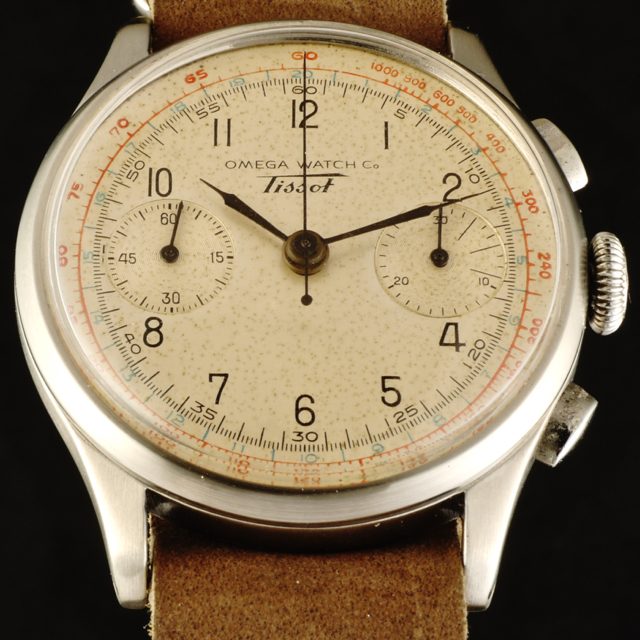
“In “Omega – A Journey through Time” Marco Richon explains that in 1935 an economic collapse in Brazil made it impossible for Omega to maintain sales at Omega’s normal price points. Rather than cut prices just for Brazil, which would have inevitably affected Omega branded watches sold in other markets, the company withdrew Omega marketing and sales from the country and sold watches branded “Omega Watch Co. – Tissot” at the lower price points in Brazil”.

Omega Watch Co. – Tissot

As far as the opposite, i.e., Omega with Tissot movement, my watch, wich I bought in the USA in the 70’s, had a Tissot movement…

My Omega of 25 years with Tissot movement

I discovered it in the year 2000, when the automatic winding ceased to work and I have it repaired by the Omega dealer of my hometown, (Relojoaria Moretti, now extinct) which was owned by the neighbour of my parent’s house, Nezo, as we called him. Nezo candidly told me that my Omega had a Tissot movement, which I didn’t know for almost 25 years…

This false step hasn’t been only a sin of Omega Tissot. As matter of fact Rolex made the same mistake selling Rolexes with Marconi movements and when it was in its infancy did some incursions towards this direction and it is particularly a problem difficult to spot on vintage Rolexex, specially the Rolexes Marconi. It goes the same way for vintage Rolexes Unicorn, ROLCO, Tudor, etc., specialy the Oyster Watch brand, from the Rolex group, but not a real Rolex, despite partially having the same name. Wilsdorf, the father of Rolex, had other incursions under marketting contingencies. It should be mention “Northern Goldsmiths”, “Admiralty” and “Genex”, which were manufactured by Rolex. He discontinued everything by the end of WW II and kept only Tudor, which is alive today in the 21rst century. Believe it or not, my father, when visiting Swtzerland in the 60’s, toured the Rolex Manufacturing facilities and bought a Tudor. As time passed, its case presented a corrosion which does not match to the Rolex standard. I found out now by making this blog site that the Tudor my dad bought was made of Snowite. It’s hard to understand how Rolex used chrome zinc, which Rolex patented as Snowite, to make its watch cases, because it is a very bad material that corrodes easily. The Tudor my father bought when visiting Swtizerland was stolen, but it looked like that one, without the inscription of its Rolex origins, with the same false step of my Omega Tissot:

Tudor sold in Australia with Rolex inscription

I have another interesting story about my “fake” Omega Tissot. When I bought my Omega in the US, back in 1974, a colleague of mine at IBM, with whom I would work for over 20 years together, bought a Rolex. He was of light build and a Rolex Oyster dress watch, which has a smaller dial than the submarine and is also less thick, matched his wrist better. His Rolex Oyster costed about the same I paid for my Omega. 250 US$ dollars, about 7% of a Chevy Nova, which I bought also (which means a price range as of 2020 of some US$3000 dollars and the fact that Rolex stepped up its price and Omega lagged behind). I, although I have a large complexion, I do not feel comfortable with watches the size of Rolex Submariners or even Omega’s Chronograph Seamaster on my wrist. He always joked with me because he said I hadn’t bought a real watch. When my Omega wore out the automatic winding mechanism, I commented to him that he was right, because the Omega had ended up showing signs of wear and wouldn’t last forever, as expected. He laughed, and said candidly: “The same thing happened to my Rolex, I had to send it to fix the winding mechanism because it wore out too…”  

Rolex Oyster 41 mm

Another interesting observation is that the watch store where I bought, more recently, , in 2010, together with Daniel’s wife, his Omega Seamaster Chronograph, is that they ceased to sell Omegas a few years later. I questioned them why and they told me that Omega doubled the prices and demanded them to have at least ten watches stored in their inventory. They simply relinquished to be Omega dealers, perhaps as Omega anticipated. Obviously Brazil was below the level of Omega’s consumers purchasing power once again, what is easy to understand why because the same Omega which is sold here in Brazil you can buy it for une third of the price in the USA and we are talking several times the cost of a plane ticket…

The perception above is confirmed by Nicolas Hayek, who said the following in an interview to Harvard Business Review:

“So why was Omega near oblivion?”

Omega is one of the Swiss watch industry’s great brands. Its history goes back to 1848. You should visit the watchmaking museums and look at the pieces Omega made 50 or 100 years ago. They are wonderful. Few brands had or have Omega’s potential power.
The problems started in the early 1970s. There were bad business practices. The people there became arrogant. They treated their agents and dealers badly. If an agent from, say, New Jersey needed 200 units of a particular model, Omega would say: ‘You’re crazy! Don’t bother us with such nonsense. We’ll give you 50.’
Second, and much worse, Omega became greedy. Rolex sells 600,000 watches per year. That’s about as many as you can sell before a luxury brand begins to lose its prestige. That’s about how many Omega was selling in the late 1970s. But Omega wanted to grow more rapidly. So they took the easy route. They figured, ‘If we can sell 600,000, why not a million? Or 2 million? Or 3 million?’
Which meant, of course, they had to lower the price radically. A jeweler would say, ‘Omega is wonderful, but it is too expensive for my clients. How about giving me an Omega that is cheaper?’ Now, if you are crazy, or I guess if you are greedy, you agree.
That was the kiss of death. Omega was everywhere: high price, medium price, precious metals, cheap gold plating. There were 2,000 different models! No one knew what Omega stood for. By the end of 1980, the company was again in a deep crisis, its deepest ever.”

You can have the whole picture reading the inteview to Harvard Business Review.

On top of that, this may sound also suspicious but, although there is some malice in it, it is perfectly understandable under the system the swiss watchmaking industry works, which was established back in the 17th century by Daniel JeanRichard.

Daniel JeanRichard by Charles Iguel, Le Locle, 1888.


As Estelle Fallet informs us at page 49 of her wonderful book “The story of a watch company” and with some aditional information from David Boettcher, Daniel JeanRichard created the following idea, and I quote:

Daniel JeanRichard, happens to be the first horological entrepreneur, in the modern sense of the term.

  • He created a product, developed from obsolete French models.
  • He fixed a sale price adapted to the possibilities of the market.
  • He used the retail network already set up by the domestic textile industry for their own products.
  • He trained apprentices, the first of whom came from La Neuveville.
  • He encouraged professional ties with mechanics and watchmakers specialising in equipment, tools and various supplies.
  • He sought and purchased products not available locally, such as springs and hairsprings, from as far afield as Geneva.
  • By selling land, he set up a fund so that he could pay his creditors before receiving payment from debtors for the sale of his goods.

Établissage and Établisseurs

What is known is that 1691 at the age of 19, Daniel JeanRichard opened a watch workshop near Le Locle, and proceeded to revolutionize the watch industry. He defied the restrictions of the guild system and employed local farmers, who had little work during the long winters, to manufacture individual components for him, which he would assemble into watches. This system of division of labour was called établissage and the person who sat at the centre of the web and controlled it all was called the établisseur. Businesses of this type were called comptoirs.

JeanRichard taught the farmers to specialise in making certain parts, so that with experience they could produce high quality individual parts very cheaply compared to the guild system, where a few craftsmen made all the parts of a watch. He also increasingly mechanized watchmaking, designing and improving tools and machines so that less skilled workers could still produce high quality parts. This system of increasing specialisation and mechanisation produced high quality watches at low prices.

In other words and I quote David Boettcher: The “haute horology” (high, or top end, manufactures) became a minority of Swiss watch makers after the creation of the mass production watch industry in the Jura region in the seventeenth and eighteenth century, after Daniel Jean-Richard showed farmers in the Jura mountains how to supplement their income by making watch parts during the long winter months when they were snowed in and work in the fields was impossible. After that revolution most Swiss watches were made by a style of manufacturing called établissage. Material was provided to workers operating in their own homes or small workshops, and then the finished components were collected and assembled into complete watches in a workshop or small factory établissement”. The man in charge of the whole process was called the établisseur.

Bottom line: Farmers specialised in a making individual components of a watch, and these would be brought together and assembled into a complete watch by an établisseur. Doing it this way, while it took Daniel JeanRichard nearly six months to make his first watch, but by 1837 it was possible to make a watch in just one day.

It should be noticed that the British have dominated the watch manufacture for most ot the 17th and 18th century but maintained a system of production that was geared towards high quality products for the elite. Daniel JeanRichard simply broke the tradition upside down, producing watches for the masses and framing the path to enable the Swiss replace the British (and any other) to offer high quality products.

The combination of the above facts originated he following:

  • Large watch firms see the light of day
  • First workshops, then factories producing spare parts are set up (assortments, hairsprings, jewels, ébauches, cases, dials, etc.)
  • Training is organised around the new horological colleges opened in Le Locle (1868) and La Chaux-de-Fonds (1865) and around the Technicum (1933)
  • Infrastructure is developed, railways are built innovation and research are encouraged in the area by the Society of Patriotic Emulation (1791), the Neuchâtel
    Astronomical Observatory (1858) and the Laboratory of Horological Research, which opened in Neuchâtel in 1921
  • These developments receive the financial support of the banks
  • Bosses and workers found their respective unions and confront one another, notably during the general strike of 1918, over working conditions

Ébauche

An unfinished movement sold as such. Until circa 1850, an ébauche comprised only the plate, bridges, fusee and barrel. It was known as a blanc and was finished at the établissage.

The modern ébauche is a watch movement, with or without jewels but always without its regulating organ, mainspring, dial and hands. It is also known as a blanc roulant

The reason they interchange the two Ébauches not caring to match the brand in the dial and the brand in the movement and the way they reacted to the brazilian market, in two instances, in the 30’s and in the beginning of the 21rst century, not to mention to the american market in the 70’s based in the Omega I bought there. If you look at Ebay for vintage Omega watches you will find also Omega Tissots in the UK, Israel, Bulgaria and others.

This shows up something Nicolas Hayek perceived keenly as the Swiss biggest problems. 

In the early 80’s, UBS bank, on the verge of the country’s two largest watch manufacturers close to financial collapse, hired him as an external consultant and it is history that he not only hit the nerve of the problem, but fixed it consolidating what today is the biggest watchmaker of the world, Swatch.

Quoting Professor Preston Bottger, author of a case study based on Hayek’s interventions in a Forbes article, it can be summarized as: 

He concluded that Swiss watch companies had become absorbed in the technology of producing watches rather than thinking comprehensively about what made a customer actually want to buy a watch. In short, the manufacturing process had become detached from a clear understanding of the market.

The high price of Swiss watches had been based on a promise of exceptional accuracy and reliability. It was assumed that accuracy required complex, finely tuned engineering that justified high pricing, but Hayek realized that the quartz watch had erased that advantage. He decided that the customer had to be sold on the idea of wearing a watch as a personal statement. If an astronaut wore an Omega watch, a consumer could identify with the adventure of walking on the moon by wearing the same watch. For Swiss watches, the message counted more than functionality.

He drafted an analysis that was eventually accepted, and then he was asked to manage the newly formed consolidated company that was to become the Swatch Group. It would control 18 leading brands, as follows:

  • Balmain
  • Blancpain
  • Breguet
  • Calvin Klein
  • Certina
  • Flik Flak
  • Glashütte Original
  • Hamilton
  • Harry Winston
  • Jaquet Droz
  • Léon Hatot
  • Longines
  • Mido
  • Omega
  • Rado
  • Swatch
  • Tissot
  • Union Glashütte/SA.

He went on helping to create the Mercedes Benz Smart Car and eventually became the biggest stockholder of the Swatch Group which is actually controlled by his family.

Tissot style and positioning

The official explanation as it is exposed in the 150th anniversary can be read at page 144 of the book “The story of a watch company”:

Pierre extracts from his presentation case an elegant wristwatch whose dial features a kind of double brand “Tissot-Omega Watch Co”. For a fleeting moment I am nonplussed.
Undeterred, I grab my notebook. I remember having sketched out a precise genealogy”.
In 1930, Tissot and Omega’s respective Boards of Trustees signed an agreement recognising their common interest in both the commercial and industrial fields. The origins of the agreement went back to 1925. The official act of 1930 marked
the inception of the SSIH, or Société Suisse pour l’Industrie Horlogère (Swiss Society for the Horology Industry). The company’s headquarters were located in Geneva. From that
moment, it seemed clear that production would be organised on the basis of the SSIH agreement, that, effectively, Tissot and Omega would share a common production plan.
Henceforth, Tissot was to produce certain calibres under the Omega brand and vice-versa. And conjointly. “It is also through this arrangement that some Tissot calibres
were made by Lemania,” the former President points out.
“In effect,” I remember what Mr. Jean-Charles told me a few days ago in the Place du Marché: “This is what Paul Tissot said. I was still a young man at the time! ‘In Bienne, we have just taken the decision to design and produce a new automatic calibre at Le Locle for the SSIH (Omega + Tissot + Lemania, you remember?), Twin brand: Omega Watch Co Tissot, circa 1935.
Mr. Henchoz will direct and advise you in this task. So, what do you think?’
That’s why I spent another year in Le Locle, to work on the development of the 28.5 calibre with a rotor with an axial support piece. In fact, you can see one of the pototypes at the Museum at the Château des Monts.”
I examine the automatic movement, amusing myself with the oscillating mass for a while… Perhaps I’ve never entirely grown up!
“You have in your hands one of Tissot’s pioneering works.”
How, why?
After having designed and produced watches with antimagnetic movements and then distributed them all over the world starting in 1933, Tissot was able to dominate the
automatic watch market for a substantial period of time.
There was a profusion of watches of this kind in the decade between 1945 and 1955 and you can still find them in the catalogue.

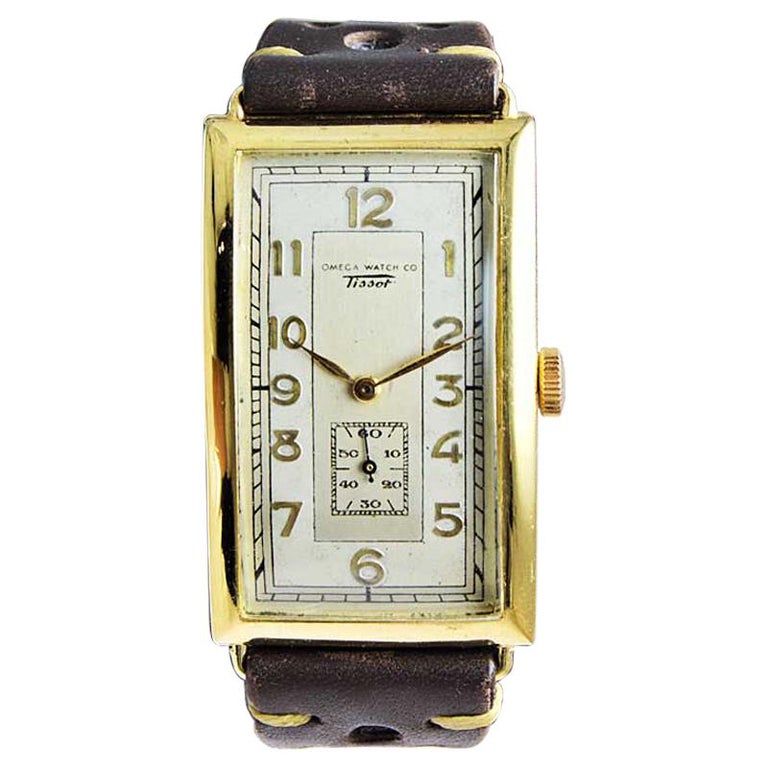
1935 Omega-Tissot Monopulsante Porcelain dial cal. 33.3
Omega / Tissot Art Deco Yellow Gold Filled Rare Watch with Original Dial,  1930s For Sale at 1stDibs
1940 Omega-Tissot Chronograph tachymeter and telemeter dial cal. 33.3

The name of the game is Style which is analysed separately

Last but not least

This blog site was done with Omega in mind, with an emphasis on the perfect machine it is, perhaps admittedly, the best you can have as a mechanical watch. The context, however, is very broad and deserves some considerations in other emphasis when it comes to watches.

I came accross with extremely interesting information which should be kept for eventually be examined.

Stephen Bogoff

Prestige and Luxury

Prestige and Luxury (Spanish)

Chuck Maddox

David Boettcher

William Ehrhardt

Nicolas Hayek

Tag Heuer

Watch

Groups of Watch Makers in Swtzerland

When a Rolex is better than an Omega

Take a look first what the general public has in mind about Omega and Rolex

Although Omega is definitely the best watch as a timekeeping device, as it can be seen if you read my posts and the stories behind the moon watch, it lags in something that Rolex does to perfection: Rolex Wannabe. I have selected a couple of youtube discussions where that shows up in more detail, you can see it down bellow, but first take a look at this testimony. Wannabe does not only reflects other watches compared to Rolex, it reflex Rolex owners compared to the statement their owners wannabe by wearing them.

If you replace Invicta with Omega, which might not be the case, it is perfect to figure out the contention we are talking about:

Do watch enthusiasts find Invicta Watches tacky and too Rolex wannabe?

Alex Denka
Former Instructor/Assistant Manager/Bartender at Studio Cellar (2014–2016)

My answer is long, as I feel that to understand my opinion, you’ll also need an understanding of where it stems from & how my own experiences influence my perspective. A watch enthusiast for most of my life, I had my first high end watch at 12, was ‘collecting’ (mostly quartz movement fashion watches) by 15, & by 18 had my one & only Rolex. My early tastes ran with the likes of Fendi, Gucci & other fashion brands sold at high end department stores who utilized quartz movements by respected watch makers to justify luxury watch prices…I didn’t know any better & the 80’s WERE all about conspicuous consumption.. There would’ve been the occasional mechanical classic piece by a Swiss maker thrown in that I rarely wore, knew little about & most likely gave away somewhere along the way, thinking it to be trash. I had my year where I thought Rolex was the holy grail of timepieces…and then I owned one. My experience owning a Breitling was the same…the one I owned was just louder (both literally and figuratively) than the Rolex.

My adult life has seen my financial situation much changed (for the worse) from the days of my youth & folly, & my tastes have adapted with that budget into the Tissot, TAG, Baume et Mercier, vintage Bulova & Oris realm.

So to answer your question, I find Rolex tacky & “too Rolex wannabe” & Invicta has just gone over the top with the same formula by using the same business model to capitalize on the ignorance of the masses the same way Rolex has, just as successfully separating the fool from his money as the “iconic” watchmaker that uses assembly line parts to make a mediocre product they get $10,000 for all day long has done for years.

I’ve long been on the fringe of watch enthusiasts, & this may just push me out of the club for good. But I have found TAG to not only look better on me & fit me better than my Rolex, but it keeps much more accurate time, has needed far less servicing & is more reliable…all at less than a third the price of my Rolex. My vintage (1973) Tissot Seastar Visodate has been serviced once in over 10 years, keeps amazingly accurate time, looks great with everything & has been a conversation piece since the first day I wore it, & has been my go-to watch for a few years now. My Oris is understated, reliable, durable & subtle, & my 1973 Bulova Railroad Approved watch is easy to read, has a unique & bold look, keeps just as good of time as any Rolex & is worth more now than when I bought it. In fact, my entire current collection of these 4 i just mentioned plus another 15 pieces, (all unique & from tolerable to respectable watchmakers from Bulova & Hamilton to Longines & Tourneau) would cost less to replace than one Rolex. And in my humble opinion, every single one looks better & has a better story behind it.

2.9K views

Rolex Wannabe

Alex Denka hit the mark when he stated that he does not feel confortable with Rolex, because Rolex is “too Rolex wannabe”. What is this thing of “Rolex Wannabe”?

For the lack of an adequate adjective, let’s figure out what could be the “Rolex Wannabe” syndrome, which is not limited to Rolex, but as Rolex is the most recognized watch brand, it summarizes the group to which it belongs. As you can read at the article of the NY times “Omegamania”, and I quote:

“Traditionally, collectors have focused on brands like Rolex, Patek Philippe, Vacheron Constantin and Breguet, because they offer great complications, beautiful designs and have limited editions that make them rarer,” said Osvaldo Patrizzi, the chairman and chief executive of Antiquorum. “What we’re hoping to show with this sale is that Omega has the same breadth of quality and history.”

The outstanding apparent features are:

Rolex, which is the gold standard to be compared with, has practically no complications, the design does not change and its beauty is arguable, because the outstanding feature of its unchangeable design is sturdiness associated with diving. How come then it achieved that position?

To my understanding it is basically due to two things:

If you hit Style above it will take you to a youtube presentation where Kevin O’Leary and Teddy Baldassarre give what seems to me the Rolex Wannabe style. You’ve to read the information about them to properly understand their Style, which I am not saying is the style of all Rolexes owners, but probably most of them.

Kevin, who is born in 1954, at the opening ot the interview, when discussing his “Collection” informs us that when he was 7 he went to Geneve and his father (actually his step father) got him as a gift an Omega Speedmaster Moonwatch. There are two implications here: First, although the Speedmaster existed since 1948, it would become moonwatch after the Apollo mission, which happened in 1969 and when he was 7, it was 1961. Second, there is an obvious metaphor here, he has “grown up” from a moonwatch to Rolexes…

He shows a Cartier Tank (designed under Santos Dumont specifications) and does not call it by its name. Cartier Tank is either used by man and women (and he relates to his wife only) and it is the most endurable design which exists and beats Rolexes hands down in value terms and Rolex wannabe style. Wearing a Rolex is something, wearing a Cartier Tank is something else… Obviously Cartier also has High quality materials but it has more genuine historical significance, and is by far the gold standard in, as “influencer” endorsements from some of the world’s most iconic fashionistas have led to a perfect storm of brand clout.

I stop here, although there are plenty of other considerations such as the above, but it leaves me cold, it is not my style and I will throw it under  “If you did understand, it is not necessary to explain, if you didn’t understand, it’s no use explaining.”

I rest my case.

After thoughts and conclusion

Watches, etc

Repositório em Inglês para postagem em Português

A watch is not a watch

This phrase is intentionally contradictory, or paradoxical, and to be understood we can use two very widespread concepts, art, based on Magritte, and communication, using Marshall McLuhan’s concepts.

McLuhan explores the media as active environments rather than passive systems in their role.
For McLuhan, “‘figure’ refers to something that jumps on us, something that catches our attention, [while] ‘(back) ground’ refers to something that supports or contextualizes a situation and is usually an area of inattention.”

Nothing is what it seems like

What is at stake here is the rational point of view of things, which assumes science as a source of reference compared to the point of view loaded with subjectivity plus values, which characterizes human nature. As there is a tendency to privilege science, let us examine this context in light of one of the most famous critics of rationalism:

Giambattista Vico proposed that the human imagination, not the circumstances of the environment or the innovations of technology, shaped human culture, thought, and its institutions. In short, he did not accept that only the Cartesian notion that René Descartes introduced with his method should be valid, advocating that everything should be examined from a rational objectivity, which gave birth to Science, or to positivism,  versus the previous dominant pattern of thinking which is subjectivity, which was and is the characteristic of non-scientific thought.

In other words, objectivity is based on the scientific precision of examination of reality in which we are inserted, and subjectivity centers its concern on the question of value and meaning within the context of what is being examined.

From the introduction of positivism or scientific thinking, there is a tendency to subordinate Human Sciences to the Physical Sciences, which are defined based on a “knowledge of causes”. Under this it is argued that we have access to objects or phenomena that are not self-aware and are the same to any observer, and can therefore be subjected to experimentation and manipulation.

In contrast, “subjective” human thinking becomes a “black box” for science and either today or in Vico’s time is seem subject to whims and illusion, not obeying fixed rules or laws, except perhaps those that are beyond or hidden from consciousness as it is the case with Freud’s psychoanalysis.

What are these scientific and technological circumstances and aspects for watches, clocks and time keeping devics and how does human imagination perceive them? It’s not the technology itself that regulates this, but what we ask it to do for us that makes all the difference that it’s human choices.

Artifacts for measuring time are amongst the most Cartesian things and most used for what science does, even when they are built with the intention of drawing an horoscope, as they have to reflect astronomy, however, they are also among the things with the greatest load of concern about the value and meaning in everything that human beings have created, which is reflected in our culture and in our thinking.

Let’s take a look at both cases for watches, i.e., under scientific objective scrutiny and subjectively from the perceived value.

Watches under the scientific point of view

Clocks, and watches, are instruments that measure and show the time. The way they are today in this 21rst century, is rather recent, and its format, although starting from the 14th century, is from the last 200 years, effect of the improvement in the technology of making them.

Although the day has 24 hours, the 12-hour display prevailed in most cases and even in situations where clocks with 24-hour display are used, there is always one with a 12-hour display nearby, because the human psyche has absorbed it in such a way that we can’t see it any other way. It is interesting that the 60 base time system, that is a 60-minute and 60-second increment clock, dates back to 2,000 B.C. The English   word “clock” replaced the Old English word daegmael meaning “day measure.” The word “clock” comes from the French word cloche meaning bell,   which are naturally expected in large public clocks such as Churches or in special buildings such as the Big Ben in London but in wrist watches are what is known as complications.

You can see a detailed explation of all that in the site blog The Timekeeping: The Evolution Of Clocks and Watches.

A day does not have 24 hours

The 2000 years old idea of the 60 x 24 hours division to count time is a human invention to cope with the fact that to define how long is a day we have two possibilities:

  • A complete spin of the Earth on its axis — a stellar day — then a day is about 4 minutes less than 24 hours.
  • The time between true noon one day and true noon the next day — a solar day — then the length of a day varies throughout the year, ranging from 21 seconds less than 24 hours to 30 seconds more than 24 hours.

If we take the average length of all the solar days in a year, then the result is exactly 24 hours, which is how we arrived at our standard day. However, there are only 4 times each year when the standard day and the true solar day have the same length.

The upshot is that the standard 24-hour day is not something found in nature, but a human invention that only roughly corresponds to the real days — solar days or stellar days — that we actually experience on Earth.

Variations in a Solar Day and Time Zones

The length of a true solar day in late December is about 24 hours plus 30 seconds. The length of a true solar day in mid-September is about 24 hours minus 21 seconds. Thus the length of a solar day varies by nearly a minute during the year.

If you add to that variations the fact that the idea of using the sun also creates a specific time for a specific place, which is known as Local Mean Time, you have the picture what has to be taken into consideration to anwer the question: what time is it?

To overcome all that and make it practical, Sir Sanford Fleming invented standard time in 1878. Standard time is the synchronization of clocks within a geographical area to a single time standard. It developed out of a need to aid weather forecasting and train travel. In the 20th century, the geographical areas were evenly spaced into time zones.

The answer to the question: What time is it? is a human invention.

Why astronauts need a Chronograph wrist watch

The nature of Time keeping reflecting astronomical positioning, specially that of the Earth in relation to the sun, ended up with the 60′ based 24 hours/365 days system which is the reference to time keeping related needs, be it scientific or whatever.

Let’s see, then, what led NASA to have need of a Chronograph and how it came up to be the Omega Seamaster:

To set up routines

Because it takes 90 minutes to go around the earth, there are 16 sunrises and 16 sunsets every 24 hours. … So even though we have sunrises and sunsets in space, you don’t want to set your watch or go to bed by them! Sleeping is a big issue for astronauts and they are monitored on that and the wrist watch plays a part on it.

To kep tracking

Astronauts have to pay attention to more than one watch or a time keeping device because they are required to keep track of multiple time zones. First, some astronauts might measure Mission Elapsed Time (MET), which actually is the time on board. Second, at the International Space Station, they will use the standard of Greenwich Mean Time (GMT). Third, there is also the time at Mission Control Center location time, which mostly has been in Houston Texas.  

As a sensor for monitoring

The black watches in this picture are part of an experiment called SLEEP. The experiment requires the astronaut wear a special watch, capable of “seeing” light/dark and sensing movement/no movement. Over time, astronauts upload the data from the watch to the ground investigators, using a laptop computer. These onboard/zero-gravity data are compared with data gathered on Earth pre- and post-flight. The scientists can then tell how well/long an astronaut slept during the nights throughout their time in orbit. (I averaged about 7 hrs, 20 minutes over 152 days). This data will lead to possible ways to increase/enhance an astronaut’s ability to get meaningful/restful sleep while in space.

Practical examples: The best storyThe 14 seconds that showed why you need reliable mechanical watches in space

The most gripping tale about the Speedmaster is probably how it helped to save the lives of the astronauts on the Apollo 13 mission, after an oxygen tank in its service module exploded, two days into the mission. “The astronauts had to do an exact 14-second burn of fuel,” says Ragan, in order to execute a manoeuvre that would let them manually guide the lunar module back to earth. With power shut down to conserve energy and the onboard clock not working, they timed the 14-second burn using an Omega chronograph. “It’s amazing to me. Had we not had it up there, they might not have got back.”

There are lots of accounts of this story, but this one fits it perfectly in more detail

Why they were not automatic neither quartz and resemble stopwatches?

First, chronograph style watches were used by American astronauts primarily because the space program in the United States initially had all astronauts recruited from the population of military test pilots. Chronograph watches, at the time, were the only style of wristwatch that could accurately gauge length of time with a stopwatch-like functionality. This is very important for test pilots, because it allowed them to gauge fuel consumption, and if necessary, to navigate using their chronograph watch, their heading, and airspeed. As a result, American astronauts were almost sure to bring chronograph watches with them when they went into space. Well before its official qualification, Wally Schirra, an astronaut who flew in the Mercury, Gemini and Apollo missions, took his personal Omega Speedmaster CK2998 on Mercury 8.

Second, the Omega Speedmaster, the famous “Moonwatch,” is mechanical because the technology for accurate quartz wristwatches did not exist in the early 1960s. The advent of advanced solid state electronics allowed Seiko to introduce the first quartz wristwatch, the Astron 35SQ, in December 1969 – five months after the Apollo 11 landing. Mechanical wristwatches need a high degree of craftsmanship to achieve reasonable accuracy, and so a solidly practical wristwatch of the era is and was an expensive timepiece. In addition, the timepiece needed to be functional under a punishing set of conditions, including at high and low temperatures, under rapidly cycling temperatures, under high levels of vibration, and in a vacuum. Very few wristwatches can meet those standards. In fact, the Omega Speedmaster was only one of three watches submitted to be approved for use in the space program, the others being from Longines and Rolex. The others failed. In the end it was only the Omega that was worn in the first American spacewalk in Gemini 4, and on the moon in Apollo 11.

The first Omega Speedmaster to the space and it’s fate

Edward H.White, II first Onega Seamaster in space

The story of How Omega got to that

How and why NASA selected Omega Seamaster

It should be pointed out that Omega has a tradition as a military equipment

You can read about how it was at Omega military watches during World War II

Back to the Moon:

From: The Watches That Went to the Moon

“It was so nebulous that people couldn’t tell what we were going to do with them,” he says. Ten companies were approached, but after reading NASA’s specifications, only four submitted watches for evaluation; three were selected.

Then began months of testing: vacuum, humidity, vibration, shock. In addition, Ragan gave samples of the three designs to the astronauts, asking which they preferred. After months of testing, only one met all of the requirements: the Omega Speedmaster chronograph. Ragan crossed his fingers, hoping it was the astronauts’ choice too. It was.

From: How the Speedmaster became the Moonwatch

October 24th 1964. That was only a month since the internal memo by Deke Slayton. Remember that it was an era without e-mail, so going back and forth with letters was already consuming quite a bit of time. To be sure, Ragan sent out his request for proposal to 10 different watch brands. Only four brands responded to NASA’s request, which were: RolexLongines-WittnauerHamilton and Omega. Ragan still had to chuckle when he told this, but Hamilton sent a pocket watch instead of the chronograph wristwatch he asked for. Unbelievable.

The famous Valjoux 72 caliber movement powered both the Rolex and the Longines-Wittnauer. Omega’s Speedmaster, as you know, was powered by the caliber 321 movement. Omega’s enhanced version of the Lemania C27 CHRO 12 movement. For a long time, it wasn’t known which exact Rolex and Longines-Wittnauer were tested, but these records have been made public during one of our Speedy Tuesday events earlier this year. Longines-Wittnauer submitted their reference 235T, and Rolex sent their reference 6238 chronograph.

The 105.003 had a new design regarding the hands, which were now white baton ones instead of the Alpha hands. The white baton hands were more legible.
This reference is the model that was tried and tested by NASA and got eventually qualified. Or ‘Flight Qualified for all Manned Space Missions’, as you see engraved in the case backs on later references.

11 Types of Tests

NASA designed a couple of tests for these watches, that weren’t meant to keep the watches in one part. These tests were designed to test the watches to destruction. In a relatively short period (of months), the following tests were performed on the watches:

  1. High temperature: 48 hours at a temperature of 160°F (71°C) followed by 30 minutes at 200°F (93°C). This under a pressure of 5.5 psia (0.35 atm) and relative humidity not exceeding 15%.
  2. Low temperature: Four hours at a temperature of 0°F (-18°C).T
  3. Temperature-Pressure: Chamber pressure maximum of 1.47 x 10⁻⁵ psia (10-6 atm) with temperature raised to 160°F (71°C). The temperature shall then be lowered to 0°F (-18°C) in 45 minutes and raised again to 160°F in 45 minutes. Fifteen more such cycles shall be completed. 
  4. Relative humidity:A total time of 240 hours at temperatures varying between 68°F and 160°F (20°C and 71°C) in a relative humidity of at least 95%. The steam used must have a pH value between 6.5 and 7.5.
  5. Oxygen atmosphere: The test item shall be placed in an atmosphere of 100% oxygen at a pressure of 5.5 psia (0.35 atm) for 48 hours. Performance outside of specification, tolerance, visible burning, creation of toxic gases, obnoxious odours, or deterioration of seals or lubricants shall constitute failure to pass this test. The ambient temperature shall be maintained at 160°F (71°C).
  6. Shock: Six shocks of 40 Gs, each 11 milliseconds in duration, in six different directions.
  7. Acceleration:The equipment shall be accelerated linearly from 1 G to 7.25 Gs within 333 seconds, along an axis parallel to the longitudinal spacecraft axis.
  8. Decompression: Ninety minutes in a vacuum of 1.47 x 10⁻⁵ (10-6 atm) at a temperature of 160°F (71°C) and 30 minutes at 200°F (93°C).
  9. High pressure: The equipment to be subjected to a pressure of 23.5 psia (1.6 atm) for a minimum period of one hour.
  10. Vibration: Three cycles of 30 minutes (lateral, horizontal, vertical), the frequency of varying from 5 to 2,000 cps and back to 5 cps in 15 minutes. Average acceleration per impulse must be at least 8.8 Gs.
  11. Acoustic noise: 130 db over a frequency range of 40 to 10,000 Hz, duration 30 minutes.

Results

On March 1st 1965, the tests were completed. On June 1st 1965, the Omega Speedmaster 105.003 received the official qualification (not certification! A common misunderstanding, but NASA does not certify watches) for use during manned space missions. The other two brands failed (and stopped working during the test). The information that Petros Protopapas (Omega’s Head of Brand Heritage) showed during a Speedmaster event in Tokyo indicates that the Rolex 6238 failed the humidity test by completely stopping the movement and again it failed during the high-temperature test. The Longines-Wittnauer 235T failed the high-temperature test as well, as the crystal warped and disengaged.

A legend was created!

The Moonwatch

So, the 105.003 is the Moonwatch? We are not entirely there yet. You should know that the Speedmaster 105.003 was in production for a long time, from 1964 till 1969. Meanwhile, Omega also introduced newer references, 105.012 and 145.012. NASA ordered their Speedmasters in four different batches, the last one in September 1968. The reason for this is that Omega introduced the newer caliber 861 movement for their Speedmaster chronographs. This would mean the rigorous tests needed to be performed all over again (which they did in 1978 for the Space Shuttle program).

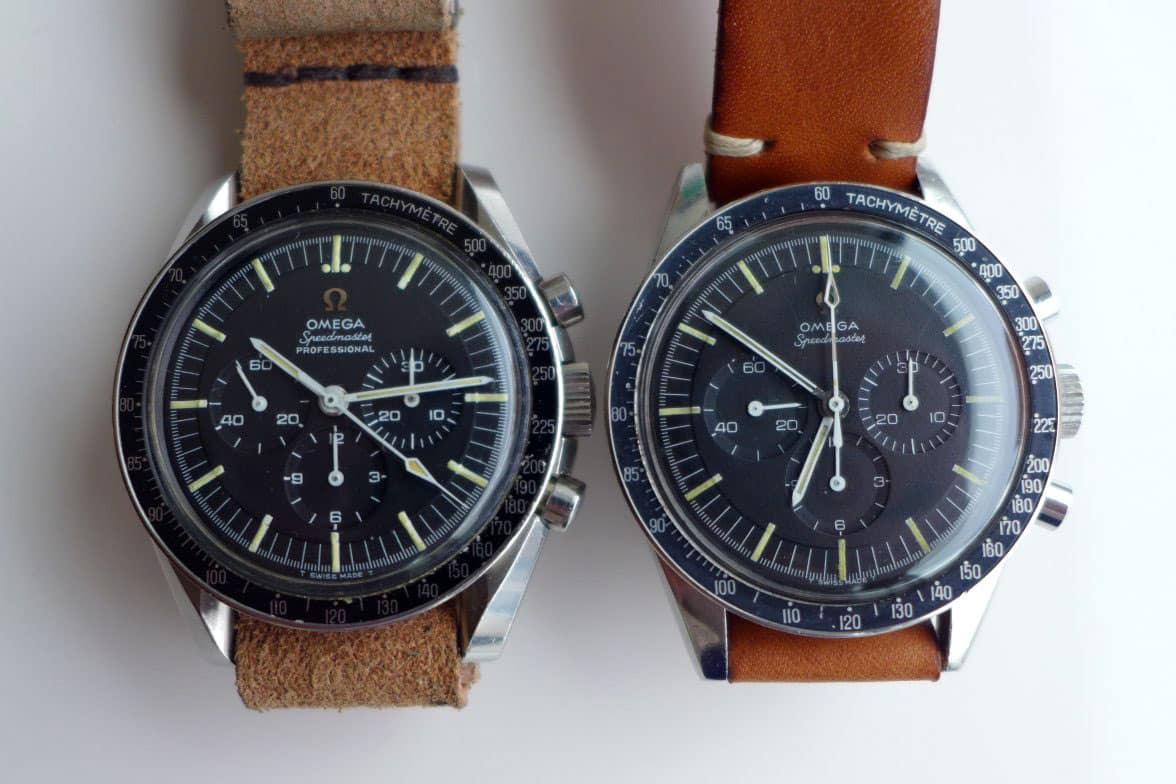
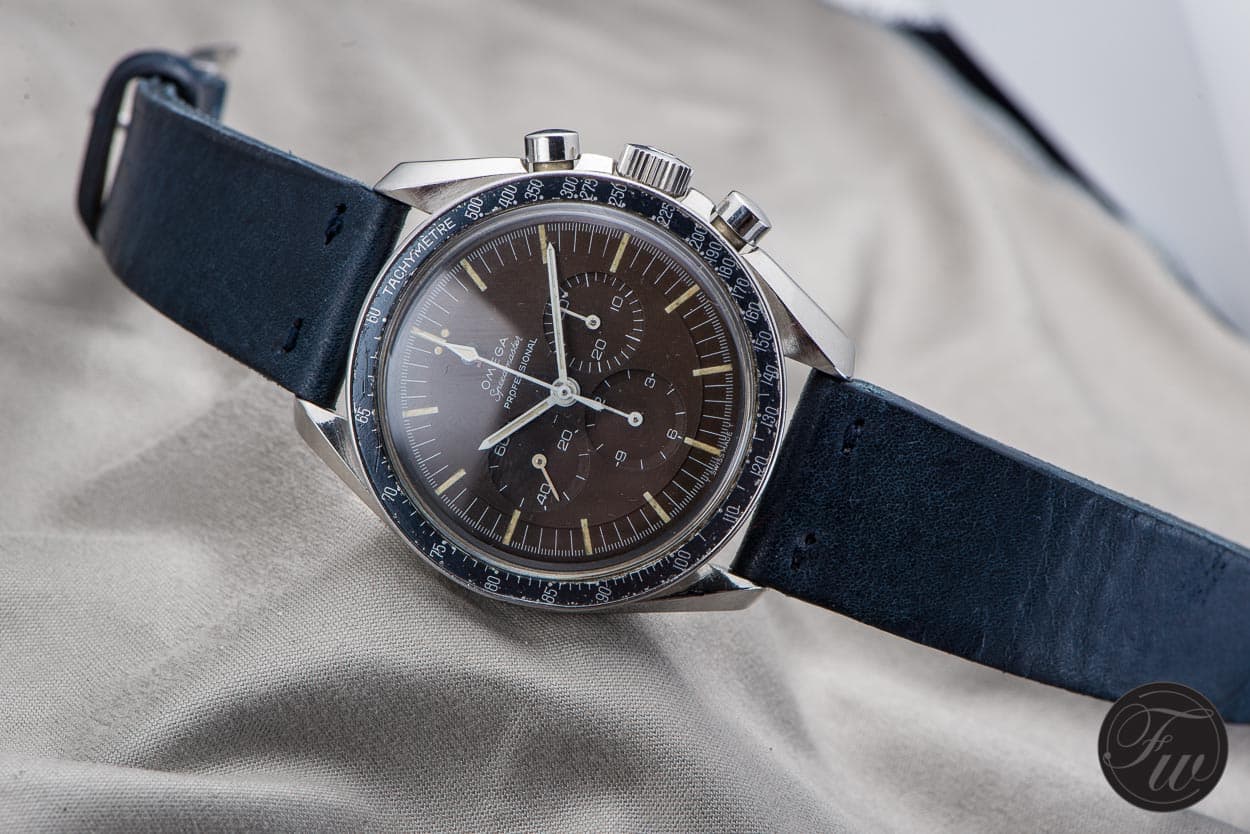
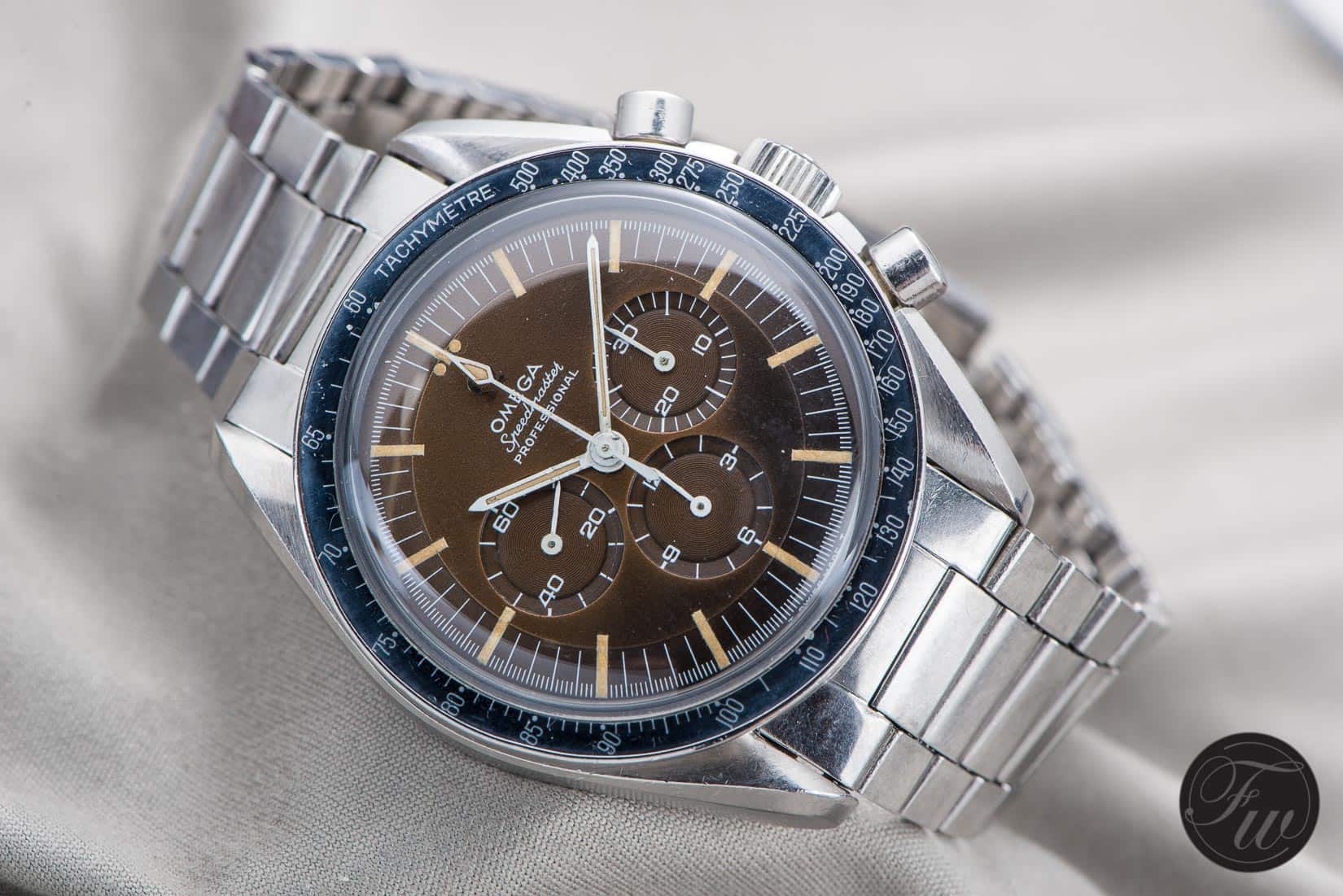
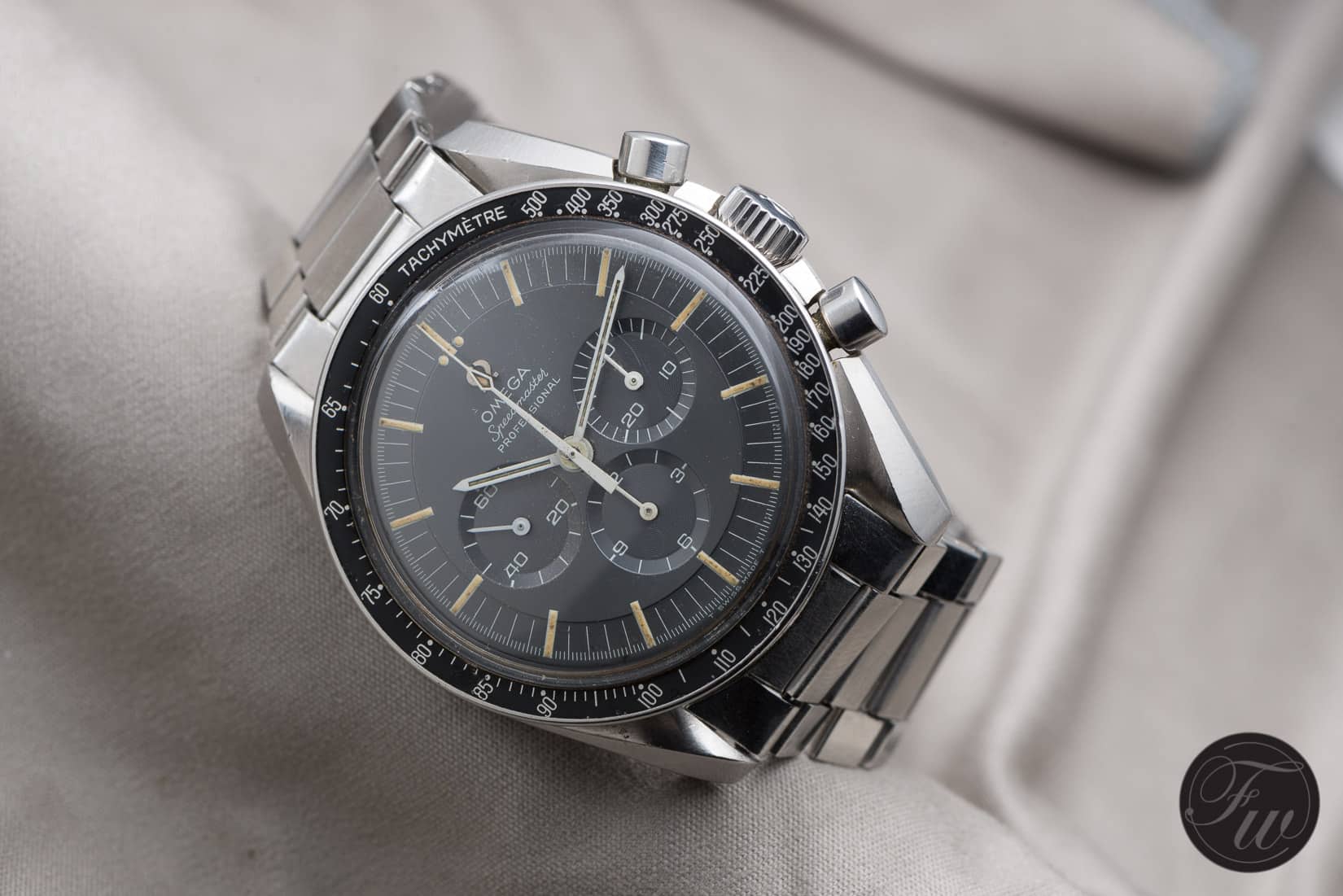
The 105.012 and 145.012 had lyre lugs and crown guards as opposed to the straight-lugs Speedmaster 105.003. Also, the 105.012 and 145.012 had ‘Professional’ written on the dial. It is a common misunderstanding that ‘Professional’ was printed after the qualification on March 1st 1965. This is not the case. Already in 1964 Omega introduced the 105.012 with the ‘Professional’ word written on the dial.

Left: 105.012-66, Right: 105.003 (Photo credits: Rob from Denmark)

Speedmaster 105.012

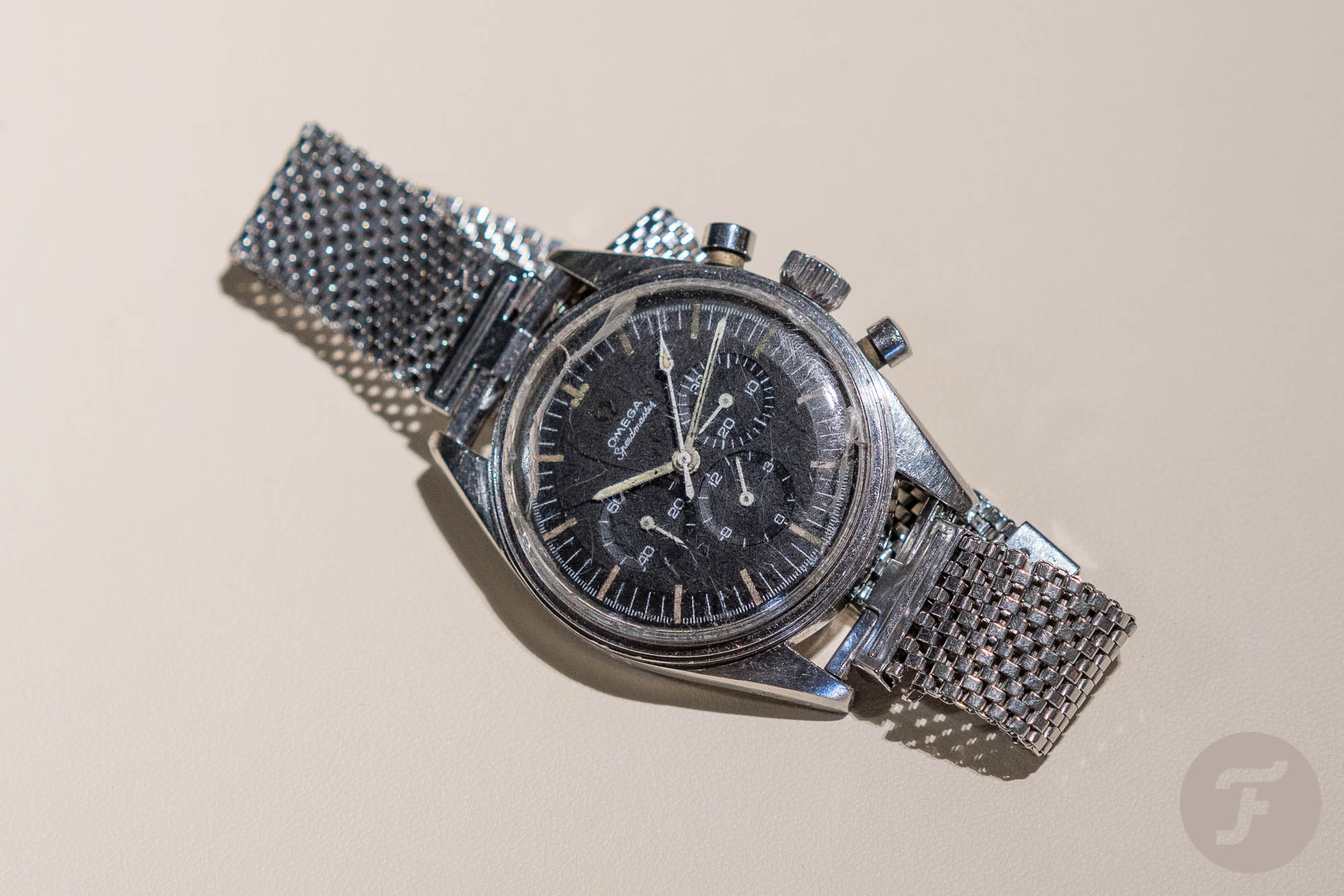
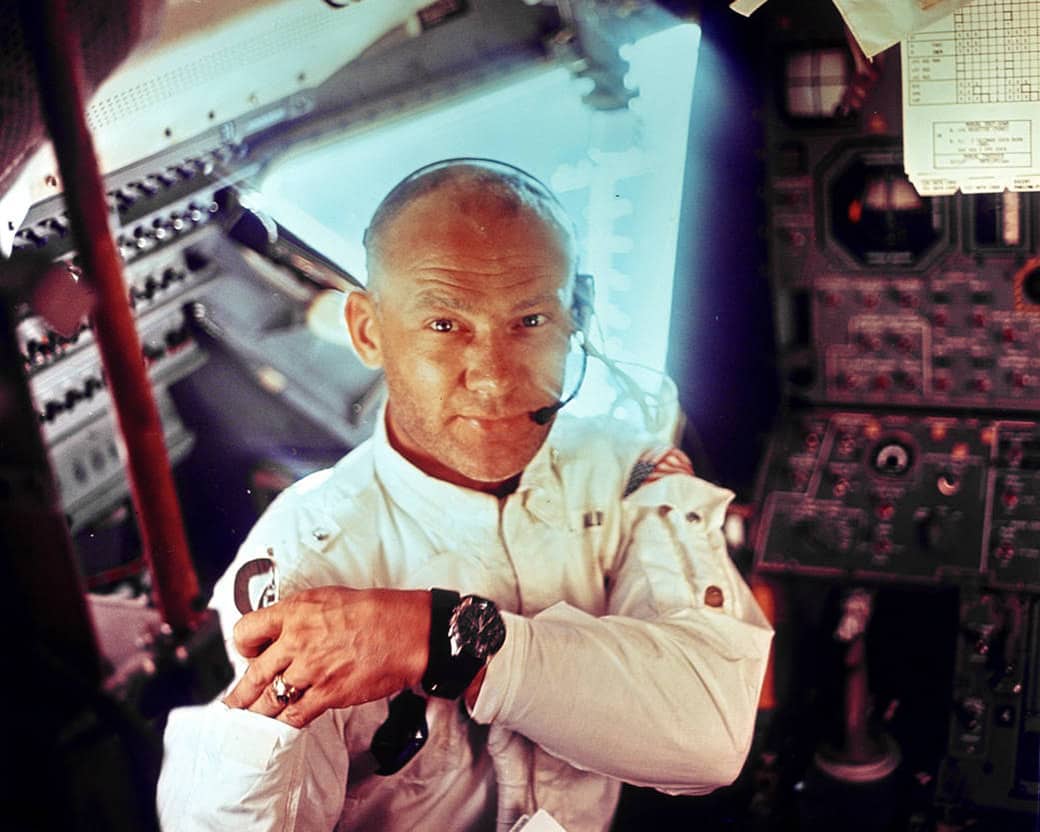
For a long time, it was a mystery which references were exactly used during the Apollo 11 mission. Or whether a caliber 861 Speedmaster ever was on the moon.  In the meantime, a lot has changed, and Omega did great work together with NASA. For a few years, it is known that Edwin “Buzz” Aldrin wore a Speedmaster reference 105.012 – the first Speedmaster on the surface of the moon.

105.012-64

Legend has it that Neil Armstrong left his Speedmaster (also a 105.012) on board of the lunar module as the (Bulova) board clock malfunctioned. Aldrin’s watch later disappeared (in 1970), when it was sent off to the Smithsonian museum.

astronaut Edwin E. “Buzz” Aldrin, Jr. during the lunar landing mission. The picture was taken by astronaut Neil A. Armstrong

Speedmaster 145.012

Michael Collins, who remained in the Command Module of the Apollo 11, was wearing a Speedmaster reference 145.012. So it did not make a trip to the surface of the Moon that first time. During the third mission where astronauts set foot on the Moon, Apollo 14 astronaut Alan Shepard was wearing the Omega Speedmaster 145.012. The 145.012 was in production from 1967 to 1969 and had a new design for its pushers. The pushers of the 145.012 were screwed into the case and had slightly larger caps. It is the last reference to have the column-wheel chronograph caliber 321 movement.

Speedmaster 145.012

Now, you would probably like to know the exact case numbers from the Speedmaster watches of Aldrin, Armstrong and Collins. From Aldrin, it is believed to be the Speedmaster 105.012-65. Armstrong’s watch was definitely a 105.012-65, and Collins was wearing the 145.012-68 (yes, a -68!!).

An Omega Speedmaster Professional 145.012-68, similar to what Michael Collins wore

The Third Moonwatch Reference

Very important: as mentioned earlier, the Speedmaster 105.003 was also issued to Apollo astronauts, as NASA had it in stock from the original procurement. On some of the six missions that had successful landings on the Moon, the 105.003 was also used by the astronauts. Below, the 105.003 as worn by Gene Cernan during his Apollo 17 mission in 1972: the Last Man on the Moon.

Moonwatch 50th Anniversary

Omega is known to celebrate things and often very properly! This year, Omega celebrates the 50th anniversary of their Moonwatch on several locations all over the globe. Our local event in Amsterdam was held on July 2nd, and we did a report here. But, what better way to celebrate the Moonwatch with two exceptional watches. A re-edition of the Speedmaster Professional Apollo XI 1969 BA145.022 and a new Speedmaster Professional in stainless steel and touches of (Moonshine) gold, based on the 105.012 case. We described both watches in detail on Fratello, click here for the Moonshine gold Speedmaster Professional (1014 pieces) and here for the stainless steel Apollo XI 50th anniversary edition (6969 pieces).

Of course, if you want something close to the Moonwatch, you need to go vintage. It is ranging from the 105.003 till the 105.12 and 145.012 references. These watches, in good condition, are becoming more challenging to find and make sure that you will do your homework. If you want a modern watch, that is close to the Moonwatch; you might want to read this article here.

Stick around this week, as we will have something very cool coming up this weekend for the Moon landing anniversary.

Also make sure to visit the official Omega website for more Moonwatch stories.

“Who said a watch is for keeping time?”

Veja em Português

Choosing a watch is a rather difficult task.

Perhaps arrogantly, my first inclination is to group this endeavour among the things which goes well with the sentence: “If you did understand, it is not necessary to explain, if you didn’t understand, it’s no use explaining.”

On second thoughts, examining my case and my family, let’s try to find out why watches are not only meant to tell the time and why they are difficult to choose.

Paulo, my middle son, likes bulky heavy watches such as these:

Pedro, my youngster son, simply does not like to wear wrist watches… I gave to him as a token to have completed his MBA a Tissot dress Wristwatch, one of the thinnest I’ve ever seen.

Daniel, my oldest son, has a special attraction for watches, maybe more than me and my father. I also gave to him, together with his wife, also as a token to have completed his MBA, an Omega Seamaster, which unfortunately was stolen together with my Omega and a few others from his starting collection. Daniel gave me a Tissot in 2015 which I would give to my oldest grandson, Tiago, in 2021 on occasion to his admission to the Engineering Course at Rensselaer. The Tissot choice has an interesting history behind it.  

My father liked watches, but his watch that I remember was called Cauny and had written below its dial: “La chaux de Fonds” , which I came to discover many years later is the name of a city that is to watches what Detroit was to automobiles.

Other watches stuck also in the back of my mind, perhaps because of seeing them at watch shops and I mention, MidoMovadoTissot and, most of all, Omega. Maybe it’s because I saw it in the window of a watch shop of a neighbor of my parents and he was one of the Omega dealers of my home town. He was also an Omega expert and repaired my Omega when it wore out it’s automatic mechanism. All these brands today are under the Swatch group umbrella.

My first watch was given to me by my uncle (Wol)Ney, brother to my father, an Eska,, which seemed marvelous to me, although my high school classmates, who used other brands, pretended their watches were better. Their watches stuck in my memory, Omodox, Lanco, which, I didn’t know why, seemed better to me. Maybe it was because their users seemed rich to me. 

I would discover much later in life that one of the most important characteristic of wrist watches is to make a statement about its owner, being synonymous to where socially he stands, or pretend to be considered belonging… I discovered, to my surprise, doing this job, along with knowing that Omega is better than Rolex, that my Eska was probably better than my gym buddies watches and Cauny was not that bad…

Before joining IBM, I worked as a Chrono Analyst, which required accurate timing of the operations involved. Typical tasks were the the investigation of the manufacturing cycle time split into all and each of the tooling involved, defining the optimum required production time, calculations of the quantity of required parts, production preparation and launching, cycle scheduling, i.e., make the best use of the assets required and necessary material flow, specially under time keeping.

Before IBM at all the companies I worked for, Swift Armour, Gessy Lever, Clark Equipment and Bosch I was a chrono analyst specialized in Time and Methods and the Chronometers to perform the job were provided by these Companies. I vaguely remember these chronometers, or stop watches as being Tissot’s, Omegas and IWC

Mechanical Stop Watch

How Omega entered my life

Omega for life

When I joined IBM I changed area, to Product engineering, where the stop watch was no longer needed and production efficiency no longer resided in the minute detail of the production process. However, time had to be controlled acurately, because of trips, meetings, etc., including to other countries, and those appointments demanded punctuality. So, the very first thing I did when I for the very first time went to the USA, I bought an Omega wrist watch, which in Brazil would be beyond my means:

My Omega for 25 years: Automatic, stainless steel, with date and leather strap.

Much later in life those trips included Switzerland, where I had to go to perform duties related to Quality Certification and Qualification issued by the Brazilian Government and had a chance to see in loco how the Swiss watch industry exposed what they did and how their products were ranked, simply by the way they were displayed in the windows of its stores.

Why my preference for Omegas and Tissot’s, which comes from the same origins?

I will point separately specific analysis to specific points about watches which attracts my curiousity, build a case study comparing Omegas Seamaster and Rolexes, compare my oppinion with that of consumers and will close with the findings I did when doing all that.

What makes a watch a watch?

Tag Heuer

If you Google Tag Heuer and browse what you find and know your way about, you will notice that one way or another, the basics about Tag Heur comes from Chuck Maddox in his postings:

All of them

From wich it should be highlighted:

Heuer Carrera Chronographs: A Brief Overview: Then, Now and the Future:

Written in 2002, but to the point missing very little of what it has to be known. It is divided as follows:

Porsche is the new sponsor of Tag Heuer

Groups of Watch makers in Switzerland

They are:

Limited Editions, complication & value for money

Watch Industry – Back to Reality

HEAD TART

I’ve been noticing for a few years that the retail prices just seem to be going up, up, up yet production is also increasing, which should imply some savings in economy of scale, but no. The value equation, which 10 years ago seemed to be a tad questionable, has now lost all relationship to reality and as the prices go up, the number of potential customers becomes smaller, as has already been pointed out, real wage growth has tended to be somewhat stagnant in recent years. Add to the mix the extortionate prices charged for servicing and the refusal to supply spares to independent watchmakers, the growth of zero discount Boutiques and the endless ‘limited editions‘ which have to a large degree made a mockery of the concept, and the end result is buyer fatigue. Can anyone really justify $80,000 for a manual wind chrono that can’t even tell you the date? Or a steel chronograph that costs as much as a mid range BMW ? Many of these ultra complicated watches seem to be more examples of horological oneupmanship rather than devices that can actually be used to tell the time, in fact , the new trend seems to be who can build the ugliest, most expensive monstrosity that will probably lose 50% of its value when you walk out the door. Smaller brands that don’t spend the money on hype, advertising, ambassadors and sponsoring million dollar sporting events, and therefore are able to offer something approaching value for money, seems to be the direction that many buyers are heading in, either that or quality, reasonably priced , vintage acquisitions .

An overview in more details as of 2020/2021

Chuck Maddox

A picture of Chuck with astronauts Charlie Duke and Wally Schirra in 2007.

From IWC Magazine, Chuck Maddox in Memoriam

In February 2007, International Watch sent Chuck to interview Apollo astronaut Tom Stafford. Chuck spent weeks preparing to interview Stafford, but last minute scheduling change found Chuck instead interviewing the late Wally Schirra, a particular hero of his, on only an hour’s notice. Chuck didn’t miss a beat; his interview with Schirra had the tone of a conversation between two old friends. “It’s like I was preparing to interview Willie Stargell and I ended up with Willie Mays” he quipped. (Stargell is more or less the equivalent of Rivelino and Willie Mays the equivalent of Pelé, in brazilian soccer).

The story of this interview can be seen at: A Conversation With Astronaut Wally Schirra (by Chuck Maddox) as retold by:

Robert-Jan Broer , who wrote the following in 2008, which is the perfect introduction to Chuck:

On the 12th of May, Chuck Maddox passed away.

I will keep this post short, as it is quite hard for me to put my thoughts and feelings about Chuck in this message. I considered Chuck to be a friend, although we never met in person. For almost 9 years I conversated with him via email and AIM and once by phone. Long winded emails and AIM conversations about watches and all kinds of other things that came to mind. He used to send me CD’s with photos, a CD with interviews with Wally Schirra, magazines he contributed for and a sci-fi book. A few years ago, I found this Speedmaster LCD for him and he sent me a bunch of watch tools to say thanks. The incredible thing is, based on the numereous responses to this sad news, that he had a whole bunch of people from the watch community he did such things for.

Chuck Maddox was the king of Speedmasters and chronographs in general. Without him, I don’t think the on-line Speedmaster community would have grown so big or would have so much knowledge about these watches and the link to the NASA space program. His emails, forum posts and articles are legendary. As he is.

Goodbye my friend. My AIM window says you are offline and I still can’t believe it will stay that way. Rest in peace.

Recently, in September 04, 2018, Fratello Site blog has published a report on Chuck:

Speedy Tuesday – Tribute To Chuck Maddox

Robert-Joan Broer published the following articles:

If you type in the search engine at the Fratelo blog Chuck Maddox you will find the following which one way or another has his touch:

Fratelo and Chuck Maddox

Chuck Maddox had himself the following indications:

Cauny Watches

From: Cauny 1940s, any thoughts?

It’s interesting that Pritcher lists Cauny without seeming to know much about it. If she had looked on the Internet, she would have found it over run with Cauny. To begin with, Cauny is a small town in France. Why a Spanish watch company took its’ name, I have have no idea. However Cauny was founded in La Chaux de Fonds in 1928 by a Spanish watch wholesaler to manufacture watches for sale in Spain. The company remains in existence to this day and you can visit their website at cauny.es if you feel like it. Cauny was sold extensively throughout spain and Portugal, where it achieved the status of a brand comparable to Benrus in the USA. Very solid quality, reasonable prices and reasonably good contemporary design that kept up with more famous brands. So lost of watch stores in both Spain and Portugal carried it as one of their lower to middle price brands, and it continues to have fairly decent brand name recognition in Iberia. It’s also known a bit in South america, and apparently Cauny has had representatives on and off in Argentina in particular, so it is by no means unknown to South American collectors either.

Cauny Prima seems to be the top of their line. It’s as good as a Benrus, which, let us not forget, was the second best selling watch in the USA in the 1950s and nearly absorbed Hamilton in a hostile take over attempt. So no doubt there are a few monsters of that sort under Cauny’s bed too. What will come as a surprise to anyone who does not know the brand or how long it has been around is the prices some sellers are asking for their chronographs on eb**y . Maybe this is because people have woken up to the fact (finally!) that the 7733 is not a piece of junk. Much more likely, people are asking these prices because there is a demand, though maybe not as much as they think.

Cauny joins a number of other small non Swiss European brands that were made in Switzerland for export to specific markets–Eska in the Netherlands, Anker and Regent in Germany and Pontiac in Belgium as being a lot of watch for the money and a good buy if you value movement and design, and are not particularly after grail pieces, but instead want to build a collection that is easy on your pocket book also.

Como Escolher um Relógio

Escolher um relógio, precisando de conselho, vai bem dentro da frase: “Se entendeu não precisa explicar, se não entendeu, não adianta explicar”.Na minha família, e possivelmente no meio que eu venho e estou inserido, o primeiro relógio a gente ganha e depois, presta atenção nos outros relogios, ou não, e vai desenvolvendo gosto ou opinião, ou não…Meu pai gostava de relógios, mas o relógio dele que eu me lembro chamava Cauny e tinha embaixo escrito:”La chaux de Fonds“, que eu vim a descobrir muitos anos depois que é o nome de uma cidade que é para relógios o que Detroit foi para automóveis.Meu primeiro relógio ganhei do meu Tio Ney, um Eska, que eu achava sensacional, mas me parecia inferior aos dos meu colegas de ginásio, que usavam outras marcas, mas me ficou na memória Omodox, Lanco, não sei porque, talvez porque seus usuários me parecessem ricos. Descubro, para minha surpresa, juntamente com saber que Omega é melhor que Rolex, que meu Eska era provavelmente melhor que os dos meus colegas de ginásio. Fui crescendo, observando e, tambem nao sei porque, algumas marcas me pareceram bem melhores que meu Eska, e saliento, Mido, Movado, Tissot e, sobretudo, Omega, que constato que estão juntos com o Omega no grupo Swatch. Talvez por vê-los nas vitrinas de relojoarias e a natural  sobre exposição dos Omegas. Antes de entrar na IBM trabalhei como Cronoanalista, que demandava cronometrar com exatidão as operações envolvidas e as empresas forneciam os cronômetros que eu me lembro vagamente serem Tissot’s, Omegas e IWC. Mudei de área, para engenharia de Produto, onde o cronômetro nao era mais necessário e a eficiência da produção não residia mais nas minúcias do processo produtivo. Porém, o tempo tinha que ser controlado minuto a minuto, por causa das viagens, inclusive para outros países e os compromissos que demandavam pontualidade.

Era automático, de aço inoxidável, com data e pulseira de couro.

Meu Omega por 25 anos

Daniel, tenho ideias, mas quero que voce ajude a delinear e eventualmente mesmo escrever este entry

Design a site like this with WordPress.com
Get started