Antiquorum, the specialized watch auctioneer, is hoping to open a new “collecting front” with a two-day themed sale, Omegamania, featuring Omega watches, which starts Saturday in Geneva.
“Traditionally, collectors have focused on brands like Rolex, Patek Philippe, Vacheron Constantin and Breguet, because they offer great complications, beautiful designs and have limited editions that make them rarer,” said Osvaldo Patrizzi, the chairman and chief executive of Antiquorum. “What we’re hoping to show with this sale is that Omega has the same breadth of quality and history.”
Auction prices for Rolex watches last year rose an average of 30 to 35 percent, while prices for Patek Philippe pieces rose 10 to 15 percent from an already high base. That is starting to put them beyond the reach of some would-be collectors, opening up a market niche for a brand that has not yet caught the wave, Patrizzi said.
“This sale should put Omega back in its natural position vis-à-vis other brands,” he said. “In my view there is no difference from a technology or solidity point of view between Omega and Rolex.
“Omega, with its Master series, parallels the same concepts, producing similar models, sometimes before and sometimes following Rolex,” he said. For example, the anti-magnetic Railmaster, designed to cope with the huge magnetic fields generated by big electric motors, was introduced in 1957, ahead of its rival the Rolex Milgauss; and the Omega Masters series started with the water-resistant, self-winding Seamaster in 1948, ahead of the 1950 Rolex Tourn-o-Graph, with which it shares many characteristics, and the 1953 Submariner.
In the 1970s and early 1980s, as swaths of the Swiss watch industry were mown down by financial crisis and competition from Japanese quartz-and-battery-driven imports, Rolex took the upper hand, holding firm to its positioning at the high end of the luxury market while Omega made a strategic decision to survive by switching to lower cost electronic movements.
In 1974, Omega produced the Marine Chronometer – still the most precise quartz wristwatch in the world, a claim verified in competitions organized by the Kew and Geneva observatories, Patrizzi said.
But when the market for mechanical watches returned in the mid-1980s, Omega was 10 years off the pace. Also, said John Ireland, a watch enthusiast and Rolex fan, Omega “lost its way in terms of exterior design in the seventies.”
“Omega was making good watches mechanically but started putting them in ugly cases,” Ireland said. “That hurt them exactly when electric watches finally were taking off.”
Antiquorum hopes that the Omegamania auction will refocus attention on the brand’s historical strengths, especially its award-winning precision watches, which include its first minute-repeating wristwatch, produced in 1892, and its innovative coaxial central tourbillon watch, with hands printed on revolving sapphire disks, introduced in 1994.
The auction will feature rare pocket watches, prize-winning chronometers, military watches from World War I and World War II, and some of the earliest diving watches and Olympic timers. It will also include space-certified models from a batch of 35 that went to the Mir space station in 1993-94, and an “Alaska project” prototype, from 1973, designed to withstand extreme cold on the dark side of the moon.
Sophie Tay, an avid watch collector, already owns several Omegas and is hoping to bid at Omegamania.
“I find the older Omegas very interesting,” Tay said. “They’re very intricate, and so much effort went into them. I think Omega is one of the real watchmakers.
“I’m very impressed by how well kept the watches offered in this sale are, because Omega watches tend to be worn in everyday life, and it’s rare to find watches in mint condition.”
While Omega has a long tradition of producing masculine watches, the auction will also offer some interesting pieces for women, including the Rocaille d’Or, a small watch extravagantly peppered with little gold nuggets, designed by the Geneva-based art jeweler Gilbert Albert in the late 1960s, and a diamond-and-platinum ring watch originally owned by the actress Ursula Andress.
“Omega is really one of the few brands that cover all the different fields of watch-making,” Claude Guelbert, special project manager at Omega, said. “We were always at the forefront of precision and design.”
No caso do Relógio Marie Antoinette, quando o site diz que é o quinto mais complicado, somos traídos pela origem latina da palavra, pois em Inglês quer dizer simplesmente que é o quinto em número de funções, pois complicação em linguagem de relojoeiro quer dizer função e não o que nós que falamos Português normalmente entendemos.
Basic watches will only tell time, but “complicated” watches will go beyond just telling time. Depending on movement type watch complications will vary and they are most often found on the bezel or the dial. An example of a complication would be a date aperture or a dial aperture. Secondary time dials, battery and power reserve indicators are also examples of complications.
No caso do Omega Seamaster, em que é dada ênfase para o “movimento”, novamente o latim nos trai, pois no caso movimento indica o mecanismo completo, o motor do relógio e não algum detalhe mecânico que poderia variar, ou algo assim.
Isso é particularmente importante se você for pesquisar em Inglês sobre como escolher um relógio a partir do seu funcionamento, pois as explicações serão a partir de como escolher um Movement Watch, quando nossa percepção linguística requereria que procurássemos como escolher um relógio a partir do seu mecanismo ou seu motor. Note-se que a escolha depende de outros fatores que analiso em separado na postagemComo Escolher um Relógio.
Um relógio não é um relógio
Esta frase é contraditória, ou paradoxal, intencionalmente e para ser entendida podemos usar dois conceitos bastante difundidos, o da arte, a partir de Magritte e o da comunicação, usando os conceitos de Marshall McLuhan.
McLuhan explora a mídia como ambientes ativos em vez de sistemas passivos na sua função.
Para McLuhan, “‘figura’ se refere a algo que salta sobre nós, algo que chama nossa atenção, [enquanto] ‘pano de fundo’ se refere a algo que apóia ou contextualiza uma situação e geralmente é uma área de desatenção.”
Nadaé o que parece
O que está em jogo aqui é a visão racional das coisas, que supõe a ciência como fonte de referência e a visão carregada da subjetividade acrescida de valores, que caracteriza a natureza humana. Como existe uma tendência para privilegiar a Ciência, vamos examinar esse contexto à luz de um dos mais famosos críticos do racionalismo:
Giambattista Vicopropôs que a imaginação humana, não as circunstâncias do meio ambiente ou as inovações da tecnologia, moldou a cultura, o pensamento e as instituições humanas. Em suma, ele não aceitava que somente deveria valer a noção Cartesiana que René Descartes introduziu com seu método, preconizando que tudo deveria ser examinado a partir de uma objetividade racional, que deu origem à Ciência, ou ao positivismo, versus o padrão dominante de pensar que é a subjetividade, que foi e é a característica do pensamento não científico.
Em outras palavras, a objetividade baseia-se na precisão científica do exame da realidade que estamos inseridos e a subjetividade centra sua preocupação na questão do valor e significado dentro do contexto daquilo que é examinado.
A partir da introdução do positivismo ou pensamento científico, existe uma tendência de subordinar as Ciências Humanas às Ciências Físicas, que são definidas a partir de um “conhecimento de causas”, que argumenta que no caso do seu contexto, temos acesso a objetos ou fenômenos que não têm consciência de si mesmos e são os mesmos para qualquer observador, podendo por isso ser submetidos à experimentação e manipulação.
Em contrapartida, o pensamento humano “subjetivo” se transforma numa “caixa preta” para a ciência e tanto hoje como no tempo de Vico sendo vistos como sujeitos a caprichos e a ilusão, não obedecendo a regras ou leis fixas, exceto talvez àquelas que estão além ou escondidas da consciência como é o caso da psicanálise de Freud.
Quais são essas circunstâncias e aspectos científicos tecnológicos para relógios e medidores de tempo e como a imaginação humana os percebe? Não é a tecnologia em si que regula isso, mas o que pedimos que ela faça por nós que faz toda a diferença que são escolhas humanas.
O artefatos para medir tempo estão entre as coisas mais cartesianas e de maior utilização para o que a ciência faz, porém, também estão entre as coisas com maior carga de preocupação quanto a valor e significado em tudo que o ser humano criou e que inseriu e insere na sua cultura e no seu pensamento.
Examinemos os dois casos para o relógios e medidores de tempo.
Quando você “seta” ou monta seu celular para ajudá-lo a ir para algum lugar, aparece o tempo que leva para chegar lá e as coordenadas de latitude e longitude de onde você está e para onde você irá.
Vamos transferir esse contexto para os astronautas, mais especificamente os da NASA e suas missões e a relação que eles tinham e têm com o tempo, sua marcação com relógios e medidores de tempo, especificamente com o relógio de pulso que usavam, o Omega Seamaster.
De onde você sai, para onde volta, onde vai cair, segue esse esquema, igual ao nosso GPS quando procuramos endereço de carro, com a diferença que você viaja a alguns klm por hora e os astronautas viajam a milhares de quilômetros por hora, que significa que qualquer diferença de segundos, significa quilômetros de distância, que complica o resgate ou o socorro.
Esta imagem acima sintetiza o sistema de Navegação associado com tempo em utilização pela NASA já há 20 anos. No site da NASA encontra-se uma explicação mais detalhada e a dependência de um sistema de apoio espalhado pela Terra, que eles chamam de DSN pode ser vista no video.
No vídeo eles informam que a precisão de relógios com movimentos mecânicos é de 3 segundos por dia. Na verdade a precisão do Omega Speedmaster que os astronautas usaram na missão Apolo é de -4 / + 6 segundos por dia, ou uma precisão de 99,99%, a maior precisão atingível por um movimento mecânico.
Claro que o relógio de pulso é um complemento dos equipamentos que efetivamente regulam todo o processo, por razões óbvias, mas, neste caso, para que servem então?
“It was so nebulous that people couldn’t tell what we were going to do with them,” he says. Ten companies were approached, but after reading NASA’s specifications, only four submitted watches for evaluation; three were selected.
Then began months of testing: vacuum, humidity, vibration, shock. In addition, Ragan gave samples of the three designs to the astronauts, asking which they preferred. After months of testing, only one met all of the requirements: the Omega Speedmaster chronograph. Ragan crossed his fingers, hoping it was the astronauts’ choice too. It was.
October 24th 1964. That was only a month since the internal memo by Deke Slayton. Remember that it was an era without e-mail, so going back and forth with letters was already consuming quite a bit of time. To be sure, Ragan sent out his request for proposal to 10 different watch brands. Only four brands responded to NASA’s request, which were: Rolex, Longines-Wittnauer, Hamilton and Omega. Ragan still had to chuckle when he told this, but Hamilton sent a pocket watch instead of the chronograph wristwatch he asked for. Unbelievable.
The famous Valjoux 72 caliber movement powered both the Rolex and the Longines-Wittnauer. Omega’s Speedmaster, as you know, was powered by the caliber 321 movement. Omega’s enhanced version of the Lemania C27 CHRO 12 movement. For a long time, it wasn’t known which exact Rolex and Longines-Wittnauer were tested, but these records have been made public during one of our Speedy Tuesday events earlier this year. Longines-Wittnauer submitted their reference 235T, and Rolex sent their reference 6238 chronograph.
Rolex6238
Wittnauer235T
The 105.003 had a new design regarding the hands, which were now white baton ones instead of the Alpha hands. The white baton hands were more legible. This reference is the model that was tried and tested by NASA and got eventually qualified. Or ‘Flight Qualified for all Manned Space Missions’, as you see engraved in the case backs on later references.
11 Types of Tests
NASA designed a couple of tests for these watches, that weren’t meant to keep the watches in one part. These tests were designed to test the watches to destruction. In a relatively short period (of months), the following tests were performed on the watches:
High temperature: 48 hours at a temperature of 160°F (71°C) followed by 30 minutes at 200°F (93°C). This under a pressure of 5.5 psia (0.35 atm) and relative humidity not exceeding 15%.
Low temperature: Four hours at a temperature of 0°F (-18°C).T
emperature-Pressure: Chamber pressure maximum of 1.47 x 10⁻⁵ psia (10-6 atm) with temperature raised to 160°F (71°C). The temperature shall then be lowered to 0°F (-18°C) in 45 minutes and raised again to 160°F in 45 minutes. Fifteen more such cycles shall be completed.
Relative humidity:A total time of 240 hours at temperatures varying between 68°F and 160°F (20°C and 71°C) in a relative humidity of at least 95%. The steam used must have a pH value between 6.5 and 7.5.
Oxygen atmosphere: The test item shall be placed in an atmosphere of 100% oxygen at a pressure of 5.5 psia (0.35 atm) for 48 hours. Performance outside of specification, tolerance, visible burning, creation of toxic gases, obnoxious odours, or deterioration of seals or lubricants shall constitute failure to pass this test. The ambient temperature shall be maintained at 160°F (71°C).
Shock:Six shocks of 40 Gs, each 11 milliseconds in duration, in six different directions.
Acceleration:The equipment shall be accelerated linearly from 1 G to 7.25 Gs within 333 seconds, along an axis parallel to the longitudinal spacecraft axis.
Decompression:Ninety minutes in a vacuum of 1.47 x 10⁻⁵ (10-6 atm) at a temperature of 160°F (71°C) and 30 minutes at 200°F (93°C).
High pressure:The equipment to be subjected to a pressure of 23.5 psia (1.6 atm) for a minimum period of one hour.
Vibration:Three cycles of 30 minutes (lateral, horizontal, vertical), the frequency of varying from 5 to 2,000 cps and back to 5 cps in 15 minutes. Average acceleration per impulse must be at least 8.8 Gs.
Acoustic noise:130 db over a frequency range of 40 to 10,000 Hz, duration 30 minutes.
Results
On March 1st 1965, the tests were completed. On June 1st 1965, the Omega Speedmaster 105.003 received the official qualification (not certification! A common misunderstanding, but NASA does not certify watches) for use during manned space missions. The other two brands failed (and stopped working during the test). The information that Petros Protopapas (Omega’s Head of Brand Heritage) showed during a Speedmaster event in Tokyo indicates that the Rolex 6238 failed the humidity test by completely stopping the movement and again it failed during the high-temperature test. The Longines-Wittnauer 235T failed the high-temperature test as well, as the crystal warped and disengaged.
The Moonwatch
So, the 105.003 is the Moonwatch? We are not entirely there yet. You should know that the Speedmaster 105.003 was in production for a long time, from 1964 till 1969. Meanwhile, Omega also introduced newer references, 105.012 and 145.012. NASA ordered their Speedmasters in four different batches, the last one in September 1968. The reason for this is that Omega introduced the newer caliber 861 movement for their Speedmaster chronographs. This would mean the rigorous tests needed to be performed all over again (which they did in 1978 for the Space Shuttle program).
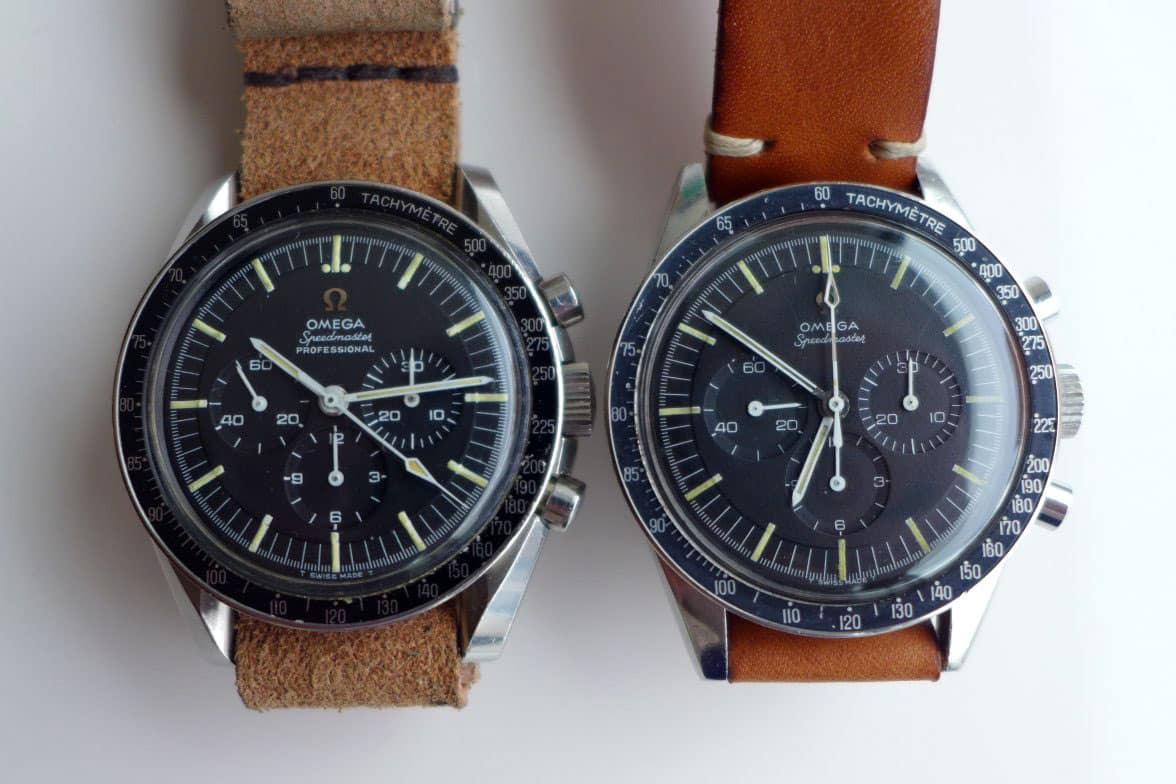
The 105.012 and 145.012 had lyre lugs and crown guards as opposed to the straight-lugs Speedmaster 105.003. Also, the 105.012 and 145.012 had ‘Professional’ written on the dial. It is a common misunderstanding that ‘Professional’ was printed after the qualification on March 1st 1965. This is not the case. Already in 1964 Omega introduced the 105.012 with the ‘Professional’ word written on the dial.
Left: 105.012-66, Right: 105.003 (Photo credits: Rob from Denmark)
Speedmaster 105.012
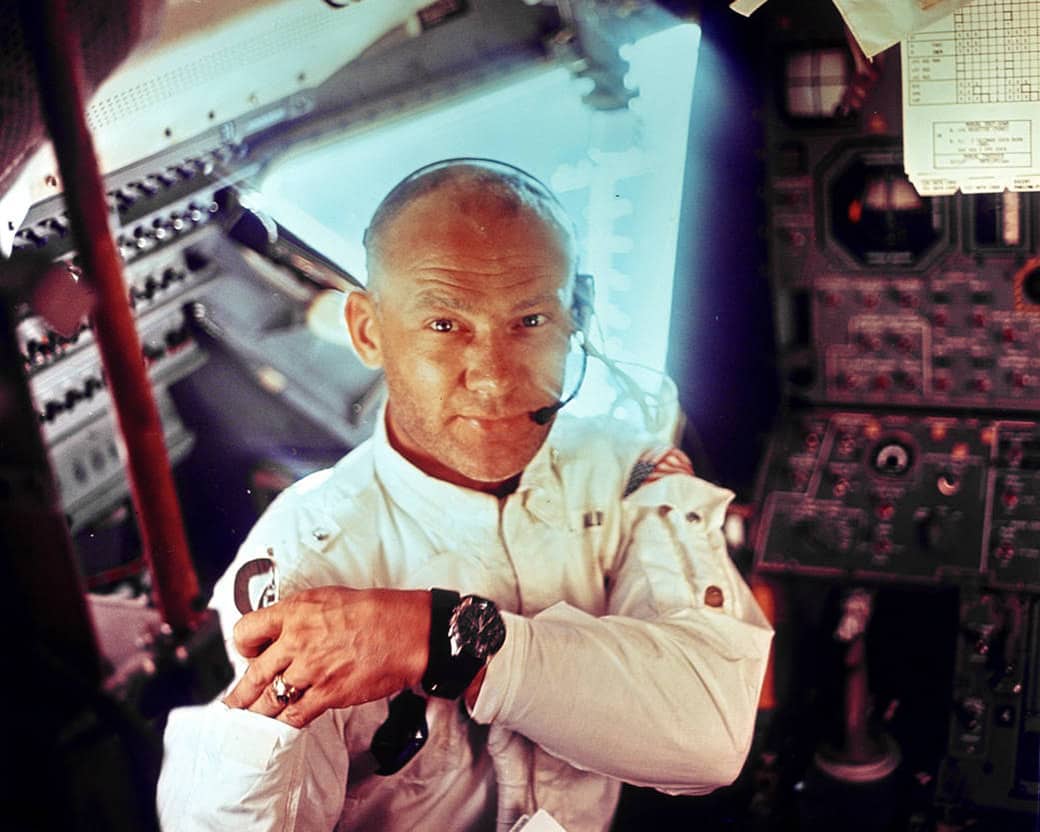
For a long time, it was a mystery which references were exactly used during the Apollo 11 mission. Or whether a caliber 861 Speedmaster ever was on the moon. In the meantime, a lot has changed, and Omega did great work together with NASA. For a few years, it is known that Edwin “Buzz” Aldrin wore a Speedmaster reference 105.012 – the first Speedmaster on the surface of the moon.
105.012-64
Legend has it that Neil Armstrong left his Speedmaster (also a 105.012) on board of the lunar module as the (Bulova) board clock malfunctioned. Aldrin’s watch later disappeared (in 1970), when it was sent off to the Smithsonian museum.
astronaut Edwin E. “Buzz” Aldrin, Jr. during the lunar landing mission. The picture was taken by astronaut Neil A. Armstrong
Speedmaster 145.012
Michael Collins, who remained in the Command Module of the Apollo 11, was wearing a Speedmaster reference 145.012. So it did not make a trip to the surface of the Moon that first time. During the third mission where astronauts set foot on the Moon, Apollo 14 astronaut Alan Shepard was wearing the Omega Speedmaster 145.012. The 145.012 was in production from 1967 to 1969 and had a new design for its pushers. The pushers of the 145.012 were screwed into the case and had slightly larger caps. It is the last reference to have the column-wheel chronograph caliber 321 movement.
Speedmaster 145.012
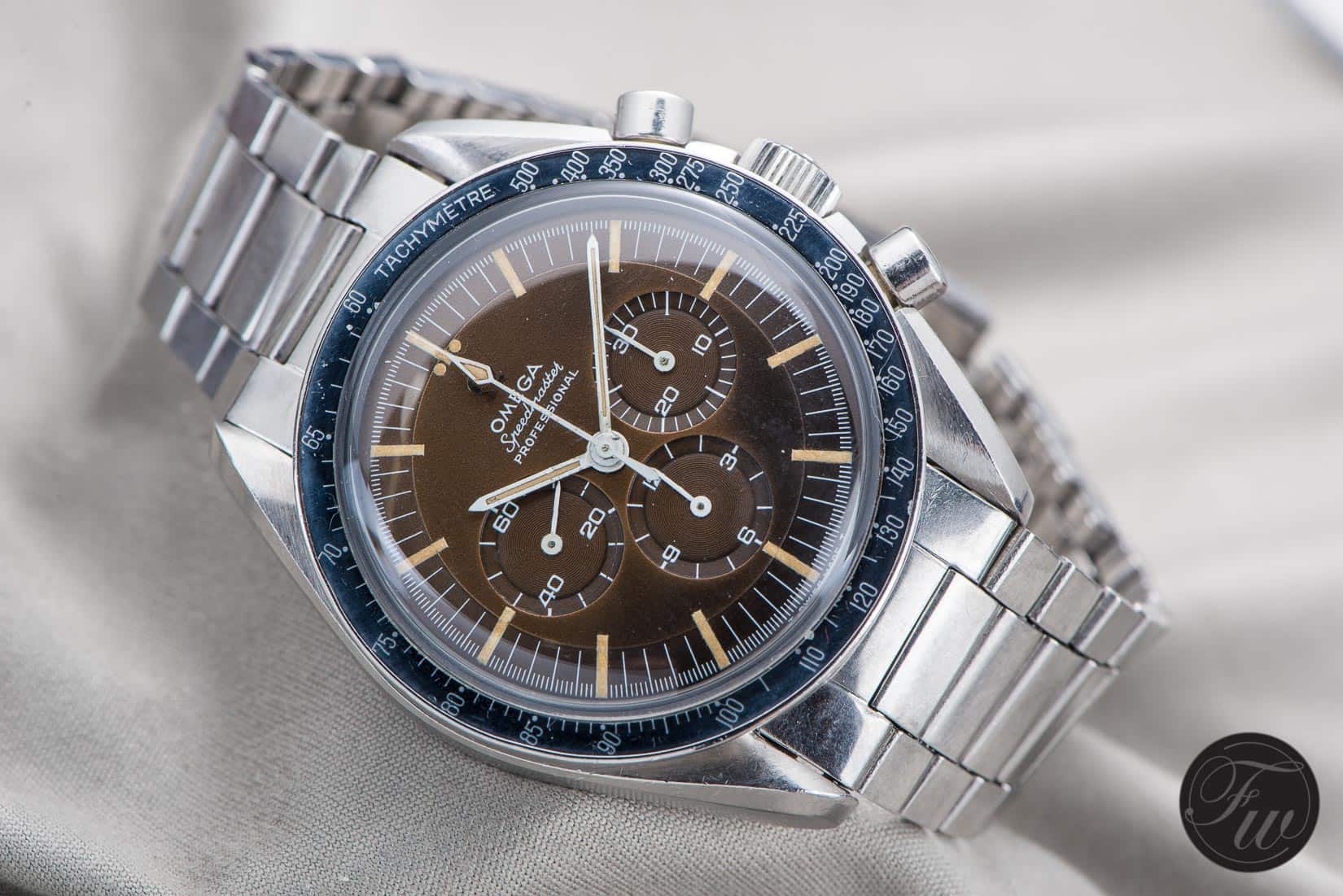
Now, you would probably like to know the exact case numbers from the Speedmaster watches of Aldrin, Armstrong and Collins. From Aldrin, it is believed to be the Speedmaster 105.012-65. Armstrong’s watch was definitely a 105.012-65, and Collins was wearing the 145.012-68 (yes, a -68!!).
An Omega Speedmaster Professional 145.012-68, similar to what Michael Collins wore
The Third Moonwatch Reference
Very important: as mentioned earlier, the Speedmaster 105.003 was also issued to Apollo astronauts, as NASA had it in stock from the original procurement. On some of the six missions that had successful landings on the Moon, the 105.003 was also used by the astronauts. Below, the 105.003 as worn by Gene Cernan during his Apollo 17 mission in 1972: the Last Man on the Moon.
Moonwatch 50th Anniversary
Omega is known to celebrate things and often very properly! This year, Omega celebrates the 50th anniversary of their Moonwatch on several locations all over the globe. Our local event in Amsterdam was held on July 2nd, and we did a report here. But, what better way to celebrate the Moonwatch with two exceptional watches. A re-edition of the Speedmaster Professional Apollo XI 1969 BA145.022 and a new Speedmaster Professional in stainless steel and touches of (Moonshine) gold, based on the 105.012 case. We described both watches in detail on Fratello, click here for the Moonshine gold Speedmaster Professional (1014 pieces) and here for the stainless steel Apollo XI 50th anniversary edition (6969 pieces).
Of course, if you want something close to the Moonwatch, you need to go vintage. It is ranging from the 105.003 till the 105.12 and 145.012 references. These watches, in good condition, are becoming more challenging to find and make sure that you will do your homework. If you want a modern watch, that is close to the Moonwatch; you might want to read this article here.
Stick around this week, as we will have something very cool coming up this weekend for the Moon landing anniversary.
The astronauts, the Omega Seamaster and Omegamania
At the end of the day, what then is the use of a wrist watch, namely Omega Seamaster, what is it good for? Perhaps there are some hints at the Omegamania article.
There are two group of answers: How they are used objectivelly and how they are considered by those who use them subjectively.
Objectivelly
To set up routines
Because it takes 90 minutes to go around the earth, there are 16 sunrises and 16 sunsets every 24 hours. … So even though we have sunrises and sunsets in space, you don’t want to set your watch or go to bed by them! Sleeping is a big issue for astronauts and they are monitored on that and the wrist watch plays a part on it.
Keep tracking
Astronauts have to pay attention to more than one watch or a time keeping device because they are required to keep track of multiple time zones. First, some astronauts might measure Mission Elapsed Time (MET), which actually is the time on board. Second, at the International Space Station, they will use the standard of Greenwich Mean Time (GMT). Third, there is also the time at Mission Control Center location time, which mostly has been in Houston Texas.
As a sensor for monitoring
The black watches in this picture are part of an experiment called SLEEP. The experiment requires the astronaut wear a special watch, capable of “seeing” light/dark and sensing movement/no movement. Over time, astronauts upload the data from the watch to the ground investigators, using a laptop computer. These onboard/zero-gravity data are compared with data gathered on Earth pre- and post-flight. The scientists can then tell how well/long an astronaut slept during the nights throughout their time in orbit. (I averaged about 7 hrs, 20 minutes over 152 days). This data will lead to possible ways to increase/enhance an astronaut’s ability to get meaningful/restful sleep while in space.
First, chronograph style watches were used by American astronauts primarily because the space program in the United States initially had all astronauts recruited from the population of military test pilots. Chronograph watches, at the time, were the only style of wristwatch that could accurately gauge length of time with a stopwatch-like functionality. This is very important for test pilots, because it allowed them to gauge fuel consumption, and if necessary, to navigate using their chronograph watch, their heading, and airspeed. As a result, American astronauts were almost sure to bring chronograph watches with them when they went into space. Well before its official qualification, Wally Schirra, an astronaut who flew in the Mercury, Gemini and Apollo missions, took his personal Omega Speedmaster CK2998 on Mercury 8.
Second, the Omega Speedmaster, the famous “Moonwatch,” is mechanical because the technology for accurate quartz wristwatches did not exist in the early 1960s. The advent of advanced solid state electronics allowed Seiko to introduce the first quartz wristwatch, the Astron 35SQ, in December 1969 – five months after the Apollo 11 landing. Mechanical wristwatches need a high degree of craftsmanship to achieve reasonable accuracy, and so a solidly practical wristwatch of the era is and was an expensive timepiece. In addition, the timepiece needed to be functional under a punishing set of conditions, including at high and low temperatures, under rapidly cycling temperatures, under high levels of vibration, and in a vacuum. Very few wristwatches can meet those standards. In fact, the Omega Speedmaster was only one of three watches submitted to be approved for use in the space program, the others being from Longines and Rolex. The others failed. In the end it was only the Omega that was worn in the first American spacewalk in Gemini 4, and on the moon in Apollo 11.
The first Omega Speedmaster to the space and it’s fate
Edward H.White, II first Onega Seamaster in space
The best story: The 14 seconds that showed why you need reliable mechanical watches in space
The most gripping tale about the Speedmaster is probably how it helped to save the lives of the astronauts on the Apollo 13 mission, after an oxygen tank in its service module exploded, two days into the mission. “The astronauts had to do an exact 14-second burn of fuel,” says Ragan, in order to execute a manoeuvre that would let them manually guide the lunar module back to earth. With power shut down to conserve energy and the onboard clock not working, they timed the 14-second burn using an Omega chronograph. “It’s amazing to me. Had we not had it up there, they might not have got back.”
Omega value perception historically and as of 2021
I will try to figure out having in mind the notions Giambattista Vico, who proposed that human imagination, not environmental circumstances or technological innovations, shaped human culture, thought, and institutions. Obviously I will particularize the case of watches, i.e., wrist watches.
How Imagination affected Omega watches?
Whatever the effect sought after, the final product reflects it, i.e., what the industry produces, is what the imagination of the consumer public wants. Obviously, that changes with time, and one of the most influential effects of imagination is the current fashion, which, besides imagination, suffers influence from the technological changes, specially in things like watches.
You can have details about each one if ou go to The Swatch Group and press each of these squares. Besides that, if you scroll down, they have pointers which indicates:
Production
Electronic Systems
Corporate
Landmarks
Distribution
Pressing each one of these will lead to an intricate network which lays the foundation of how they manage their business and craft. I call special atention in Landmarks to the Omega Museum.
There are interesting circumstances and contexts how they came about and why and how they set the targets of each of these brands, but before getting into that, as an example, let’s understand a little bit how Omega came about and where it stands:
This video is probably the best all around depiction of what is Omega today as of 2021. Since time is a problem (22 m) I will summarize it, but I strongly recommend to go through it:
Constellation
DeVille
Seamaster
The Rolex Killer
The King of the Road
Design
Anatomy of a Watch
We have to understand, in the way the industry does, their product and how that molded its way of becoming and shaped the industry:
The Best Watch in the world and the most expensive
It is generally accepted that the groups the watch industry serves are (under two basic movements, or engines, mechanical and electronic):
Dress Watches
Aviator/military/professional watches
Dive watches
Field/military watches
Racing (chronograph & tachymeter(
There are watches which combine functions such as the speedmaster, that can be used either as Aviator, military, field and racing.
The question of “better” is confused with the price tag. If, for example, we take into account the Omegas and Rolexes, most are below $10,000. But there are models that go up to $20000 dollars. Effectively expensive watches can cost millions of dollars, as is the case of the one who opened this post, the Marie Antoinette, which is valued at 30 million dollars.
The price, or price range, refers to what is called positioning, which does not happen by chance, but is the result of a careful strategy that involves all phases from the creation to the sale and maintenance of watches and varies from time to time.
Positioning has little and sometimes even nothing to do with what the watch is primarily in itself, which is a time piece.
Positioning
I will present two contexts:
A case study betwen Omega and Rolex
Swiss watch industry and worldwide
Case Study
Omega and Rolex – case study of positioning
If you go to the Rolex site and look for their history, they will say that are pioneers and have 500 patents and that is it. If you check the question of the tests they are submitted to, the aspect of resisting high water depths stands out and the certification is of their own and not third party.
Omega is an entirely different story and it is no coincidence that they have been timing the Olympics since 1905, it is the choice of Britain’s Royal Flying Corps, which chose Omega watches in 1917 as its official timekeepers for its combat units, as did the U.S. Army in 1918.
More recently, it was the choice for the astronauts of the Apollo mission, as it can be seen in the introduction of this post, and today is the choice of NASA missions.
Rolex strategy as Return of Investment
How come then that generally Rolex is accepted as a better watch? If you see a review between the Omega Killer and the Rolex, even if it is biased towards the Omega, because at the end of the day it seems that it is an Omega sponsored thing, the general tone of the reviewer is that of difficulty to demonstrate the obvious which is that the Omega is by far better than the Rolex at the aspects Rolex stands out for. He knows that he is trying to change a long standing perception about Rolex and Omega and the title betrays it, because indirectly it recognizes Rolex as the reference, or the gold standard, when it should read, based on reality, : Can The Sea-Dweller compare to the Planet Ocean ?
This is due to the way Rolex positioned and positions itself and the false perception that the resistance to water pressure is the worst condition a watch has to endure, associated to a pattern of size of the dial, thickness and design that suggests utmost ruggedness which was not matched to reality under Nasa qualification tests. This associated with the aspect of value which is normally associated with jewelry watches, specially the dress ones closes the deal.
Perhaps, it is the positioning as an expensive watch which is it is the strongest point of their strategy. They woke up one generation before Omega in this regard and they consistently pressure their way up, what is a sort of warranty that you are making actually an investment. Nowadays their GMT master II series watches run in the $500 000 dollars bracket and some vintage Rolexes, such as the Paul Newman Daytona which was auctioned for $17.8 million dollars.
Omega is chasing after the loss with some offers on the Marie Antoinette line in the $250,000 range, plus some women’s watches in the $100,000 range.
Omega’s Limited Series
Omega’s basic strategy when they woke up, has been to focus on special series, such as the Omega Speedmaster Professional Moonwatch Apollo 11 40th and 50th Anniversary, in the $100,000 dollars range, which actually lowers the price as it goes by:
Omega made a special commemorative watch (250 pieces) with the Apollo-Soyuz mission at 12 o’clock on the dial.
To me it came as a surprise that Omegas are better than Rolexes, what I always took for granted as better. I could have had a Rolex instead of an Omega, as I did, for some 25 years, but I sort of have always rejected them because of their size, thickness, steel bracelet requirement and, to be honest, ugliness.
Incidentally, I would not buy the Omega Rolex killer either…
Swiss and worldwide watch industry
As a 2020 one CHF= us$1,08
Multiply by average cost of unit per country and the Swiss export more than all the others combined in total value
Bottom line: Mechanical Watches are winning the race, and the better ones are Swiss. When it comes to money, nobody beats them up… In terms of GDP per capita, they are only surpassed by countries which are actually tax heavens, although they are obviously perhaps the most famous tax heaven on earth… But it also rains in paradise as you can see at:
There is an interesting account of that at Wikipedia, which can be seen pressing above. There is another more simplified version, but interesting version, which deserves to be seen. Summarizing, visually, my take:
Although both articles attribute the almost monopoly of the Swiss watch industry to its neutrality in both wars, with more than 50% of the global market around 1970, I suspect that there are more reasons than that, but I will leave it aside. With the introduction of the Astron by Seiko in 1969, they took a plunge that made then in the next ten years to cut in half their production.
The very first quartz watch was the Hamilton 600 and Bulova also preceded the Seyko:
These were the forces behind the formation of the Swatch group
Em algum momento entre 1964 e 65, quando eu tinha pouco mais de 20 anos, me associei com um chileno e compramos em sociedade um posto de gasolina, aqui em Campinas, SP, onde nasci, cresci e moro até hoje. Esse chileno, de quem eu era sócio, trouxe outro compatriota do Chile, Juan Navaja, que era talvez 20 anos mais velho que eu e supostamente também entrara na sociedade. O Chile estava amargando um período duríssimo de Allende, que queria socializar o nada que o Chile era e que seria o perfeito “nada para todos” que caracteriza a única possibilidade do comunismo… Trabalhamos como mouros quase dois anos para perceber que aquilo ali era um conto do vigário, pois nosso sócio nos enganou. Eu saí do negócio e Juan Navaja ficou literalmente no ar, saindo em seguida. Como ele morava com seu compatriota, mudou-se para uma pensão, sendo que os problemas básicos de sobrevivência, como ter onde ficar, comer, lavar e passar roupa, transformaram-se num pesadelo, pois ele viera para tentar fazer algum negócio e acabou perdendo todo seu dinheiro. Juan era um homem extremamente fino e educado e muito bem preparado, Engenheiro por formação e profissão. Fiquei penalizado, e o trouxe para o ambiente da casa dos meus pais, até resolver alguma coisa.Ele ficou tão agradecido pelo meu gesto que mostrou-me uma carta do seu compatriota em que relatava com todas as letras que se juntara a mim apenas pelo dinheiro e pretendia me descartar. Acabou nos descartando aos dois e não nos devolveu o que investimos em espécie, mas sim, recebemos dois automóveis velhos, Um Ford 1935 e um Wolseley 1948 e algumas notas promissórias. Fiquei com o Wolseley e ele com o Ford.
Os automóveis estavam em péssimo estado, e o meu, o Wolseley, nem funcionava. Era um carro inglês complicadíssimo, com tudo diferente do padrão das coisas que existiam por aqui. Juan era muito habilidoso e literalmente construímos a peça que impedia o carro de andar na cozinha da casa de meus pais, para horror de minha mãe.O carro que era dele, o Ford 35, tinha um problema sério no estofamento e Juan teve a inusitada ideia de pintarmos a revolver (spray) o estofamento. Incrivelmente ficou bom. Aquele período se caracterizou pelo que fizemos com as porcarias que recebemos do sócio malandro para recuperar o que havíamos colocado no negócio. Finalmente Juan conseguiu do ex-sócio uma passagem de volta para o Chile e fui até Viracopos, que era internacional na época, e me despedi dele ali. Nunca mais o vi ou conversamos. Uns 30 anos depois, em 1995, eu estava trabalhando no Mercosul, e me vi em Santiago. Com o fim de semana livre, procurei na lista telefônica e encontrei uma porção de Navajas, mas nenhum Juan. Telefonei para um que me pareceu importante e era o Diretor da Volkswagen Chile, que estava se instalando no país. A secretária dele localizou Juan, que era parente distante do chefe dela, e ele estava morando em Viña Del Mar, o porto principal do Chile que fica a duas horas de Santiago. Telefonei, me identifiquei para a filha dele, que atendeu e se prontificou a me receber, me orientando como chegar. No fim de semana, aluguei um carro e lá fui. Não conheço Suécia, Dinamarca, Noruega, mas conheço Hamburgo, que é próximo destes lugares gelados e Viña Del mar é o perfeito ambiente nórdico, inclusive o gelo flutuando na água congelante, que é observável no mar que bate no porto de Santiago, no Inverno, estação que estávamos vivendo. Logo que cheguei, vi um velhinho, que me pareceu entre 70 e 80 anos e quando me aproximei, reconheci o Juan que vivera comigo naquele período tão sofrido . A experiência de tempo começa agora. Fomos até a casa dele e a esposa, visivelmente preocupada, nos preparara uma mesa fantástica de café, pois que eu saíra cedo de Santiago e ainda não eram 9 horas e naquela região, o dia amanhece às 9. Sentamos e começamos a conversar e, incrivelmente, nosso imaginário voltou completamente ao período da saída dele do Brasil. Tudo que se referia àquele tempo, desde a peça que ele construiu para o Morris Wolseley, como ele lembrou, a pintura do estofamento, os problemas de cada uma das pessoas da época, enfim, uma quantidade de detalhes que parecia que tinha acabado de acontecer. O grau de detalhe que surgiu nesta conversa foi de arrepiar. Não só dele, como de mim também. Voltamos 30 anos atrás, como que tomados por um transe! Fomos interrompidos pela filha, que me submeteu a um verdadeiro questionário, pois este tempo que Juan passara no Brasil, era um mistério total para a família, como se ele ao se desligar da família no Chile, pudesse ter criado outra realidade aqui no Brasil. Conclui que o casamento dele também estivera em crise no período que esteve no Brasil e que a separação consertou a relação que se endireitou e suportou muitos anos até aquele momento. Essa minha aventura de ir procurá-lo tantos anos depois trouxe para a esposa a paz que nunca tivera após o período que ele se aventurou a deixar seu país e vir para o nosso. Uma coisa incrível, aconteceu quando eu comecei a prestar atenção na casa dele, que era excelente e vi nas fotos penduradas Juan mais novo, nos anos 70, como eu o conheci, e nos anos 80 com o General Pinochet ao lado de vários bondes do tipo trolley que eu acabara de ver em Genebra, na Suíça, de onde eu viera para o Chile e onde eu fui várias vezes por causa dos negócios do Mercosul. Achei aquilo estranhíssimo e perguntei o que significava aquilo. Ele me tranquilizou que sua relação com Pinochet era puramente comercial, pois já se sabia que o General Pinochet era o que se viu. O que aconteceu quando ele voltou do Brasil foi que Pinochet deu o golpe e decidiu trazer progresso ao país. Um dos problemas graves era a falta de transporte público decente. Isso aconteceu alguns anos após Juan ter voltado do Brasil. Pinochet assumiu o poder e liberalizou a economia. Dentro outras coisas, abriu uma concorrência, para trazer de Genebra e de outras cidades da Suíça uma geração de bondes trolleys que estavam sendo descontinuados para o Chile. Estes trolley buses iriam rodar por muito tempo até serem substituídos, pois Pinochet os havia conseguido a preço muito barato, mas precisava transportar, reformar, instalar, fazer funcionar e manter o serviço. Juan, com o espírito aventureiro e sem limites que o caracterizava, entrou na concorrência e ganhou… Eu estava simplesmente diante de um dos donos do transporte público de Santiago e de Valparaiso…
troleybus de Genebra
Juan, com a mesma habilidade que construira aquela peça do Morris e o fizera andar, reformara o Ford 1935, recuperou os bondes suiços, montou tudo, fez funcionar e competentemente respondeu por uma parte dos serviços de transporte público de Santiago e Valparaíso… Era um homem rico… Nos despedimos, estupefatos, com a experiência de recordação daqueles amargos e difíceis tempos que passamos juntos e nunca mais nos vimos. A filha não cabia em si e não conseguia esconder a alegria de espantar fantasmas do tempo que seu pai passara no Brasil.
Tenho certeza que aquele filme que passa diante de nós quando morremos, é exatamente o que aconteceu comigo naquele dia…
Segunda experiência
Eu fiquei nos Estados Unidos mais ou menos na década de 74 a 83, em várias viagens e permaneci a maior parte do tempo no interior do estado de N.York, mais precisamente em Endicott. Chegamos na região em 77 e saímos de lá em Julho de 1983 em duas viagens e coincidiu com o período de meus filhos pequenos, pois eles nasceram em 70, 72 e 76. Eles cresceram ali e, claro, eram companhias constantes para todos os lugares aonde íamos. Em 1995, no mesmo ano que tive aquela experiência com Juan no Chile, resolvi passear em Endicott, junto com minha esposa. Mais de 15 anos haviam se passado e a região é um conjunto de 3 ou 4 cidades, como se fosse Campinas, Valinhos, Vinhedo, Jundiaí, mas muito espalhado e relativamente difícil de andar sem conhecer. Aluguei um carro em N.York e lá fui, arriscando a sorte. Estávamos profundamente preocupados, pois lembramos que quando chegamos na região foi uma dificuldade até montar um mapa mental e andar à vontade, . Quando se chega de NY, imediações de Endicott, na entrada da cidade, havia e ainda existe, uma padaria onde a gente quando viajava sempre parava cansado, faminto e com sede, principalmente com crianças. Roma´s Bakery. Não vou esquecer o nome nunca.
Paramos, entramos e a primeira surpresa foi encontrar tudo rigorosamente no mesmo lugar. Era uma família de italianos e as pessoas de nossa época lá estavam, mais velhas, cercadas pelos seus filhos, talvez netos e netas, via-se o sangue na expressão facial e tudo, mas tudo, inclusive os tipos de sanduíche, que eles chamam de submarino nos Estados Unidos, estava lá, como conheceramos anos atrás. Primeiro calafrio, eu pedi à seleção que eu gostava, minha mulher pediu a dela e tivemos ímpeto de pedir a dos meninos, pois tínhamos a sensação que eles iriam entrar correndo, como faziam sempre. Sentamos lembrando da preocupação que os meninos, especialmente os dois menores, nos causavam, pois não alcançavam a mesa e se penduravam esperando alcançar o lanche e a bebida. Também tinham mania de assaltar a máquina automática de venda de doces e eu cheguei a levantar e ir olhar para ver se não estavam aprontando alguma tão intensa foi a lembrança. Vivemos um momento de 1978 em 1995… A segunda surpresa foi mais sutil, pois pegamos o carro, eu fui automaticamente em todos os lugares que eu quis e ia tudo aparecendo como por mágica, pois o mapa mental havia ficado gravado no meu subconsciente e parecia que eu nunca havia saido de lá. Aqueles americanos que nos olhavam como estranhos nunca poderiam entender a consternação que fomos tomados de reviver um período tão trabalhoso e tão grato de nossa vida ali naquele lugar….
Sometime between 1964 and 65, when I was just over 20 years old, I associated myself with a Chilean and we bought a gas station in partnership, here in Campinas, SP, where I was born, grew up and still live today. This Chilean, with whom I was a partner, brought another fellow countryman from Chile, Juan Navaja, (not his real name, because could easily be spotted in Chile) who was perhaps 20 years older than me and had supposedly joined the partnership as well. Chile was experiencing a very difficult period of Allende, who wanted to socialize the nothing that Chile was and that would be the perfect “nothing for everyone” that characterizes the only possibility of communism… We worked like beavers for almost two years to realize that it was a trap, because our partner deceived us. I got away from the business and Juan Navaja was literally up in the air, leaving soon after me. As he lived with his compatriot, he moved to a boarding house, and the basic problems of survival, such as having a place to stay, eat, washing and ironning clothes, etc., became a nightmare, as he came to Brazil to try doing some business and he ended losing all his money. Juan was an extremely fine and educated man and very well prepared, an engineer by training and profession. I felt sorry for him, and brought him to my parents’ home environment, until he could move on something. He was so grateful for my gesture that he showed me a letter from his compatriot in which he reported unequivocally that he had joined with me just for the money and intended to discard me. He ended up dismissing both of us and didn’t give us back what we invested in cash, instead, he gave us two old cars, a 1935 Ford and a 1948 Wolseley and some promissory notes. I got the Wolseley and he got Ford.
The cars were in pretty bad shape, and mine, the Wolseley, didn’t even run. It was a very complicated English automobile, with everything different from the average standard of things that existed here in Brazil. Juan was very skilled and we literally built the part that prevented the car from moving in my parents’ kitchen, much to my mother’s horror. His car, the Ford 35, had a serious upholstery problem and Juan had the unusual idea of painting the upholstery using a spray gun. It turned out incredibly good. That period was characterized by what we did with the rubbish we received from the rogue partner to recover what we had put into the business. Finally Juan got a ticket back to Chile from his former partner and I went to Viracopos, who was international airport at the time, and said goodbye to him there.
I never saw or talked to him again. About 30 years later, in 1995, I was working at Mercosul, and found myself in Santiago, capital of Chile. With the weekend free, I looked over the phone book and found a lot of Navajas, but no Juans.(His family is spread and wealthy and this is not his name) I called one Navaja who seemed important to me and he was the Director of Volkswagen Chile, who was moving into the country. His secretary located Juan, who was a distant relative of her boss, and he was living in Viña Del Mar, Chile’s main harbour, two hours away from Santiago. I phoned him, identified myself to his daughter, who was extremely nice and set up a meeting, telling me how to get there. Over the weekend, I rented a car and went there. I don’t know Sweden, Denmark, Norway, but I know Hamburg, which is close to these icy places and Viña Del mar is the perfect Nordic environment, including the ice floating in the freezing water, which is observable in the sea that hits the harbour of Santiago in the winter, the season we were living in. As soon as I arrived, I saw an old man, who seemed to be between 70 and 80 years old, (I was at that time 50) and when I approached, I recognized the Juan who had lived with me in that very painful period. The experience of time starts now. We went to his house and his wife, visibly worried, had prepared us a fantastic breakfast, since I had left Santiago early and it was not yet 9 o’clock and in that region, the day starts at 9. We sat down and started talking and, incredibly, our imagery completely went back to the period when he left Brazil. Everything that referred to that time, from the piece he built for the Morris Wolseley, as he recalled, the Ford upholstery painting, the problems of each of the people of the time, in short, a number of details that sounded like it had just happened . The degree of detail that emerged in this conversation was chilling. Not only from him, but from me as well. We go back 30 years ago, as if in a trance! We were interrupted by his daughter, who submitted me to a real questionnaire, as this time Juan spent in Brazil was a total mystery for the family. Apparently, they imagined that he could have created another reality here in Brazil by leaving his family in Chile. I concluded that his marriage was also in crisis during the period he was in Brazil and that the separation repaired the relationship that straightened out and endured for many years until that moment. This adventure of mine looking for him so many years later brought to his wife the peace she never had after the period he ventured to leave his country and come to ours. An amazing thing happened when I started to pay attention to his house, which was excellent. I saw Juan younger as I had known him in the hanging photos, back in the 70s, with General Pinochet siding several trams similar to the trolleys I had just saw in Geneva, Switzerland, where I came from to Chile and where I went several times because of the Mercosur business I got involved with working for the government. I found it very strange and asked what it meant. He reassured me that his relationship with Pinochet were purely commercial, as it was already known that General Pinochet was what he was. What happened when he returned from Brazil was that Pinochet staged a coup and decided to bring progress to the country. One of the serious problems was the lack of decent public transportation. This happened a few years after Juan returned from Brazil. Pinochet took over to rule the country and liberalized the economy. Among other things, he put up a bidding, to bring from Geneva and other cities in Switzerland a generation of trolley trams that were being discontinued for its use in Chile. These trolley buses would run for a long time before being replaced, as Pinochet had gotten them at a very cheap price, but it was needed to bring them from there, repair, install, run and maintain the service. Juan, with the adventurous and limitless spirit that characterized him, entered the competition and won… I was simply in front of one of the owners of the public transportation in Santiago and Valparaiso…
troleybus de Genebratroleybus de Zurich
Juan, with the same skill which he hand built that part of the Morris and made it run, fixed the 1935 Ford, he rebuilt the Swiss trams, assembled everything, had them to run properly and competently was in charge of a part of the public transportation services of Santiago and Valparaíso… He became a rich man… We said goodbye, thunderstruck with the experience of remembering those bitter and difficult times we spent together and never saw each other again. His daughter could not conceal her relief and could not hide the joy of scaring away ghosts of her father’s time in Brazil.
I’m sure that movie that passes before us when we die is exactly what happened to me that day…
Second experience
I stayed in the United States from mid seventies to early eighties, on several trips and spent most of the time upstate New York, more precisely in Endicott. We arrived in the region in 75 and left in July 1983 on two trips and it coincided with the period of my children growing up, as they were born in 70, 72 and 76. They grew up there and, of course, were constant companions wherever we went. In 1995, the same year I had that experience with Juan in Chile, I decided to visit Endicott, with my wife. More than 15 years had passed and the region is a group of 3 or 4 cities, as if it were Campinas, Valinhos, Vinhedo, Jundiaí, here in Brazil, where I live, but spread out and relatively difficult to get around without knowing where you are going. I rented a car in New York and went there, taking my chance. We were deeply concerned, as we remember that when we arrived in the region, it was difficult to put together a mental map and walk freely, . When you arrive from NY, getting close to Endicott, at the entrance to the city, there was and still is, a bakery where we stoped, after a tiresome travel, hungry and thirsty, especially with children. Roma´s Bakery. I will never forget the name.
We parked, got in and the first surprise was to find everything exactly in the same place. It was a family of Italians and the people from our time were there, older, surrounded by their children, maybe grandchildren. You could see their blood on their facial expression and everything, but everything, including the types of sandwiches, which they call submarine in the United States, were there, as we knew years ago. We chilled scared down after I asked the sandwich I liked, my wife asked hers and we had the impulse to ask something for the boys, because we had the feeling that they would run in, as they always did. We sat down remembering the uneasiness we felt with the boys, especially the two younger ones, caused on us, as they did not reach the table and hung around waiting to reach a snack and a drink. They also had a habit of poking around the candy vending machine and I even got up and went to take a look and see if they weren’t up to something, so intense was the memory. We live a 1978 moment in 1995… The second surprise was more subtle, as we took the car, I automatically went everywhere I wanted and everything appeared as if by magic, because the mental map had been engraved in my subconscious and it seemed that I had never left the place. Those Americans who looked at us as strangers could never understand the dismay we were taken to relive such a laborious and grateful period of our life there in that place….
In this post it will be discussed J.B. Priest’s method of time treating in his plays and books. To have an idea what he thought about methaphysics of Time, please take a look at One Man and Time, speculations and case studies.
After an extensive discussion about how the creations of his most famous plays occurred, Priestley came up about the following theory, and I quote:
Time seems to divide itself into times:
There is one for passing time;
there is another for the first kind of experience, the contemplative slower-up;
there is another for the second kind of experience, the purposeful, imaginative, creative speeder-up: three times.
So can it be true to say that nothing in our actual experience suggests – if we want to be geometrical about it – that there might be three dimensions of Time? I say it cannot be true. I will agree that no exact analysis may be possible, that no sharp lines can be drawn, that all except one’s innermost feeling is blurred and shadowy, that the relation between consciousness and the unconscious may complicate the issue; but I cannot escape the feeling that Time, itself so blurred and vague and elusive, divides itself into three to match these different modes of consciousness. We are at least entitled to say that it is as if there are three kinds of time. (And this is hardly an impudent claim when Time itself, on close examination, can be turned into an as if, even though we have in this age transformed it into a ball-and-chain to keep the spirit a prisoner.) At the risk of appearing to put myself too close to Dunne, I propose to call these three times— time One, time Two, and time Three. To follow some theorists and call time Two “eternity,” a term rich in associations, would only mislead and confuse many readers. Again, though it would not be difficult to invent a name for time Three – like Mr. Bennett’s “Hyparxis”—some of us are easily repelled by unfamiliar terms. So let us make do with times One, Two, and Three, remembering that we live in all three of them at once, though we may not enjoy, so to speak, equal portions of them.
As visible creatures of earth we are ruled by time One.
We are born into it, grow up and grow old in it, and die in it. Our brains have developed through eons into marvelous instruments of time-One attention. Not only do they bring to our notice almost everything we feel we ought to know, but they are able to exclude what might be bewildering and unhelpful. When drugs interfere with their chemistry, some of their inhibiting processes do not work, and then we might see a chair as a Van Gogh might see it, not as a furniture salesman and a customer might see it. (The Time-shift in drug experiences is well attested; they free consciousness from its age-old concentration upon time one). Our relation through the brain with time One tends to be practical and economic, good for our matter-handling business, which helps to explain why we are now great time-One people and mostly try not to believe in anything else. If this limited belief were imposed on people as a dogma, as it easily might be in totalitarian or severely conformist societies, it is not merely fanciful to suggest that men might become automata, ruled by better machines than themselves. There are signs, however, of a reaction against this time-One dogma. Many of them have come my way since I began writing this book. Not all the forms this reaction takes are acceptable. One that is acceptable, concerned with all the extra sensory perception phenomena, ESP at work, which only sheer bigotry can deny now, seems to me outside the scope of this inquiry. But as we have seen already, even though we ignore all manner of examples of premonition and déjà vu experiences, there are plenty of authenticated precognitive dreams to prove that our minds cannot be entirely contained within time One. So let us take an early example of the precognitive dream, one connected with an historical event, and see what we can make of it in terms of more times than One. Three months before Napoleon invaded Russia, the wife of General Toutschkoff had a dream that was repeated a second and then a third time in one night. In this dream she was in an inn she had never seen before, in some town she did not know, and her father came into the room, leading her small son by the hand, and told her in broken tones that her happiness was at an end because her husband had fallen at Borodino. She awoke in great distress, roused her husband, and asked him where Borodino was. But when they looked for the name on the map, they could not find it. (The battle in fact took its name from an obscure village.) After it was fought, everything happened as in the three dreams: She found herself in the same room in the same inn in the same town, and her father came in with her son and announced her husband’s death at Borodino, where he was commanding the army of the reserve. More or less following Dunne here, we can say that the dreaming self of Countess Toutschkoff, in time Two, revealed what would happen to her in time One. Though a soldier’s wife might always be haunted by the fear that her husband might be killed in battle, coincidence must be ruled out of her three dreams because what happened was identical in so many different particulars and that the very name afterward given to the battle was then unknown to her. If no part of her mind could escape from time One, then the whole matter remains inexplicable.
Borodino, 1812 – Louis Lejeune (1775-1848)
Time Two
Another Time order, which we can call time Two, does at least offer us a possible explanation. But what about the historical event, the Battle of Borodino? Are we to assume that before Napoleon’s army crossed the Niemen on June 24, the Battle of Borodino on September 7 was already waiting to take its place in history? And if it was not, as we cannot help feeling, if it all depended on the calculations of the French and Russian general staffs and the consequences of various minor battles and skirmishes, then where did the dreamer’s mind, wandering in time Two, discover this unknown name Borodino? If in our instinctive dislike of the idea of a fixed unalterable future, we declare that early in June 1812, when the Countess dreamed her three dreams, events that were to take place in September did not exist in any possible shape or form, then how could she dream as she did? And if we accept her precognition, and with it the idea that this was an experience in time Two, impossible in time One, then how do we avoid the fixed future, the Borodino already in its place further along the track of time One? Before I try to answer those questions, let us return to the dream of the American mother about the visit to the creek and the dead baby (page 225):
What follows now does not come from my own collection but from an article on “Precognition and Intervention” by Dr. Louisa E. Rhine, published in the American Journal of Parapsychology:
Many years ago when my son, who is now a man with a baby a year old, was a boy I had a dream early one morning. I thought the children and I had gone camping with some friends. We were camped in such a pretty little glade on the shores of the sound between two hills. It was wooded, and our tents were under the trees. I looked around and thought what a lovely spot it was. I thought I had some washing to do for the baby, so I went to the creek where it broadened out a little. There was a nice clean gravel spot, so I put the baby and the clothes down. I noticed I had forgotten the soap so I started back to the tent. The baby stood near the creek throwing handfuls of pebbles into the water. I got my soap and came back, and my baby was lying face down in the water. I pulled him out but he was dead. I awakened then, sobbing and crying. What a wave of joy went over me when I realized that I was safe in bed and that he was alive.
I thought about it and worried for a few days, but nothing happened and I forgot about it. During that summer some friends asked the children and me to go camping with them. We cruised along the sound until we found a good place for our camp near fresh water. The lovely little glade between the hills had a small creek and big trees to pitch our tents under. While sitting on the beach with one of the other women watching the children play one day, I happened to think I had some washing to do, so I took the baby and went to the tent for the clothes. When I got back to the creek I put down the baby and the clothes, and then I noticed that I had forgotten the soap. I started back for it, and as I did so, the baby picked up a handful of pebbles and threw them in the water. Instantly my dream flashed into my mind. It was like a moving picture. He stood just as he had in my dream—white dress, yellow curls, shining sun. For a moment I almost collapsed. Then I caught him up and went back to the beach and my friends. When I composed myself, I told them about it. They just laughed and I said I imagined it. That is such a simple answer when one cannot give a good explanation. I am not given to imagining wild things.
After describing that dream, I said that if we accepted it, we must also accept one of two things:
We must believe that up to the moment when the mother leaves the baby to go and fetch the soap, the dream is showing her the future, but that her return to find the baby drowned is a dramatization of not unusual maternal anxiety: the dream being therefore part-future, part-fiction.
Or we must believe that a future containing a dead baby is changed, by the mother’s action, into a future in which the baby does not die and lives to become a father himself:
so that of two possibilities, one by deliberate intervention has come to be actualized. This leaves us with a future already existing so that it can be discovered by one part of the mind, and with a future that can be shaped by the exercise of our free will. We cannot have both, we shall be told; it must be either one or the other. Possibly, possibly not.
It may be remembered that I offered a similar alternative after an account of a motorist who dreamed that he knocked down a small boy and then, a few weeks afterward, had to swerve and brake violently to avoid hitting a small boy whom he immediately recognized, after getting out of his car, as the child he saw in his dream. I said that this dream could be part prevision, part fiction, or that it could show a possibility never actualized because the driver, forewarned by the dream, was able to act promptly at the right moment, changing the future seen in his dream. In both instances, then, we are left with a choice: between a dream that only in part reveals the future and a dream entirely concerned with the future—but a future that is not fixed and inevitable, that can be changed. Let us consider the latter first. We are asked to accept a future that exists in some form or other, because it can be experienced in a dream, and yet may possibly be changed. Thinking theoretically, we feel inclined to reject at once any such idea of the future. Either the future is an “uncreated nothing” or it is wholly there, waiting for us to experience it. But this is only what we think in terms of Time theory. In our ordinary thinking, outside theory and well inside practical living, not only do we not reject this idea of a half-made future, consisting of possibilities that may or may not be actualized – that is, becoming part of our and the world’s physical history – but we accept it so wholeheartedly that it shapes and colors our thought. When we think of the next 12 months we regard them neither as a blank nothing nor as some inflexible series of events. These extreme alternatives belong to theory, not to our actual practice, in which we do not hesitate to steer a course between them. It is this intellectually infuriating future, rather like an omelette just before it is ready to be lifted out, that we hold in our minds when we are actually planning our lives and not picking and choosing among Time theories. Certainly an H-bomb missile may arrive and blow us all out of time One, but we are well aware of that, know that it is one of the possibilities that may be actualized. That missile, we may say, is waiting to be sent on its dreadful errand, to mark a high point of human folly; but it has been put together by man’s will and action and it can be outlawed and destroyed by man’s will and action. The future cannot be nothing, for it contains immediately, among other things, that missile; but neither is it fixed and inevitable, for it can be changed even after it has seemed to reveal itself in dreams and time Two. It is then not at all outrageous to suggest that these two dreamers saw a future that existed in some shape or other (notice how we like saying, with Wells, “The shape of things to come”) and yet could be dramatically changed by a sudden act of will—the picking up of the baby, or the swerving and braking of the car. After all, it is far closer to our common working idea of the future -half-made, half-there, not wholly made or wholly there—than any conclusions of the scientists or the philosophers. We have in these dreams possibilities that were actualized namely, the visit to the creek, the encounter with the boy on the road and possibilities that were prevented from being actualized-namely, the drowning of the baby, the knocking down of the boy. (With the Borodino dream, of course, every thing was actualized, probably because an event on that scale, a great battle, is fixed beyond intervention.) Now in time Two, where the dreams belong, there is no distinction between the possibilities that are actualized and those that are not. The creek and the road are there, and so are the drowned baby and the knocked-down boy. In time One, action can be taken so that what we might call the line of history avoids the drowned baby, the injured boy. But that is all. The alternative possibilities, together with the choice between them, cannot exist in time One. Nor did they exist in time Two. Therefore another time is necessary, time Three. If we think of this line of material history really as a line, then as one possibility is actualized and others are not, this line cannot move up and down in two dimensions but must curve around in three. So on this theory of the two dreams we can accept Ouspensky‘s “The three-dimensionality of time is completely analogous to the three dimensionality of space” and J. G. Bennett’s “This leads to the notion of a third kind of time connected in some way with the power to connect or disconnect potential and actual.” And certainly, taking the baby away from the creek, swerving and braking to avoid the small boy on the road, may be said to be disconnecting potential and actual. I refuse to answer questions, however, about these possibilities in time Three, these shapes of possible things to come, which can be seen in time Two and yet, until actualized, are outside our material history in time One. I refuse to answer because I do not know. Nobody should be surprised by this confession. After all I do not know, can only hazard a guess, how the sight of a picture or even the sound of a word could suddenly seem to change the tempo and tone of my existence, apparently taking me out of one time and enclosing me within another. I do not know, and again can only hazard a guess, how I came to write, let us say, the technically complicated Act Two of Time and the Conways seemingly without effort and at a headlong pace. All that is within my sure knowledge is that these things happened. But then every other day something happens that a positivist would call a coincidence and that I feel is nothing of the sort, though I cannot explain it. I am old enough now to realize how little I do know. Let us see now what happens—and here I have little more advanced information than the reader has—when we reject the idea that these dreams were entirely concerned with the future, but a future that could be changed. We put in its place the idea that these dreams were, as I said earlier, part-future, part-fiction. The visit to the creek with the baby, in the dream, is a genuine time Two glimpse of the future, but the tragic episode of the baby’s death does not belong to the future but is, as I said, “a dramatization of not unusual maternal anxiety,” the kind of thing most women cannot help imagining In the same way, that section of road and the small boy on it were there in the future, seen by the dreamer in time Two; but projected into the scene, out of the motorist’s constant anxiety about accidents, was the imaginary episode of injuring the boy. In these terms the future remains unchanged; all that happens is that what was imagined did not take place in reality. And at first sight this seems a much neater and more sensible explanation.
FreudWomen have more premonition dreams than menJung
After reflection, however, this explanation leaves me feeling dissatisfied. The questions that seem to vanish have merely been swept away like crumbs and ash under a rug. Anxiety dreams are common enough; most of us have awakened to vaguely remember those dream airplanes and trains that will not be caught because taxis break down and luggage is mislaid. But in these two dreams there is no such dim confusion. As in most precognitive dreams, everything is sharp and clear, so vivid that it is easily remembered. And there does not appear to have been any break, any change of quality, between what was previsionary, disclosing the scene and the situation, and what belonged to a dramatized anxiety. The dead baby seems to have been as convincing as the live baby. However, I do not wish to attack the theory from this position, if only because so much is possible in dreams, those vast private theatres in which we are dramatists, directors, designers, actors, and audience. (Long before I was interested in precognition, before I had read any depth psychology, I could not understand why so many people thought their dreams no more important than their sneezes and yawns. Our dreams are our nightlife.) I will suppose it to be true that a dream can move smoothly from prevision or precognition, from what is revealed, not created, to this familiar acting out of an anxiety or constant fear. Nevertheless, I am still left feeling dissatisfied. Certainly we have now dodged the future that can be experienced and yet changed, and those possibilities that may or may not be actualized. It is much easier to say that something was imagined—such as the death of the baby—that did not subsequently take place in reality. It is easier still if we assume, as so many people seem to do, that the imagination and all its creations are nothing. But this will not do, for these are very much something, and something of immense importance to our lives. (What if we should finally arrive, a long way beyond death, at a mode of existence that remained nothing but a huge blank unless the imagination went to work on it, creating for it landscapes, cities, dwellings, gardens, arts, and social life?) Because most children are highly imaginative, it is supposed by some that to reach maturity we ought to leave imagination behind, like the habit of smearing our faces with jam or chocolate. But an adult in whom imagination has withered is mentally lame and lopsided, in danger of turning into a zombie or a murderer. It is the creative imagination that has given our ruthless blood thirsty species its occasional gleams of nobility, its hope of rising above the muck it spreads.
To discover what we make of imagination I am consulting the nearest Dictionary of Philosophy, an unambitious American work, usefully modest in size. It says:
Imagination designates a mental process consisting of:
(a) The revival of sense images derived from earlier perceptions (the reproductive imagination), and
(b) the combination of these elementary images into new units (the creative or productive imagination).
The creative imagination is of two kinds:
(a) the fancy which is relatively spontaneous and uncontrolled, and
(b) the constructive imagination, exemplified in science, invention and philosophy which is controlled by a dominant plan or purpose.
To which I feel I must reply:
(a) that there is here a smell of the cobbler’s “Nothing like leather”;
(b) that I should like to read the comments of Samuel Taylor Coleridge and William Blake on this account of imagination;
(c) that the enduring vitality, say, of Don Quixote and Hamlet, apparently the products of uncontrolled fancy, is not easy to explain along these lines; and
(d) that if this can be taken as a representative statement, then we know and care very little about imagination. It really belongs to the invisible nothing department.
“The universe is neither finite nor infinite”
Because imagination appears to be free of the limitations we know in time One, we think of it as being outside Time. It is there, however, that the nothings begin. We might do better if we thought of it as belonging to a different Time order, to another time. And I have already suggested, after remembering my own experience, that imaginative creation seems to imply not a second time order, contemplative and detached from action, but a third, in which purpose and action are joined together and there seems to be an almost magical release of creative power.
If there is a part of the mind or a state of consciousness that is outside the dominion of time One and time Two but is governed by a time Three, then that is where the creative imagination has its home and does its work. And it may be that there imagination is not something escaping from reality but is itself reality, while the world we construct from our time-One experience is regarded there as something artificial, abstract, thin, and hollow.
Now what belonged to the time-One future in these two dreams, the baby at the creek, the small boy on the road, could only be observed in the wide but badly focused present (compare Dunne) of time Two. This is what the dreamers are attending to, being asleep and incapable of concentrating their attention in time One. Now we are still assuming that the main incidents of the dreams, the death of the deserted baby, the running-down of the small boy, are not part of the future revealed in time Two. These tragic incidents have been neatly introduced into the dreams, perhaps to serve as warnings, by the dreamers hastily dramatizing familiar anxieties. Thus the set and the characters are provided by future experience, but the action comes out of imagination. This is all very curious, but it is what we must accept in this theory of dreams. And Time cannot be left out, because we know the future is involved; and if Time is in, then it cannot be uni-dimensional, for we need another and different time, a time Two, to explain how the future came to be revealed. But this will not explain what we have already assumed: the sudden change in the character of the dreams, the switch-over from prevision to imagination, the dramatic intervention of the dreamers’ anxieties and fears. In which time order did imagination come to intervene? Not in time One, which is closed down for the night. Not in time Two, which is concerned with the time One future and is providing the baby at the creek and the small boy on the road. The dramas, the warning strokes of the imagination, which will eventually produce decisive actions in time One, must belong neither to time One nor time Two but to time Three. So, trhough by a very different route, we arrive again at that third dimension of Time.
Time Three
Nevertheless, I prefer the other explanation of these dreams, which does not see them as a mixture of prevision and imagination (even though we do not know what imagination is) but as glimpses of a future already shaped but still pliable, yielding—in these instances, though obviously not in many others—to will and action. It is as if ahead of us in time One were shapes, molds, patterns, possibilities, seen as definite events in certain of our dreams; and into some of these shapes, molds, patterns, there arrives the material substance that actualizes them, hardening them into world history. There is an idea not unlike this in Blake’s Jerusalem, in which Los (the name is Sol reversed) can be taken as the symbolic figure of Time:
All things acted on Earth are seen in the brightSculptures of
Los's Halls, & every Age renews its powers from
these Works
With every pathetic story possible to happen from
Hate or
Wayward Love; & every sorrow & distress is
carved here,
Every Affinity of Parents, Marriages & Friendships
are here
In all their various combinations wrought with
wondrous Art,
All that can happen to Man in his pilgrimage of
seventy years...
Jerusalem
These “Sculptures,” as Maurice Nicoll suggested, can be regarded as states of mind from which men cannot free themselves; but they can also be seen as the possibilities, like the Borodino of the Countess’s dream, that must be actualized. They are that part of the future that is fixed. But much of it, close to us as individuals, is only half made, depending for its historical time-One shape and character on a number of personal decisions. This brings us to the questions I asked at the end of the chapter “The Dreams.” There, after pointing out that more than 90 per cent of the precognitive dreams I was sent were concerned with the terrible or the trivial, I asked why the dreaming self so rarely catches a glimpse of that wide middle range of our activities and interests. And now we can reply that within this range there may so often be no determined future, only a confusion of possibilities still to be actualized, waiting to receive their time-One shape and character from will and action. Both the terrible and the trivial are nearly always outside our control, the deaths and disasters because they are too big and fateful, the trivia because they are too small and unimportant. So that it is they in nine cases out of 10, at least, that will be revealed in precognitive dreams because they are there to be revealed. These possibilities are part of the future that will not be changed, either because they are out of reach of our will or beneath its attention and interest.
Along this line we can now approach the FIP (future-influencing-present) effect. Why did my friend Dr. A feel a queer excitement when he received impersonal official reports from Mrs. B, then completely unknown to him? His consciousness in time One knew nothing about her. No dreams from time Two visited him. But in time Three they had already fallen in love and were married. This deep relationship, for some reason I cannot supply, was not a possibility but a certainty, but only in that remoter part of his being – if I may be allowed the phrase involved with time Three, able to communicate nothing to his time One consciousness but this queer feeling of excitement.
This is no doubt an exceptional instance, but what is not at all rare, at least in my experience, is a state of mind suddenly and inexplicably illuminated or darkened by feelings apparently coming from nowhere and entirely unconcerned with what we are doing, thinking, feeling, in our time One existence. This last rightly demands most of our attention, but we must not make the mistake of assuming that anything not explicable in time One terms is a nothing. It may be a very important something, like the excitement that Dr. A felt, the distant trumpets heralding the most rewarding relationship of his life. We should think a man a fool if he insisted upon meeting all his time-One experience with half closed eyes and with wax pads over his ears. we shall not be very much wiser if, to prove narrow a theory, we try to keep our minds clo to what might be revealed to them in it. I have lately received, from Italy, some material based on the findings and theorizing of a small newish international group of medical psychologists. This restored to me a term much used before the First War, when I first began read about and discussing such matters, but one have rarely seen or heard since then: This is “superconscious.” On this theory the ego and field of consciousness occupies a middle place between the unconscious, personal or collective and the superconscious, the source of our nobler feelings, intuitions and inspiration, genius illumination, and ecstasy. And if we relate this division to our tempo system here, we could say that the ego and field of consciousness belong to time One, the unconscious to time Two, the superconscious to time Three. But we must remember there are no separate compartments and exact divisions and that we live, even here and now, in all three times. This still remains true even of those people who deny the possibility of any experience outside side time One. However, it may not always be true, for if we insist upon disinheriting ourselves, men may ultimately become time One slaves automata.
I have said that we go beyond the grave. But one sense and strictly speaking, we do not. Indeed, it is the idea of a time-One existence persisting after death that has worked so much mischief. It has helped to create some of the dreariest fantasies ever known, with the spirits of departed Red Indians arriving in South London basements to establish communications between this world and the next. It has so repelled many people that they proclaim with passion that long before the doctor has signed his certificate shall be dead as mutton. The truth is, we are a to be immodest in both our claims and our denials here: Either we live for ever or perish with our last heartbeat. I think it reasonable to suggest we do neither. We are not demigods and we are not cattle. We cannot go beyond the grave in time One. When we die we come to the end of our allotment of time One. The brain ceases to supply us with any further information because it stops working, dying with the body that housed it. We have to take our leave of chronological world time. We move out of history: Thou thy worldly task hast done, Home art gone, and ta’en thy wages. But where is home, and what are our wages? In terms of our argument here, we can say that home is our continued existence in time Two and that our wages, there for us to spend in that existence, are our total experience in time One. This has an end just as it had a beginning in time One; we go jogging along that world line until death appears as a terminus; but in time Two we have never been making that journey and, as we have seen, have never been bound by its conditions. There may be some kind of death awaiting us ultimately in time Two, but it is certainly not the familiar time-One death. This we survive because our consciousness has never been contained within time One. And it is quite beside the point to object that we have no visible evidence to prove that survival. Time Two, in which we do survive, does not work in the visible-evidence department. I cannot take that “aesthetic feeling,” a time-Two experience, into a laboratory to be weighed and measured. The most meaningful and the most ecstatic moment I have ever known occurred in a dream, not precognitive but deeply symbolic, a dream that changed my whole outlook; yet I have for it less visible evidence than I have for a slight cold in the head or a broken fingernail.
Our time-Two world, in which we survive, has as its foundation our total experience in time One. Now it cannot be denied, for this has been proved over and over again, that the brain acts as a marvelous recording instrument, storing somehow and somewhere an exact impression of every moment of our lives, something quite different, in its brilliant immediacy, from what may be recovered by the ordinary memory. (Under hypnosis or the emotional pressure of drastic analysis, middle-aged men and women have been suddenly turned back into children of two, destructive and screaming with rage.) What the relations are between this stupendous brain storehouse and the mind or consciousness and the unconscious, I do not know, and I do not think anybody else knows. And I am not denying that this endless recording, much of it inaccessible to our day-by-day consciousness and seemingly out of all proportion to our needs, may play a part, not yet understood, in our time – One existence. But I believe with Dunne that when we have come to an end in time One, we go forward spatially and geometrically, we may say, at a right angle—in time Two, no longer concentrating our attention on the physical world, but now having in place of it all that accumulation of mental events, all the sensations, feelings, thoughts, left to us from our time-One lives. It must be remembered, however, that we have never been living exclusively in time One, however much we may proclaim that no other time exists. So it might be as well for us hereafter, when we are out of passing time, that we do not think and feel and behave now as if passing time were all we had. And surely this is what most religions, behind their popular melodramas of angels and demons, saviors and devils, heavens and hells, have been trying to teach us. Because we have never been living exclusively in time One, we are not without clues—that is, if we do not willfully ignore them—as to what might happen when we are no longer in passing time. I have already given some examples of what we might call time-Two and time-Three effects, taken from my own experience. Now here is another. Can we imagine ourselves in a fifth dimension (time Two) obtaining a four dimensional impression of a fellow creature? Alarmed by these dimensions, about to create a monster, we will probably reply at once that we cannot even imagine such an impression. But unless we have been unlucky in our relationships, I maintain that we are always taking what is in effect a four-dimensional view of the persons nearest and dearest to us. It is in fact impossible to avoid taking this view in a close, deep, and lasting relationship. We do not see these loved persons entirely in passing time, as three-dimensional cross-sections of their real selves. We habitually see them, somewhat out of focus in passing time, in a curious blur that releases tenderness, not only as they are but also as they might be and as they were, reaching back, if we are parents, to their earliest childhood. The eagerness of lovers—and this is especially true of most women, usually more aware of this four-dimensional effect than most men—to know, to see, what the other was like years before they met, seems part of an instinctive desire to enjoy this deeper impression as soon as possible. It is an attempt, inspired by profound emotion, to reach beyond passing time, to fix the relationship in different and more enduring conditions of experience. Then dreams, of course, offer us other clues as to what might happen when we are no longer in time One. This does not mean that dreams in general—and now we set apart those rare clear dreams can be taken as examples of our time Two existence. Allowance must be made, as Dunne pointed out, for the confusion between two times, two outlooks. When we no longer return to time One, the situation is altered. (But there is a Buddhist tradition that a man who can control his dreams while dreaming will control his states of being in the after life.) We shall have to learn how to live in time Two, which might well seem at first an uncontrollable dream world, through which our consciousness wanders like Alice on the other side of the looking glass. Because, as in dreams, we can no longer know certain time intensities, we shall miss the keenest sensual satisfactions but we shall also be beyond the reach of the sharpest pain. On the other hand, again as in dreams, what might be called our emotional landscape may be immensely enlarged and far more highly colored, mountains of wonder and joy rising above sinister depths and chasms of terror. Any notion that wish fulfillment is at work here, sketching this time-Two and time-Three existence beyond time One in soft pastel shades, can be dismissed at once. We shall not sink into Abraham’s or anybody else’s bosom. We shall not be little lambs gently carried into the fold. The last flicker of our time-One consciousness will not cancel out for ever our follies and malignities, allowing us the sleep of the just when we have been so unjust. (Because so many people believe or hope it will, they no longer feel responsible.) It is here, in the world we have made, we really begin to live with ourselves,” and reap between these heavenly heights and hellish depths what we have sown. And we can not say we have not been warned; we have been warned over and over and over again. Anybody who can find wish fulfillment here must feel a great deal more complacent about his time-One life that I do about mine. I can see this time-Two existence, with time Three and its fiery creative energies now a new time Two, offering us some very rough going. Courage, imagination, and love, which we praise in a routine fashion more often than we really try to achieve, may be as urgently necessary as air and water and bread are now. So we might be well advised to stock up while we can. (It is what we were always told to do—that is, before we became members of an affluent super-technological society, giddy with conceit because we might put a man on the moon.) There is, however, one feature of this time Two after-life that might seem to suggest a kind of professional wish fulfillment on my part. For I am by profession and temperament a dramatist, and I detest ill-contrived and under rehearsed scenes. But my time – One life can show me—and indeed will show me when it turns into my time-Two world – far too many of such scenes. So I welcome the chance not of simply re-living them, though that may have to be done, but of beginning to put them right. For this I believe, quite apart from any professional and temperamental bias, we shall have an opportunity of doing, if we can work with others, whose lines cross ours in this time-Two world, in trust and love. We may have the choice—and this involves no intervention from higher levels of being; the choice could be entirely ours—between building a self-glorifying palace out of our time-One material, until we wall ourselves into a hell of loneliness and desolation, and trying to create in trust and love, at what we might call the crossroads of our respective world lines, a new and more rewarding life. We can begin to do this here and now. But we can do it better there, on the other side of that first but not last curtain of Time. Even while we are on this side of that curtain, however, is there not always a something else that can never be fitted into the time-One pattern? I am not thinking now about precognitive dreams, premonitions, and the like, nor about the contemplative-aesthetic and the imaginative-creative experiences I described earlier. This something else is impossible to prove and is hard to capture in words. It can come at high moments of love and, though rarely, at a meeting of friends; it can transform some sudden glimpse of a landscape into an irradiated sign; it haunts some music for us; its light and its strange shadows fall on certain scenes in drama and fiction. Always it adds depth to life, suggests an ampler Time, opens a new dimension. It never stays long, at least for most of us, but if, fixed in our attention to time One, we cease to be conscious of this something else, this bonus from the unknown, really arriving from another mode of Time, we begin to feel stale and weary. We are not only not preparing ourselves for existence in the next world, we are beginning to lose interest even in this one, for the scene is flat and its colors are fading. To die is not to close our eyes when we come to the end of our time One: it is to choose to live in too few dimensions. My personal belief, then, is that our lives are not contained within passing time, a single track along which we hurry to oblivion. We exist in more than one dimension of Time. Ourselves in times Two and Three cannot vanish into the grave; they are already beyond it even now. We may not be immortal beings—I do not think we are or should want to be—but we are something better than creatures carried on that single time track to the slaughter-house. We have a larger portion of Time—and more and stranger adventures with it—than conventional or positivist thought allows. But it is still a portion; we have not unlimited Time, though what the limits will be in time Two and time Three, I do not know. Nor of course do I know what happens. I suspect, however, that in time Two we begin by being more essentially ourselves than in time One but end by being less ourselves, personality as we know it vanishing altogether in time Three.
“First Love,” by Vladimir Nabokov. He describes a trip on the Nord Express train, which went from St. Petersburg to Paris. “I would put myself to sleep by the simple act of identifying myself with the engine driver,” Nabokov wrote. And then comes a dream. “In my sleep, I would see something totally different—a glass marble rolling under a grand piano or a toy engine lying on its side with its wheels still working gamely.” That glass marble rolling under the grand piano made me want to be a writer.
We are not demigods and we are not cattle. We are more than our brains but not in the end, I feel, more than the consciousness those brains exist to serve. There is in me something greater and more enduring than anything in my time One experience. But outside or beyond that experience, not in time One, is something infinitely greater and more enduring than anything I can claim as mine. This I realized in that dream or vision of the birds, which I described 25 years ago inRain Upon Godshill, from which I shall quote it. The setting of the dream owed much to the fact that not long before, late at night, I had helped with some bird-ringing at the St. Catherine’s lighthouse in the Isle of Wight:
I dreamt I was standing at the top of a very high tower, alone, looking down upon myriads of birds all flying in one direction; every kind of bird was there, all the birds in the world. It was a noble sight, this vast aerial river of birds. But now in some mysterious fashion the gear was changed, and time speeded up, so that I saw generations of birds, watched them break their shells, flutter into life, weaken, falter, and die. Wings grew only to crumble; bodies were sleek and then, in a flash, bled and shrivelled; and death struck everywhere at every second. What was the use of all this blind struggle towards life, this eager trying of wings, all this gigantic meaningless biological effort? As I stared down, seeming to see every creature’s ignoble little history almost at a glance, I felt sick at heart. It would be better if not one of them, not one of us all, had been born, if the struggle ceased for ever. I stood on my tower, still alone, desperately unhappy. But now the gear was changed again and time went faster still, and it was rushing by at such a rate, that the birds could not show any movement but were like an enormous plain sown with feathers. But along this plain, flickering through the bodies themselves, there now passed a sort of white flame, trembling, dancing, then hurrying on; and as soon as I saw it I knew that this flame was life itself, the very quintessence of being; and then it came to me, in a rocket-burst of ecstasy, that nothing mattered, nothing could ever matter, because nothing else was real, but this quivering and hurrying lambency of being. Birds, men, or creatures not yet shaped and coloured, all were of no account except so far as this flame of life travelled through them. It left nothing to mourn over behind it; what I had thought was tragedy was mere emptiness or a shadow show; for now all real feeling was caught and purified and danced on ecstatically with the white flame of life. I had never felt before such deep happiness as I knew at the end of my dream of the tower and the birds….
And this white flame did not become visible, you may have noticed, until after the second speeding-up of all that bird life, in what could be described as the third time. Readers of Jung will remember the importance he attaches to a process of development he calls “individuation,” which, bringing a new relation to the unconscious, transforms the one sided ego into the broadly-based “Self.” (Incidentally, he found a similar process and transformation, expressed symbolically, inancient Chinese thought.)
Individuation =“the evolution of the psyche to its wholeness,” its way of maturing, in which the archetypes appear both as structural elements and as regulators of the unconscious psychic material and constitute particularly dynamic factors. The phases of this process are characterized by the confrontation of the conscious with some typical components of the unconscious realm (shadow, animus–anima, the great mother, the wise old man, the self, etc.). From the perspective of wholeness, which is always kept in mind, both the first and the second halves of life receive their appropriate significance.
Now this must be rarely achieved, and only then, in most instances, toward the end of a longish life. What, then, is the point of it? Why struggle toward a goal overshadowed by the grave? Why at last understand how to live just when you are about to stop living? Jung neither asked nor answered such questions. But now I believe that his “individuation” and achievement of the “Self” are a preparation for existence outside time One, in times Two and Three. Probably in time Two we move from personality to the essential self, never realized in time One; and that now, in time Two, sooner or later the self must take on, as it were, its final shape and coloring, extending itself to its limits; perhaps those belonging to one of a small number of equally essential types. We must become more completely ourselves before, in our existence only in time Three, finally dissolving into selfless consciousness, as I appeared to do when ecstatically aware only of that white flame. There is of course purpose in all this. I am not an atheist, but I cannot agree with men who talk about God as if He had once attended a Speech Day at their theological college. That hurrying, trembling, delicate, white flame was not God but it was numinous. We might say it was moving to and from unimaginable creative Being, both away from and toward a blinding Absolute, possibly through the history of a thousand million planets. For whatever else this universe might be, it is obviously very large and extremely complicated. It must therefore contain innumerable levels of being, about which we know no more than a beetle does about the proceedings of the British Association. We men on earth are probably on a very low level, but we have our task like other and higher orders of beings. As far as I can see—and I claim no prophetic insight—that task is to bring consciousness to the life of earth—or, as Jung wrote in his old age, “to kindle a light in the darkness of mere being.” We cannot perform this service, just as we cannot even enjoy a good life, unless our minds and personalities are free to develop in their own fashion, outside the iron molds of totalitarian states and systems, narrow and authoritarian churches, and equally narrow and dogmatic scientific-positivist opinion. It happens that all three are bearing down on us now, so that while men have always lived in jeopardy, our present position is unusually precarious. We have now arrived at a complicated crossroads, where every turning but one—and that one the least obvious, no great roaring highway—will be disastrous. I have written this book in the belief that the choice of the right turning, a decision that may be final if not for our whole species then at least for our civilization, cannot be separated from the relations between Man and Time.
Midway upon the journey of our life I found myself within a forest dark, For the straightforward pathway had been lost.
Inside this post I created a loop which intertwine what is reality with what is to think which with its kind of a stacked mobile definition which gives an idea of what is at stake.
I had a column in the local newspaper and wrote articles about the question of religion and science and obviously the time notion is basic to both, i.e., religion and science, although they are basically irreconcilable, or very difficult to talk to each other.
Here I will discuss the same matter under the scrutiny of literature and play writing.
My idea when I put myself together to create this site blog was to bring together ideas about time and its implications, especially in our notions about reality. But under the premises J B Priestley explained in this video and from which I stress his phrasing:
What should a writer do? Well, I believe it is a writer’s job now is to try and understand the whole wide social scene, to understand what people are thinking, feeling, fearing, and hoping and then to express as vividly and dramatically as possible that understanding and those feelings. A writer now should speak for the people. I believe that after the war the young writers have a great opportunity.
With that in mind, the article I wrote and where I expose what to expect from Quantum physics is the following:
Schoerodinger’s Cat
I was not understood by readers, who despite PhDs have difficulty reading and understanding text, about my elaboration of why purely scientific reasoning does not satisfy metaphysical cogitations, especially those that religion seeks to solve. I used as an example the mathematical reasoning for the pile of oranges and Einstein’s conception, which suggests the possibility of time travel. Taking into account that today Physics is struggling between Relativity and Quantum Mechanics to explain reality, I will elaborate on what I consider inconvenient for Quantum Physics to understand the reality around us and how it is also inadequate. Unfortunately there is no text collegiate level, like Einstein’s, for Quantum Physics, and I ask readers for patience with my perhaps incompetent attempt to overcome the problem. The incompatibility of Quantum Physics as a possible interpreter of reality is summarized in Einstein’s phrase, “God does not play dice with the Universe“. But what did Einstein mean in his review after all? I use the Internet. As a premise, Quantum Mechanics is not reconciled with the language of everyday life and with our observation. It acts intuitively against our perception, including scientists and even its inventor, Max Planck, Nobel Prize in Physics in 1918 and Lutheran pastor from 1920 until his death in 1947. Whereas Relativity is concerned with big things, like the Universe , Quantum Physics is concerned with very, very small things, at the atomic level or less. I advocate that at its level things look like science fiction and do not belong to the real world as we see it, although there are experiments proving its effectiveness. Perhaps the substantiation of my criticism is that for Quantum Physics, there are states that can be different parallel universes, with different effects from the universe as we know it. For example, there may be a universe where dinosaurs are still around, or Kennedy has not yet been murdered. Or there may be universes where you exist but you are a different person (sic). The number of possibilities are infinite. Sounds absurd? but it is what named and respected physicists believe. There is even a so-called “correct” way of thinking quantumly among them, which is called the Copenhagen Interpretation. Basically it dispenses with the notion of cause and effect and denies causality legitimacy. The most common example to understand this reasoning is in a mental experiment called Schroedinger’s Cat. I quote it ipsis litteris to Wikipedia: Imagine a cat encased in a box, so that it is not only alive or just dead, but “living dead”. To stay alive, he is tied to a random event, for example a hammer that releases radiation harmful to the cat’s physical state. If the hammer falls, the cat dies, otherwise he lives. This intertwining (which is the phenomenon described), of which he may be “alive-dead”, is that, however, he is neither distinctly alive nor distinctly dead, is what the Copenhagen Interpretation seeks to elucidate. The experiment also thinks that all this happens with the box closed, because if it opens, the observation changes what is being observed. Let there be a clean diaper …. I apologize for the incursion, but whoever wants to use these ideas to discuss whether the Universe has some deterministic plan or everything is there and everything is left to chance, help yourself and it is the reason why I privileged Einsteins views.
What Einstein meant?
He wrote in a letter addressed to Max Born (one of the fathers of Quantum Mechanics) in 1926:
“I do not believe in a personal God and I have never denied this but have expressed it clearly. If something is in me which can be called religious then it is the unbounded admiration for the structure of the world so far as our science can reveal it“
It is wrong, them, to interpret this quote assuming that Einstein was religious, believed in destiny, or rejected a core theory in physics.
In February 1954, just 14 months before he died, he wrote in a letter to the American physicist David Bohm: ‘If God created the world, his primary concern was certainly not to make its understanding easy for us.’
Priestley became famous and a nationally known figure after his first play The Good Companions, which has had many productions which can be seen at Youtube. This play was incorporated into English culture as Shakeaspeare plays and recently the National Theater presented a production of it. If you don’t have time to see it, take a look at Wikipedia to find out what it is about. For Lusophony, or Portuguese speaking persons, especially in Brazil, there are authors of the English language who are practically unknown, but who are extremely competent and to whom are reserved entire sections in bookstores, such a demand that exists from them on the part of those who speak English, but, despite this , they are simply not translated or known in Brazil or Portugal, or in other places where Portuguese is spoken. Priestley is one such case.
Priestley does not stand out for his books, although he wrote and edited them and even some were edited here in Brazil, but he stands out for his plays, especially for his treatment of time, which is unique and perhaps incomparable. He was greatly influenced by J.W.Dunne‘s concepts of time, especially those contained in his book An Experiment With Time.T.S. Elliot was also interested in Dunne and this is reflected in Burnt Norton , where the nature of time and salvation are discussed.
I should remark that for one thing Dunne was right: Our conventional view of Time is wrong, but, I am sorry, premonitions leave me cold.
We all due respect to the good ideas J B Priestley deserves to be admired for, his infatuation with Gurdjieff and by extension to Oupensky, leaves a lot to be desired. It is wishfull thinking not to say, pardon me, crap.
It is, as I already said, an illusion. How come then, that I can locate with my GPS an address in a place I’ve never been or recall about my dead relatives, or imagine my future grand children, or wait in the line to be vaccinated? How can we establish this supported by solid notions, tested in the best way, that are within the best heads, without the use of complicated mathematical models or sophisticated notions of physics? Everything is based on the relativity of time when contextualized in relation to light, or rather its speed.
I will develop here relativity as it stands and from where it came and separately I will try to do something equivalent to Quantum Mechanics and Time
Until Ole Roemer (1644-1710) found that eclipses to the moons of Jupiter occurred sixteen minutes earlier when Jupiter and the earth were on the same side of the sun than when on opposite sides, it was thought that light was instantaneous, what is obviously not correct after that observation.
His brilliant insight can be understood watching this video.
This discovery raised the question: what is then the speed of the earth trough the supposed ether which was believed to exist? This belief was based in the fact that since light and heat reached the earth from the sun, it was assumed that some kind of medium existed to convey the waves, and it was called “ether”. This idea raised the problem that this medium needed to be real enough to convey waves, but thin enough to offer no resistance to the passage of a body through it. It also raised another problem: this “ether” permeated the whole universe uniformly everywhere, like a sea where everything plowed away, and then what was the actual speed of the earth relative to the universe and to all other moving bodies? Our sun and the other stars appears to be rushing away as the universe expands and several observations confirmed that. Although the distance between these systems appears to be growing gradually greater, if the ether is stationary, it would be possible to discover the directions and absolute motions could be calculated.
Obviously light passing through a current of ether would be either accelerated or slowed up if such a fluid medium did in fact exist to create a current, depending on which way the light was travelling.
From the investigations to find this out, the best succeeded was the one known as the Michelson-Morley Experiment, and it led Einstein in 1905 to formulate the first two principles of his Special Theory of Relativity.
Based on that, Einstein asserted that the velocity of light is always the same whether we measure this velocity from a system which is in motion or a system which is at rest.
The complete picture looks like that:
Explained in details as it is with more in deepth theory help
Change of time rhythm was, in my view, the great insight of James Joyce. Another great insight of Joyce: to describe the common man, the anti hero, with his vicissitudes and mediocrity and petty problems of survival and not the opposite, which was the tradition of literature. Ulysses takes much longer to read than the hours it reports. Ulysses is difficult to read and has the fame of not being read although it is considered a masterpiece and mandatory text in school curricula. Joyce’s inability to achieve this, when he used the technique he used, is the price he paid to obtain other things, which, no matter what merit they have, cannot make the reading of it a fond memory as Priestley defines it. This happens because of the narrative structure which we will discuss here.
Joyce introduced a “whole galaxy of new devices and stances and verbal antics [that were] extravagant, derisive, savage, rollicking, tender and lyrical” (Joyce ix). For scholars and general readers alike, “the decipherment of obscurities” within this new literary galaxy “has gone on apace”; the meaning and significance of Joyce’s narrative techniques continue to be analyzed long after Joyce’s death. One of the areas of Ulysses that has often been overlooked, however, is that of the various functions played by the passage of time and awareness of time in the novel. A text that is ambitious both in its size and scope, the events of Ulysses actually unfold over the course of a single day: June 16, 1904. While many other traditional markers of organization and order were dispensed of by Joyce in Ulysses, there is an acute focus on the temporal setting of each major episode in the text, particularly in the first two parts of the novel, and this emphasis serves both critical narrative functions and affirms the psychological preoccupations that are at the thematic core of the novel.
As Ulysses opens, the narrator’s identity may be ambiguous, but the temporal setting of the scene and characters being described is not. While the narrator does not name the specific time of day, he does not need to do so; instead, he chooses to engage the reader and suggest the time of day by pointing out a variety of details that tell the reader the narrative begins in the morning. Buck Mulligan is introduced “bearing a bowl of lather…and a razor,” and “a yellow dressing gown, ungirdled, was sustained gently behind him on the mild morning air”. Even the mountains outside are described as “awaking”. On this first page of Ulysses, the reader feels immediately that he lacks orientation to many aspects of the setting. The characters have not been properly introduced according to the standard conventions of the novel, for instance, the physical location has not yet been identified, and the relationships among the characters have not been elucidated nor even suggested. The only certainty the reader can claim at this introductory point is that the time of day is morning.
Although it is Buck Mulligan who is shaving himself, the psychological importance of this quotidian morning ritual is emphasized when Buck passes his shaving mirror to Stephen Dedalus, saying “Look at yourself, you dreadful bard!” This is the first of many passages in which time will be used to underscore the psychological preoccupations of the central characters, particularly Stephen and, in Part II of Ulysses, Leopold Bloom. Stephen does glance at himself in the mirror, and thinks, “Who chose this face for me?”. His answer, “This dogsbody to rid of vermin”, hints at Stephen’s rather gloomy view of himself, of the world he inhabits, and the relationship between the two. Stephen’s reaction of displeasure and even disgust to his own visage is an early indication of the characters’ profound sense of dissatisfaction with themselves and with their place in the world.
Just four years into the new century, there was a general sense that political, social, and economic stability would be achieved and that individuals would be able to benefit directly from such wider scale accomplishments (Rickard, 92). The social zeitgeist, Rickard remarked, was that which is typical of any turn of the century moment: a spirit of possibility, of hope, and of change, signifying a break with the difficulties and failings of the past. For the main characters in Ulysses, however, the frequent episodes of self-reflection, such as the one with Stephen gazing at himself in the shaving mirror, suggest that the spirit of possibility is not experienced pervasively by all members of a society. In many other moments of self-reflection, especially those experienced by Stephen and Leopold, the daily rituals associated with time only sharpen their feeling that they are somehow outside of that sphere of possibility. While other characters, such as the schoolmaster Mr. Deasy, can thrive and prosper, both economically and socially, Stephen and Leopold are representatives of that group of people who are suspended in limbo between an idealized past, an inadequate present, and an imagined future.
Two related episodes that convey Stephen’s acute sense of his inability to seize the fin-de-siecle moment and better himself occur just a few hours after his shaving mirror epiphany of self-loathing. Stephen, a teacher, arrives at school, where between even the briefest pauses between the history questions he asks and the responses the students offer, Stephen reflects upon what he refers to as “the daughters of memory”. Stephen describes time as “one livid final flame,” and asks himself rhetorically, “What’s left us then?” The dismal reverie is broken when a student responds to a question about where a battle occurred by answering not with the place, but with the year. This fact is significant because it underscores how much people use time to mark their place in the world and to understand their relationships to other people. In the classroom, as in the narrative, and as in life, there is little that makes sense, there is little that cohesive, but the concreteness of time helps, at the very least, to create some context. The history lesson he is trying to deliver to his students, somewhat ineptly, becomes a meditation for Stephen on the opportunities and ravages of time. “Time has branded [and fettered] them,” Stephen thinks, “[and] they are lodged in the room of the infinite possibilities they have ousted”. Although he does not use a personal pronoun, Stephen himself clearly feels branded and fettered by time, unable to access the possibilities purported to be available, though the reader still does not know at this juncture what possibilities may even be of interest to Stephen.
The emphasis on time and related concepts continues before the class comes to a conclusion. When the students ask Stephen to tell them a story, he indulges their request by responding with a riddle: “The cock crew,/The sky was blue:/The bells in heaven/Were striking eleven./’Tis time for this poor soul/To go to heaven”. The students say they do not hear the riddle and ask for Stephen to repeat the riddle, which he does. They do not attempt to solve the riddle, though “[t]heir eyes grew bigger as the lines were repeated”. One student, Cochrane, asks, “after a silence,” “What is it, sir? We give…up”. Stephen’s answer—“The fox burying his grandmother under a hollybush”—is even more cryptic than the riddle itself, and the students spill out of the classroom as they hear a rap on the door and the invitation to go outside and play hockey. Although the narrator does not indulge in any further meditation on the significance of the riddle, Stephen’s ponderings about time and its effect on him are not yet over. The school day provides still another opportunity for the theme to be repeated and explored from yet another angle.
After teaching his class, Stephen is approached by one of his students, Cyril Sargent, who stays behind to discuss a math problem that has stymied him while the other students eagerly leave to play hockey. Stephen observes to himself that Cyril Sargent is “ugly and futile,” with a “lean neck and thick hair and a stain of ink, a snail’s bed”. The repulsion Stephen feels as he looks at Cyril, who is portrayed as a shy and fragile young boy, is palpable, and yet, Stephen begins to recognize that “someone had loved [Cyril], borne him in her arms and in her heart…. She had loved his weak watery blood drained from her own”. The realization gives Stephen pause, leading him to ask himself, “Was that [a mother’s love] then real? The only true thing in life?”. It is only after he asks himself these questions that Stephen admits he identifies with Cyril Sargent, though he does not demonstrate a total ability to empathize with the boy. “Like him was I,” Stephen thinks, with “sloping shoulders, this gracelessness…. Secrets, silent, stony sit in the dark palaces of both of our hearts”.
The role time plays in this exchange between Stephen and his student is subtle, but it is vital to the development of the narrative and the psychological themes Joyce is exploring in Ulysses. There is the suggested, but unarticulated, gulf of time that separates young Cyril from the older Stephen, who himself is separated by age from other figures in his life, such as the paternalistic and patronizing Mr. Deasy and even Leopold Bloom. There is also, however, the notion that Stephen has no time to reflect at length upon the rhetorical questions he asked himself as he looked upon Cyril. As soon as Stephen thinks about the similar secrets that their hearts harbor, the sum is declared done—much as the riddle was articulated and then abandoned– and Stephen quickly dismisses Cyril, saying “You had better get your [hockey] stick and go out to the others”. From a psychoanalytic perspective, Stephen can not allow Cyril to remain at his side any longer, for to permit the student to do so would compel Stephen to ponder at length about his own ugliness, his secrets, his dissatisfaction, and his fears. The rapid dismissal of Cyril, along with Stephen’s condescending phrase, “It is very simple,” wards off uncomfortable thoughts, but permits the reader to intuit the thoughts and their importance to the overall development of the theme of Ulysses.
Stephen does not have to wait long, however, before he is confronted with another experience that compels him to reflect upon the passage of time and the dissatisfaction that he feels with his own life and its seemingly constricted possibilities. After dismissing Cyril, Stephen proceeds to the office of Mr. Deasy, the school’s administrator, who will dispense Stephen’s payment to him. In terms of actual time and the narrative function that the transition between his classroom and Mr. Deasy’s office performs, the scene in Mr. Deasy’s office marks mid-day. Stephen has finished with his teaching responsibilities for the day, and once he is paid, he will, the reader thinks, proceed to The Ship, a pub where he has agreed to meet Buck at “half twelve”.
Stephen appears to be deeply uncomfortable in Mr. Deasy’s presence, particularly because Mr. Deasy controls the length of their meeting, its content, and the narrative itself. “First, our little financial settlement,” Mr. Deasy says at the beginning of the meeting , taking his time to gather Stephen’s wages from a mechanized savings box, an important symbol representing the technological and ideological advances of the modern age. Mr. Deasy seems to represent normative social and economic progress, and Stephen’s recognition of Mr. Deasy’s power and apparent self-satisfaction makes him feel uncomfortable. Stephen notes the setting: “The same room and hour” as previous encounters with Mr. Deasy, and, he adds, “I the same. Three times now…. [N]ooses round me here”. Although Stephen thinks to himself that he could break the nooses “at will”, he shows no signs of doing so.
Stephen accepts his wages with “shy haste” and is eager to leave, but he is restrained from doing so by Mr. Deasy, who prevails upon Stephen to convey an editorial he has written to Stephen’s acquaintances at a local newspaper. As Mr. Deasy begins to type out the last portion of his editorial, Stephen looks at the framed pictures on the wall, noticing “images of vanished horses” and the date, 1866, stamped on the photographs. The way in which the narrator conveys Stephen’s impressions of the photographs suggests that the images that are depicted represent a past that is much more distant than just 42 years, and the subsequent exchange in which Mr. Deasy and Stephen engage similarly underscore just how temporally disoriented Stephen feels, both with his elders and his contemporaries. Mr. Deasy, who holds predictably antiquated views of money, religion, and history, is shocked by Stephen’s utterance, “History… is a nightmare from which I am trying to awake” and his opinion that God is “a shout in the street”. Mr. Deasy concludes that he is happier than Stephen, but what the reader concludes is something far more profound and relevant: the gap between Mr. Deasy and Stephen is not merely a chronological generation gap; it is an ideological, social, and psychological gap that Stephen and a certain group of his contemporaries felt just after the turn of century in Dublin.
Among those contemporaries in Ulysses is the character Leopold Bloom. Throughout the course of the novel, the narrator, narrative voice, and focus on specific characters will change; however, even as these transitions occur, the emphasis on establishing the time at which the narrated event is happening—both the actual time and the context within a larger historical framework– is never diminished. Leopold Bloom is preoccupied with many of the same philosophical musings about time and possibility that plague Stephen Dedalus’s thoughts. This fact is not immediately evident, however. As Part II opens and Leopold is introduced, the reader notices a dramatic change in the narrative voice. The details that are offered by the narrator regarding the setting are both more precise and more exquisite than was the case in Part I; furthermore, the way in which Leopold is described portrays him as an individual who appears to have a happier constitution than Stephen.
Leopold is introduced while he is preparing a breakfast tray for his wife. His attention to the precise arrangement of the tray and the significance of the simplest, most mundane movements are detailed by the narrator, conveying a sense that Leopold is a man who derives more pleasure from his life than Stephen. The time to which the description of Leopold is devoted seems to suggest—somewhat deceptively—that Leopold Bloom is a man whose relationship with time is healthier and more positive than Stephen Dedalus’s relationship with time. The narrator details the kinds of foods Leopold enjoys “with relish” (Joyce 45). He describes in rich detail Leopold’s recognition of the cat, which he “watched curiously [and] kindly”. Leopold clearly enjoys the sight of the cat, which is described as “Clean to see”. She is more than pleasing to the eye, though. Leopold recognizes that although other people call cats stupid, “They understand what we say better than we understand them,” and they have the capacity for a range and depth of emotions that some of the characters can not summon up.
Time is established in Part II in much the same way as occurred in Part I. It is early morning on the same day, June 16, 1904, and again, it is not the time itself that is announced with the indication of an hour; instead, the narrator establishes the temporal setting by noting that “the sun was nearing the steeple of George’s church”. The rising of the sun provokes a pleasant stream-of-consciousness reflection from Leopold, but the reader soon learns that Leopold is as preoccupied by the passage of time and his seeming dislocation within time’s larger panorama than he initially appears. Following a beautiful young woman in the street—“Pleasant to see first thing in the morning,” he thinks to himself—he is quickly reminded of his age by the “sting of [her] disregard” for him. Just after this incident occurs, a cloud begins to obscure the sun, “slowly, wholly. Grey. Far”. The change in weather precipitates Leopold’s depressing and almost obsessive litany about death, which ends with the depressing finale, “Dead: an old woman’s: the grey sunken cunt of the world,” a thought which “seared his flesh”.
Leopold returns home, only to look upon his wife and “her bulk,” her breasts sagging “like a shegoat’s udder”. Other details in the scene—yesterday’s incense, for example—mark the division of time but also hint at how the passage of time wears away at one’s pleasure and sense of what is possible. One way in which time has affected Leopold is the degree to which he feels passion and love for his wife. He seems to find her unattractive and even repulsive. Perhaps he derives meaning in his life from her dependence upon him; perhaps he is simply anesthetized by routine. Discerning why he feels as he does, however, is not as important as noting what he feels. When his wife asks him what the word “metempsychosis” means, he replies “that we live after death”. The idea, he seems to suggest, is an attractive one, but living during life is challenging enough.
In fact, all of the evidence that the reader discerns suggests that Leopold is slowly dying before he has really achieved any true sense or purpose of meaning in his life. The kidney he enjoys eating so much is burning on the stove. After cutting away the kidney’s blackened exterior, eating the remains, and throwing the offal to his cat, Leopold begins preparing to dress for the funeral of an acquaintance. “A soft qualm [of] regret” courses “down his backbone, increasing”. Significantly, while using the bathroom, he thinks about the mundane exchanges he has with his wife—“Timing her. 9.15. Did Roberts pay you yet? 9.20. What had Gretta Conroy on? 9.23. What possessed me to buy this comb? 9.24. I’m swelled after that cabbage”—and he rips a section of a story about a prizewinner out of the newspaper, wiping himself with it. Just as he does, the bells of the church ring out, and Leopold wonders what time the funeral is (Joyce 56). From this point forward, any vestiges of Leopold’s happy countenance have largely disappeared. The passage of time and the mark it has left—and is leaving—on Leopold is evident, not only to the reader, but to Leopold himself.
As was the case with Stephen, Leopold’s daily routine, is punctuated with numerous reminders that life just keeps ticking on and he is incapable of harnessing it for his true benefit. His wife orders him about as if he is her manservant. He raises the blind for her, he delivers her correspondence to the bed, tucking the letter under her pillow and asking “[Will] That do?” before returning to the kitchen to “Hurry up with that tea!” as his wife demands. When he returns, she complains about the length of his absence—“What a time you were!”—not, presumably, because she missed him, but because she wants to ask him a question. Leopold’s experience of the funeral is another event that provokes him to meditate on the aspects of life that are not so pleasant or tinged with a sense of opportunity and the hope of the future. During the service he thinks about the heart, that “seat of the affections. Broken heart. A pump [that] [o]ne fine day gets bunged up; and there you are”. After the funeral, at noon, Leopold goes to the newspaper office, where he discusses an advertisement. An ad man, he is always interested in developing a new and more effective advertisement. In fact, it is in this section of the novel that the reader observes Leopold at his most enlivened—he moves with a quickness and awareness of time that is sharpened by his passion for advertising. Yet he is thwarted again; his creativity meets the resistance of his supervisor, who prefers a more traditional approach and tells Bloom to tell the advertiser “He can kiss my royal Irish arse”.
Leopold Bloom is often interpreted by literary scholars as a character who is more evolved than Stephen Dedalus—slightly older, striving more earnestly and with a greater sense of purpose, and still believing in his potentialities. Evidence is cited to support the claim, as was made above, that, at the very least, Bloom has a passion and seems to squeeze meaning out of it, while Dedalus is more aimless. Nonetheless, such an interpretation neglects the significance of the smaller details of Leopold’s daily life. Instead, literary analysts have tended to prefer the interpretation that Stephen is an angst-ridden young man seeking a father figure, albeit unconsciously, in Leopold Bloom. One of the few scholars to build an argument that Stephen and Leopold are more alike than they are different was Williams, who asserted that Leopold Bloom clearly exhibited symptoms of “hunger and anger” in response to the passage of time, both real and imagined. It is a hunger and anger that Williams describes as consumptive. There’s a constant reflection on the past—Leopold remembering a special moment with his wife—inability to live in/accept/re-shape the present—always desiring nostalgically to capture the past.
Stephen and Leopold are brought together in the carriage on the way to the funeral for their mutual acquaintance. Although both men, and their other companions in the carriage, commiserate lightly over their common difficulties related to age and the passage of time, they do not discuss these difficulties in a serious tone. Instead, they make jokes, only regaining their composure when they reflect on the fact that their deceased friend passed away unexpectedly and in the prime of his life. The sober moment does not prompt the men to be more intimate with one another and sharing their feelings, but once again the reader intuits the fact that whatever the larger zeitgeist of the turn of the century moment is, these men feel themselves to exist outside of it, so far outside, in fact, that it is not only impossible for them to seize and embody that spirit, but perhaps even to believe they should want to do so. Although the turn of the century offered new promise for society at large and certain segments of the population, each of these characters appears to be trapped within a predestined trajectory of his own life narrative.
What is interesting, however, is that Joyce, through the development of these characters and their psychological preoccupations with the passage of time—which they themselves feel acutely but are unable to articulate fully—was able to embody the turn of the century spirit that always facilitates the birth of new creative genres (Rickard 91-92). As Rickard observed, “the turn of the century was much more hospitable to models of mind that transgressed or violated” conventional narratives. Joyce was able to finally step outside of the narrative constraints by which he had felt himself to be bound previously with the writing and subsequent publication of Ulysses. Joyce was wholly cognizant of the novel’s uniqueness, and even questioned whether a traditional publisher would be willing to acquire the rights to the book and attach its name to Ulysses (Gilbert 112). In fact, a European literary magazine published the novel in serial format, prompting Joyce’s American publishers to burn “the entire May issue and [threaten] to cancel their license [that of the Little Review, in which the serial was published] if they continue to publish Ulysses” (in Gilbert 137). About this incident, Joyce was apparently non-plussed, writing, “This is the second time I have had the pleasure of being burned while on earth so that I hope I shall pass through the fires of purgatory as quickly as my patron [Saint] Aloysius” (in Gilbert 137). Thus, James appeared to have been free from the kind of pervasive, nearly crippling ambivalence that afflicted his characters, particularly Stephen Dedalus and Leopold Bloom. Although Bloom and Dedalus seem to have recovered some of their equilibrium upon the novel’s conclusion, the question remains: What will they do with the time that has been given to them?
What, then, to make of the effect of Ulysses and its notions of time upon the reader? Williams again offers a compelling and persuasive argument to propose an answer to this question. Ulysses, he contends, does not “endorse a passive acceptance of the status quo or advocate the patient awaiting of the end of time”. Instead, Williams suggests, Joyce’s novel “both embraces the past and faces the unknown without fear” while simultaneously demonstrating “how each day must be ‘digested,’” and “how each person who enters that text has the duty, on returning to this world, to interrogate the given universe of discourse”. One aspect of that discourse involves the effect that time has upon human beings’ perceptions of possibility. Although it is common to feel that the passage of time is ravaging, it is important to acknowledge time’s real effects while living fully and meaningfully.
Works Cited
Gilbert, Stuart. Letters of James Joyce. New York: Viking Press, 1957.
Joyce, James. Ulysses. New York: Vintage, 1986.
Rickard, John S. Joyce’s Book of Memory: The Mnemotechnics of Ulysses. Durham, NC: Duke University Press, 1999.
Williams, Trevor. “‘Hungry Man is an Angry Man’: A Marxist Reading of Consumption in Joyce’s Ulysses.” Mosaic 26.1 (1993): 87.
In contrast with the physical notions about time, i.e., you can relate to reality and sort of touch it, the notions explored here are sort of inside of us, i.e. they do not exist as such, but are our imaginings of it.
When I first did this site blog, I was more concerned with practical aspects, such as how to measure, what it is physically and I didn’t know that it would evolve to the obvious fact that internally, time is basic to everything we think. My first attempt to tackle that was laid down here but, now, after this “evolution”, I decided to explore more systematically and resonating with other speculations which already exists and the pointer to that can be found at:
One Man and Time, speculations and case studies
This more formal exercise does not preclude my first attempt which follows and I suggest to be read first:
Time in fiction and drama
J B Priestley
J.B.Priestley in his Man and Time discusses the problem of time in fiction and drama and I will summarize it to put the whole situation in perspective:
Consider, for example, one of the best examples of time travelling in fiction, which is the trilogy of Back to the Future.
Back to the future, in the first film they go back from 85 to 55, in the second they go from 55 to 2015 and in the third, they only travel a little more, returning to the Far West in 1885, when the subject was exhausted. Other Spielberg films about time travel had another acceptance. Jurassic Park was a financial success, but it had no history. Terra Nova, a TV series, did not score.
Priestley has a very interesting way of reasoning about time treatment in novels, plays and movies which has to be taken under the modern context that was generated by globalization and instantaneous communication. Priestley somehow had all that in mind and adjusted his time shifts more along the lines of Back to the Future I and II and let’s discuss it how he figured it out.
Let’s review his ideas as he explains in his book Man and Time.
Priestley opens by saying that modern society, especially urban and industrial, is quite different from previous ones, perhaps with the exception of the end of the Roman Empire (+ or – AD 250-450). The difference is not only due to progress in science, technology, productivity. There are other differences that are not mentioned. We can call our society Christian and even believe it, but in fact our current base is secular, no matter whether we claim that it is governed by God, in fact it is governed by economic and political laws. Unlike the men who preceded us, we do not feel that our society is contained in common religious beliefs and by great myths. Our life, as Prof. Mircea Eliade also puts it, is no longer symbolic and sacramental. Ancient traditions which no longer make sense. Unless we are artists, or pursue a defined vocation, we have to work and live in the hope of being able to have enough resources to achieve the good things in life and have fun in our leisure hours. However, even so, our ancestors live in us. Albeit obscurely and remotely, well below the typical level of modern consciousness. And just when we try to escape through distractions, entertainment and diversions, because we have much more of that than any society has ever had, it is when we hold hands with our remote ancestors. There is a difference, of course: What was public, of general participation, completely serious, degenerated in us turning it into some individual, private way of merely having fun or entertaining or, as we say, “spending time”. This is more true for older people than for younger people, perhaps because they are spiritually closer to our ancestors than young people. Perhaps because they feel that modern society will deny them many primary satisfactions. This helps to explain the enormous success of the heroes of police films, of “westerns”, not to mention the popularity of the artists and the personalities admired in television. They seem to exist in everything that remained in us of the old mythological atmosphere. When young people give themselves in admiration for these personalities, they are trying hysterically and blindly to restore in our society what was symbolic, mythological and sacred. He cites as evidence the fact that young Americans refused to believe that James Dean died, as they thought him immortal and continued to send letters that accumulated in the studio where he worked. Anyone who criticizes this behavior should try to understand our society more and direct their criticisms towards an examination of our society as a whole, questioning how society responds to the instinctive expectations of young teenagers. Young rebel boys and girls may behave in a foolish way, but it is impossible for them to grow up without realizing that they are inserted in a closed way between enormous and mysterious barriers. And one of these barriers was created by our idea of time. It is no accident that one of the favorite themes in “popular science” is time travel.
In the 19th and early 20th centuries, we wanted to escape a relentless chronology, which moved from an emptying youth and health to senility and extinction. The great chronicler of this was Proust. His book In Search of Lost Time needs no introduction. Priestley adds, in a 1930s mindset, that we have to move more carefully. He says that what helps us to rest and have fun in fiction and drama, besides being clear about our interest in the characters and their adventures, is simply a different type of duration or a change in temporal rhythm.
In Search of Time Lost
Priestley goes on to say that we cannot assume that a historical novel or play, or any account which covers an unusual length of time, has any special merit. These pieces may even have their admirers, but they have no merit in terms of time. He, as is well-known, claims that few readers are more aware of the issue of time than he is, but this does not make him prejudiced against novels that go from cradle to grave, where the hero or heroine is described from its birth until its death, 50 chapters later. Usually he doesn’t like novels of this type, and he even hates it when these historical figures are steeped in an unpleasant mix of fact and fiction. Priestley goes on declaring that the amount of time which is used by a novel is of little importance. What matters is the way time is treated, giving readers or viewers of a play a different type of duration, an altered time rhythm. After this rather lengthy introduction let’s take a look what he considers the three ways or methods of proposing the length of time in a novel or play.
The first method belongs to the born novelist
He does an interesting remarks by saying that those are the ones, man or women (I think of Oscar Wilde…) God intended to write novels, endowing them to do it instinctively, and I quote:
The first method belongs to the born novelist, the man or woman God intended to write novels. It is, I believe, almost entirely instinctive. An even flow of narration is maintained; a whole wide and rich scene is kept on the move without jerks and breaks; and although the days and weeks, months and years, have been enormously speeded up, they seem to pass smoothly at an even rate. It is a narrative moving in top gear. Tolstoy is a master of this method; but there are lesser novelists who, whatever else they lacked, had this particular rare gift, Thackeray , for example. All novelists who are successful with this method make us feel we are enjoying a marvelous memory. We are in a time not unlike our own but cunningly accelerated, observing the world as a demigod might observe it. The release from our own kind of duration is obvious.
Charlse DickensW M Tackeray
The second method belongs to the masters of dramatic novels
The second method may be found in highly dramatic novelists like Dickens and Dostoevsky. They give their time impatient jerks and then suddenly slow it up, to create tremendous scenes, almost as if they were about to write for the theatre. By being so masterful with their times, now hurrying everything along relentlessly, now slowing up to make a scene, as if they were driving a car that went at 80 miles an hour and then at 10, they play on our nerves, compel us to feel excitement, often strange forebodings. At one moment these novelists seem unreal, then at another moment they seem more real than life itself, showing us what it is really like. (Readers who feel this is not true of Dickens should read his later novels with more critical attention.) Such novelists are of course unusually gifted in many different ways, but the Time element is important in their work. They are impatient, ruthless masters of Time, imposing upon us unfamiliar temporal rhythms. As we surrender to them, it is as if we had a heightened temperature.
From the point of view of this early 21st century, and with the help of films, which are the novels and modern plays brought to the screen, I can add that an author who could perhaps be considered minor in the face of a Dostoevsky, which is Woody Allen , has the characteristic of executing this, I think instinctively, to perfection. In his film Midnight in Paris, he travels through three levels of time in an absolutely brilliant way.
DostoevskyWoody Allen
The third method: Slow Motion
The third method could be described as that of slow motion. Its account of some brief episode may take us longer to read than it would take us to experience in real life. Moments are expanded so that nothing they contain is left unnoticed and unrecorded. It is as if a supremely intelligent ant, well acquainted with human life, began to report our talk, minutest actions, gestures, grimaces, and swiftest glances. Sterne , to whom modern literature owes much, was an early and triumphant master of this method. Sometimes in Tristram Shandy we feel that everything is coming to a standstill, that all temporal flow has ceased, that the hands of clocks must move through glue, that the next minute had been turned into a gigantic obstacle.
And of course many novelists of this century have made use of this slow-motion effect; the “stream of consciousness” kind of narration would be impossible without it; and once again the escape from our familiar duration is obvious. We are magically transported into another and very different time, one that is not only moving very slowly but is also small-scale and very private, far removed from public events and history. This slow-motion and intensely private time can be used to create a certain strange beauty, as in some of Virginia Woolf‘s novels, or a memorable comic realism, as in James Joyce‘s Ulysses. And one reason why it seems to represent our age is that it is a revolt against the tyranny of passing time.
All writers, continues Priestley, who are successful at this, make us feel that we are experiencing a wonderful memory. We are in time, in this case, not as we normally do ourselves, but in a cunning way, as if we were half gods, watching the world as a demigod would.
He goes on to say that many writers of this century (He meant 20th) made use of this slow motion feature, the narrative that uses “flow of consciousness” would be impossible without this and the escape from the familiar length of time is obvious. We are magically transported to another different time, which not only moves slowly, but also moves on a small scale in a private and private time that can be used to create a strange beauty, as in some works by Virginia Woolf, or in the memorable book of comic realism (sic) Ulysses by James Joyce. One reason that seems to represent our era is that it is a revolt with the tyranny of the time that passes.
Images and Metaphysics of Time
He opens part 2 of the book, Images and Metaphysics of Time saying that in a dictionary of quotations about Time, he counted 288 entries and in a larger one he found 329. As you would expect (sic) many quotes come from Shakespeare. Time like Rich, was one of his favorite words.
I should remark, since I am Brazilian, that Time , in English, has a somewhat diverse or broader meaning than in our language. Rich , on the other hand, is practically the same.
Priestley informs us that Shakeaspeare was haunted by time and he challenged it. He notes that Shakeaskpeare spoke many voices, according to circumstances and moods, giving Time many meanings and often contradictory. He notes that Shakeaspeare’s characters speak like most of us, but they do it better… He resists a strong temptation to quote Shakeaspeare …
He quotes Carlyle, who is no longer read, “That great mystery of TIME, were there no other; the illimitable, silent, never-resting thing called Time, rolling, rushing on, swift, silent, like an all-embracing ocean-tide“
Of Carlyle’s contemporaries, he quotes Lewis Carroll with the Mad Hatter’s Tea, where in Carlyle Time is a mystery, and in Lewis Carroll it is a joke and they both get along better than their fellow authors, with their lively judgments and platitudes about Time, pretending to know everything, when in fact they know nothing … The combination of joke and mystery should not be overlooked when it comes to the idea of Time.
He ironically criticizes the very popular idea of time flowing as in rivers, tides, currents, anything that suggests the movement of water.
I quote him to figure out the above idea:
Our favorite images of Time are of course all these tides, floods, rivers, streams anything, it appears, that suggests moving water. (like Tennyson) The forward-flowing tide of time . Or, and I think better: John Kebleand hisTime’s waters will not ebb nor stay . And perhaps the most familiar of all, from Isac Watts‘s famous hymn: Time, like an ever-rolling stream bears all its sons away. , bears all its sons away. This seems a fine image until we begin to think about it (though, to be fair to Watts, he probably never intended us to think about it). These sons that are being borne away—where are they going? Obviously, they are being floated into the past. Some of them were around last year, but now they have gone. This seems all right until we realize that, if this stream is bearing all its sons away, it must be flowing from the future into the past. And if so, tomorrow’s rough water might drown somebody yesterday.
And if we feel this will not do, and we reverse the movement of the stream, making it roll from the past into the future, then nobody would have been borne away. We would all be floating happily together, catching an occasional glimpse of Alfred the Great, Chaucer, andNell Gwyn. This is a fine fantastic idea, everybody in the past floating into the future, but it is certainly not what the hymn-writer meant. Moving water has been our favorite image of Time probably because it does suggest the stealthy but irresistible passing of the days, months, years. Intellectually it is not a satisfying image because oceans and tides have shores, floods and rivers and streams have banks, so that we cannot help wondering what these shores and banks are, what it is that stands still while Time keeps flowing. On the other hand, it is worth remembering that water is one of the most powerful symbols (frequently making its appearance in dreams) of our dark unconscious life. Perhaps Time the destroyer rises out of these depths.
There is more force in our complaints (where the poets can be found crying in chorus) against Time the destroyer than in our compliments to Time the healer or the wise detective. Most people can join in this chorus because sooner or later they feel they are being changed for the worse. They seem to themselves in their latter days to be poor creatures and in a world that is poorer still. (“There’s Capt. Burney gone!” Lamb wrote to Wordsworth. “What fun has whist now?” The quotation editors ignore that cry, yet there is behind it a universal lament.) Even Emerson, a comparatively cheerful sage, can declare: “The surest poison is time.” We are so haunted by these ravaging and devouring aspects of Time that some recent writers, perhaps after seeing a film run backward, have told us how much happier we would feel if Time could be reversed. Then we should see thieves stealthily bringing presents of jewelry to strangers, millions of young men rising out of war graves, and Sunday editions of New York papers being magically transformed into green trees again.
I have no desire to edit a dictionary of quotations–and indeed I have never made a habit of collecting them—but here are a few on Time that seem to me worth reading. They are not all running one way; they may seem, especially at first sight, to contradict one another; but they are alike in cutting across the accepted conclusions of the pulpit and the marketplace, in giving our minds at least a little jolt. I offer them without any names attached; You talk of the scythe of Time, and the tooth of Time: I tell you Time is scytheless and toothless; it is we who gnaw like the worms, we who smite like the scythe.
To things immortal, Time can do no wrong, And that which never is to die, for ever must be young.
In order to see famous hills and rivers, one must have also predestined luck; unless the appointed time has come, one has no time to see them even though they are situated within a dozen miles.
For everything that exists and not one sigh nor smile not tear, One hair nor particle of dust, not one can pass away.
There are optical illusions in time as well as in space.
Eternity both enfoldeth and unfoldeth succession.
Do but suppose a man to know himself, that he comes into this world on no other errand but to arise out of the vanity of time.
Think that you are not yet begotten, think that you are in the womb, that you are young, that you are old, that you are dead, that you are in the world beyond the grave, grasp all that in your thought at once, all times and places.
Time cannot be reduced to mere change. It is true that without change in some form or other, there would be no Time. This has been denied, chiefly because a certain amount of change has been cheated into the picture. If we try to imagine ourselves in a world without sound or movement, with nothing stirring, without even our breathing or heart-beats, we must agree that we cannot have Time there. Time may not be merely something happening, but unless something is happening, there cannot be Time.
People who deny this do not completely freeze the scene; they put their living selves in it; and then of course they would be aware of Time just because something would be happening, and change, no matter on how minute a scale, would be at work. With no possibility of anything changing, within or without, Time would vanish. No change, then, no Time.
Change itself, however, does not give us Time. Suppose we found ourselves in a mad world, created by a surrealist demiurge. A sun like ours rises and sets and there is darkness; then three blue suns follow one another across the sky; then there is a lot of darkness, finally dispelled by a colossal double sun that glares and glares at us until we are sick of it; then a twilight into which six multicolored moons arise; and so it goes on, the scene forever changing, without repetition or rhythm. Even in such a world, of course, somebody could say, “we met when there were those three blue suns, remember?” so that some faint notion of time would be struggling through. But it would be a very dim and distorted notion, not our Time at all.
I have googled the phrase in red above and the images which came up were:
For Time as we know it, we need both change and not-change, some things moving and others apparently keeping still, the stream flowing and its banks motionless. This may seem a too obvious point to make. I do not think it is, chiefly because, in wider fields of speculation, the point has often seemed to me to have been completely missed. One philosopher tells me that all is flux, nothing remaining the same. But how can he know this? If everything is changing, including himself, how can he know that anything is changing? There could be no standard of comparison, no point of reference.
Similarly, if another philosopher tells me that when he examines his mind and finds there nothing fixed, only an endless flicker of thought and feeling, he seems to me to be forgetting that, unless the searching and reporting self is steadier and more reliable than any flicker or flux, his report is useless anyhow.
—————————————
I spent some time with all this because I liked the image he has in the book with the 1930 painting by Marc Chagall, Time is a River without Banks, which is his personal interpretation of the above concept, with memories of his childhood – the fish, violin, and family watch, set against a backdrop of a river. On the bank, two lovers probably represent the eternal or timeless quality of love.
Time is a River without Banks, painted in the 1930s by Russian born artist Marc Chagall. In this highly personal interpretation of the familiar concept of Time as a flowing stream, recollections from the artist’s childhood—the fish, the violin, and the family clock are set against the background of the river. On the bank, two lovers probably represent the timeless quality of love.
It seems to me much easier to interpret the illustration below than to read all this … The artist who painted this picture is unknown.
The past, present, and future of the Elizabethan courtier Sir Henry Unton (center) illustrate McTaggart’s Time series A in the form of one man’s life from birth (right) to death (left). In terms of this theory, past, present, and future are not qualities of Sir Henry, but relations that can be distinguished only by reference to some point outside Time which therefore becomes meaningless. Also, every event must have a past, present, and future; yet these factors cannot exist simultaneously. So, McTaggart concluded, Time is only an appearance, not a reality.
The notions exposed here should be confronted with the notions exposed at “God does not play dice with the Universe” where a more formal approach according to Science and method as it is practiced and understood by those who where after objectivity and rational approaches to the subject.





 Man & Time J B Priestley